
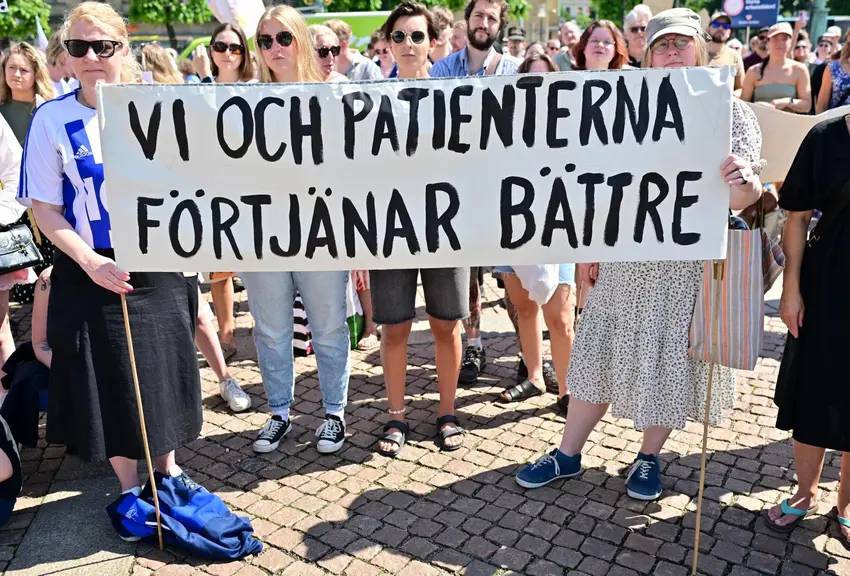
Who exactly is striking and when?
On June 11th, 1,300 healthcare workers are set to join the conflict. Members in Region Värmland will go on strike and healthcare advice lines in three regions will be affected.
They will join 2,000 midwives, nurses, biomedical scientists and radiographers in seven hospitals across five regions, who went on strike from 11am on June 4th. The affected regions are Stockholm, Västra Götaland, Skåne, Östergötland and Västerbotten, although some of the strike action has been lifted or partially lifted since June 4th to ensure lives are not in danger.
Why are they striking?
They're striking for better working conditions - specifically shorter days (starting 7.5 minutes later and finishing 7.5 minutes earlier a day), more holiday and higher wages.
“We haven't had any unreasonable expectations. We want to be able to have the energy to work full time, we want sustainable schedules and four weeks of continuous vacation in summer. We want higher wages so that it's equal," chair of the Swedish Association of Health Professionals, Sineva Ribeiro, said in April.
"During the pandemic we were called superheroes and went to work on our days off to save lives. We were applauded then, but today we have to choose between falling ill ourselves or reducing our hours to part time to be able to cope. At the end of the day, patients take the hit," she added.
She said the workers they represent in total worked 3 million hours in overtime last year.
Almost a third of the union's members work part time, with many stating that they do so as they are physically unable to work full time, in a report written by the union. Four out of ten young people said in the same report that they do not expect to work in healthcare for their entire career, although many did say that they may work full time if working hours are shortened.
Aren't they already on strike?
Yes.
The first strike, affecting 2,000 workers, broke out on June 4th.
There has also been a blockade on overtime and new hires in place for 63,000 members of the Swedish Association of Health Professionals in all Swedish regions since April 25th, which was extended to 5,000 municipal employees in 29 municipalities from May 20th. Healthcare is run regionally in Sweden, but municipalities organise welfare services such as elderly care and school nurses.
Managers are exempt from the overtime ban, and the new hire blockade was partially lifted from June 4th, so that new graduates taking their final exams in June, who would otherwise be affected, are able to start work as soon as their qualifications are issued.
EXPLAINED:
Why are they extending the strike?
Negotiations with SKR (the umbrella organisation for Swedish regions) and employer organisation Sobona have so far failed to bring the parties closer together, with the union and SKR and Sobona rejecting each other’s proposals and counter proposals.
"We've decided to launch a strike at these hospitals for a number of reasons," Ribiero said. "They're major employers and have a significant responsibility for the workload and working hours we want to improve. We also have many members in these hospitals, and there are alternatives for patients whose treatment could be affected by the groups who will be striking."
According to the union, SKR is primarily unwilling to accept their demands for shorter working hours.
"Unfortunately, SKR employers don't want to negotiate shorter working hours with us. But we're not going to give up," Ribiero said.
SKR on the other hand claims that the union has rejected all of its proposals.
"We need every healthcare worker, and a large-scale cut to working hours will affect patients and the working environment," deputy chair of SKR's negotiation delegation Sten Nordin said.
Psychiatry and pediatric nurses are not included in the strike, and the union said it had worked to ensure that it will not put patients' lives or health at risk.
Healthcare services have generally urged patients to turn up to scheduled or emergency appointments (although as healthcare is managed on a regional basis in Sweden, it may make sense to check with your healthcare provider), but have warned that surgeries may have to be cancelled.
SKR is blaming the consequences of the strike on the union, claiming that it could risk the lives of patients. Ribiero refutes this, saying that healthcare was already endangered before the union threatened to strike.
"We know what their planning looks like for the summer, how they're planning on closing cancer departments, oncology and everything else. And we know how that affects patients. And it also affects us," she said.
"We are striking responsibly by including exemptions for cancer treatment, child healthcare and life-threatening illnesses, for example."
Comments