

At the branch of Ica in Gärsnäs, one of the less picturesque villages in the Swedish holiday area of Österlen, the pick-and-mix sweets selection is relatively restrained. Little perspex containers are stacked just five rows high and stretch along about three metres of shelf space.
But it still manages to contain almost all of the classic Swedish candies -- with close to 100 varieties, from the Ahlgrens Bilar (cars) munched by the Alexander Skarsgård character in HBO's Succession, to the licorice-flavoured Salt Sill (salty herring) which are the REAL Swedish fish.
"Everyone likes a different one," boasts the slogan on the bag, which announces that these are smågodis för finsmakare: "pick and mix for connoisseurs"
I bought all of them apart from more upmarket ones wrapped in paper, setting me back a sum total of 64 kronor.
Apologies for the low standard of food photography.
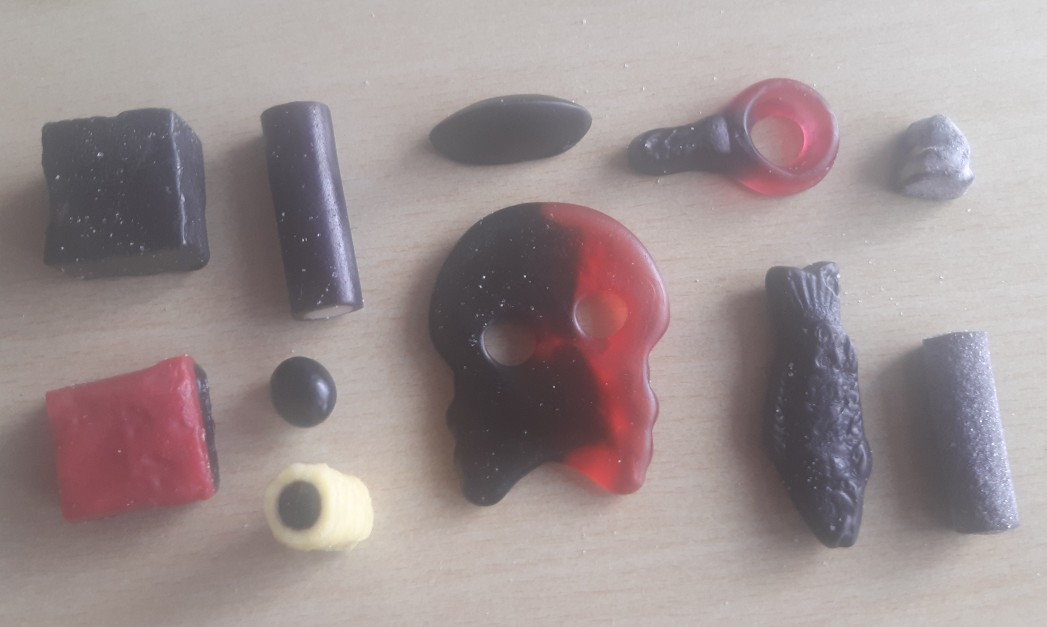
Licorice candy
Licorice is a acquired taste, in Sweden as everywhere else, and I find that most Swedish children I know avoid licorice and salt licorice. But Swedes in general are mad for it, so the tastebuds for it must kick in around 12 years old.
I'll start with the central skull in the picture above which is a Hallon/Lakritsskalle, or "Rasberry/Licorice skull", from Bubs, the medium-sized Swedish manufacturer that has seen such gigantic demand for its candies that it can no longer meet requests.
Skulls, are along with fish, cars, and dummies, one of the most common shapes for sweets in Sweden.
It's a relatively mild licorice, sweet rather than salty, and the fruity, rather artificial tasting, raspberry giving it an additional tang.
In the bottom left corner is Hallon/Lakritsfudge, or "Raspberry and licorice fudge", by a company called Kolafabriken, a small business in Blekinge which makes various fudge varieties. It's much sweeter and if you hadn't told me it was raspberry and licorice I wouldn't have known. Above it is a Lakritsfudge from the same producer, which is more discernibly licorice flavoured but still predominantly a sickly sweet block of fudge.
Then I'll move on to the Salt sill, or "Salty Herring" from Malaco, one of the biggest brands from Swedish sweets giant Cloetta.
These (which you can see one in from right above) are the most common candy fish you'll see consumed in Sweden, and not the garishly coloured and rather waxy Swedish Fish sold in the US by Mondelēz International.
It's salt licorice -- so flavoured with ammonium chloride or salmiak rather than licorice -- but as it isn't coated in salmiak powder its less intense than a lot of Swedish salt licorice.
This is very much not the case for the djungelvrål, or "jungle roar", a powerful little salt licorice gummy that is supposed to be shaped like a monkey, which you can see in the top-right corner. Also by Malaco and often sold in bags, this gets most of its power from the salty salmiak powder around it, and is not for the beginners.
Directly above the skull is a lakritsbåt, or "licorice boat", from Godisfabriken Aroma, a sweets company that has been going since 1921 and is one of the few to still do its production in Sweden. It has a pleasantly crunchy exterior and an almost liquid centre, which is mildly flavoured with sweet licorice.
The tube near the top left is a Stora mintbit, or "big mint bite" and is much more minty than it is licorice, with the licorice exterior mainly used to hold the minty cream in place.
From the picture I missed out one of the classic licorice sweets, a Saltagroda, or "salty frog", which is a classic crunchy boiled sweet from Grahns Konfektyr, which is owned by Norway's Haugen-Gruppen. If you crunch it (which I did), you get an explosion of salt licorice flavour, and then a sticky sugary coating all over your molars. If you suck it, I imagine, you'd get a slow dribble of salty sweetness over several minutes.
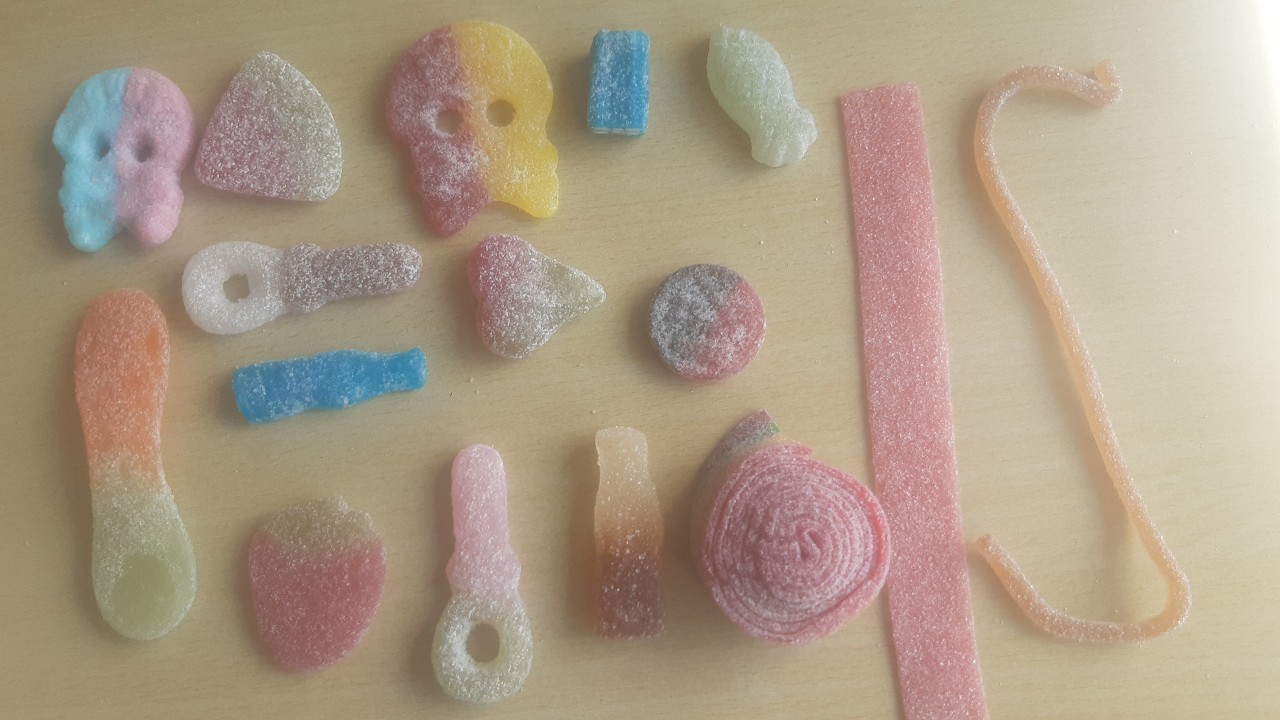
While Swedes traditionally go mad for salty licorice, sour and super-sour candy, where the kick comes from a generous dusting of citric acid powder, have been growing in popularity.
The best and sourest of all in my opinion are are the S-märke sweets, which, although I bought at Ica, I managed to miss out from the picture above. It's a very simple design -- a flat oval marked with an S -- but when you chew one, it really makes you wince with the sourness.
S-märke is a relative newcomer, produced by Candy People, a company launched by the Syrian refugee Joanis Masudi Youssef. They also sell the acidic powder is little bags which you can pour directly in your mouth.
After eating the S-märke I moved on to one of the Sura Tungar or "sour tongue" I had bought. Produced by Malaco, it was satisfyingly sour, though not to the same extent as the S-märke, and it had a pleasant fruity flavour. Its grater than normal size also meant that there was a fair amount to chew on.
I moved on to the example of Bubs Surskalle, or sour skulls, one of the sweets that has had the most viral coverage and third in the top left in the picture, which had a similar taste and consistency. The very similar Bubs Dizzy Skalle (top left corner), is slightly less sour with a sweeter bubblegum flavour.
The Fizzy Blue, also by Malaco (near the centre one column from the left), is shaped like a bottle and was disappointingly neither that sour or that fizzy in a sherbert powder kind of way, but it did taste fruity, although I couldn't tell which fruit it was supposed to be.
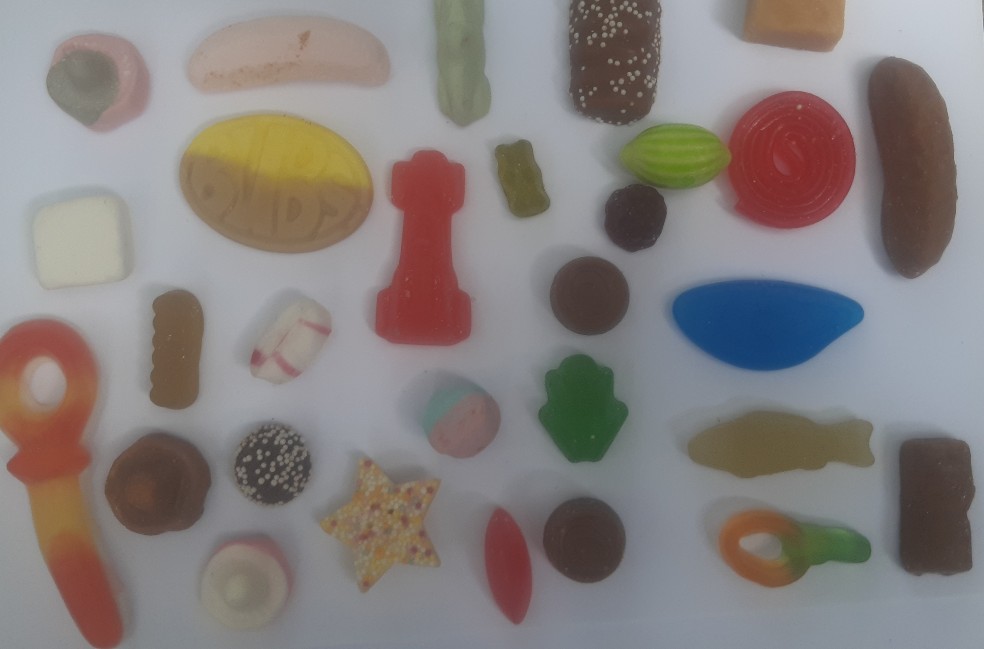
Ica Gärsnäs also offered a Sur skumbanan, a "sour foam banana", which you can see in the final picture below above the Bubs mini oval. It combines an artificial banana flavour with the texture of a foam sweet.
Next I moved on to Sorbisar, another Bubs favourite, which is the two-coloured round coin in the centre two columns from the right, which is sweeter than the other sour sweets and is designed apparently to dissolve on the tongue, something I didn't give mine time to do.
People in the UK, and I imagine more or less everywhere else, will be familiar with the Stora colaflaskor sur, or Big Cola Bottle (sour) you can see in the middle of the bottom row. It's a cola flavoured gummy shaped like a bottle, in this case dusted with sherbert powder.
More unusual is the example of Stora colanappar sur, second down second column, which is a basically the same but shaped like a child's dummy.
The sugary tape you can see bottom row, third from the right, is a Regnbågs remmar, or rainbow tape. It is sweet and fizzy rather than sour and is designed to be chewed on sporadically rather than wolfed down in one go (as my children did).
The brown string to the right, is a Spaghetti cola from Haribo, which is perhaps less common than the Malaco-produced rival Cola snørre, or cola strings, which is spelled with a Danish ø with dots on like a Swedish ö.
The blue sweet in the centre of the top row is a Sockrade tegelsten, or "sugary brick", from the producer ASBA.
Foam, jellies, and chocolate
I have to confess I don't really understand the Swedish love of foam sweets, perhaps it goes back to the 1950s when they were a new and modern alternative to the boiled sweets of the past.
Ahlgrens bilar, or "Ahlgren's cars", the foam sweets made famous by Skärsgård, are shaped like 1930s racing cars, and taste almost of nothing, apart from a slightly creamy, foamy vanilla. They were first produced in the 1950s at a factory in Gävle and are now owned by Cloetta.
Skumkantareller, one from the left on the bottom row, are another foam sweet which taste pretty much exactly the same as bilar (and thankfully not of mushrooms).
The white cube below the mushroom is a Sockerbit, or "sugar cube", and is simply a cube of sweet, white foam.
The reddish orange example of Ferraribilar (ferrari cars) you can see in the centre are made by the Danish company Toms and have the same waxy quality of American Swedish Fish, and a non-descript fruity taste.
The green frogs, second from the end of the second to bottom row, are Gröna grodor, "Green frogs", perhaps the classic product of Godisfabriken Aroma, and have slightly looser, you could almost say 'slimier' texture than most other jelly sweets.
To the left of the Ferrari car is the classic Bubs Mini Ovaler Banana. It has a strong artificial banana flavour which is preferable the the plain foam flavours above.
The Blåöga, or "blue eye", sweet third down on the right, has a similar texture to the Ferrari car, and is made by the local Skåne Konfektyrer.
To the top side of the far-left is a Choklad skumbanan, or "chocolate foam banana", which is a banana-flavoured foam coated in chocolate.
Below the Bubs mini oval, is a piece of classic Swedish sweet-making - a Polkagris bit, which is a boiled sweet made of the same crunchy minty sugar as a Polkagris, the Swedish version of candy cane.
Below that is a Punschpralin, a punch praline, another classic Swedish sweet, which is a pralin flavoured with punsch, a rum-like spirit.
The star-shaped white chocolate sweet on the bottom row is a Hollywood Star, distributed by the company Candinavia, and is a very sweet white chocolate with sprinkles on top.
To dummy shaped sweet next to the djun gelvrål in the first picture is a Nappar bär, or berry dummy, from the German sweets giant Haribo. It has the same gelative texture as the skull but with some sort of blackberry flavour instead of the licorice. You can see another napp sweet, this time citrus flavoured in the bottom right hand corner in the picture above.
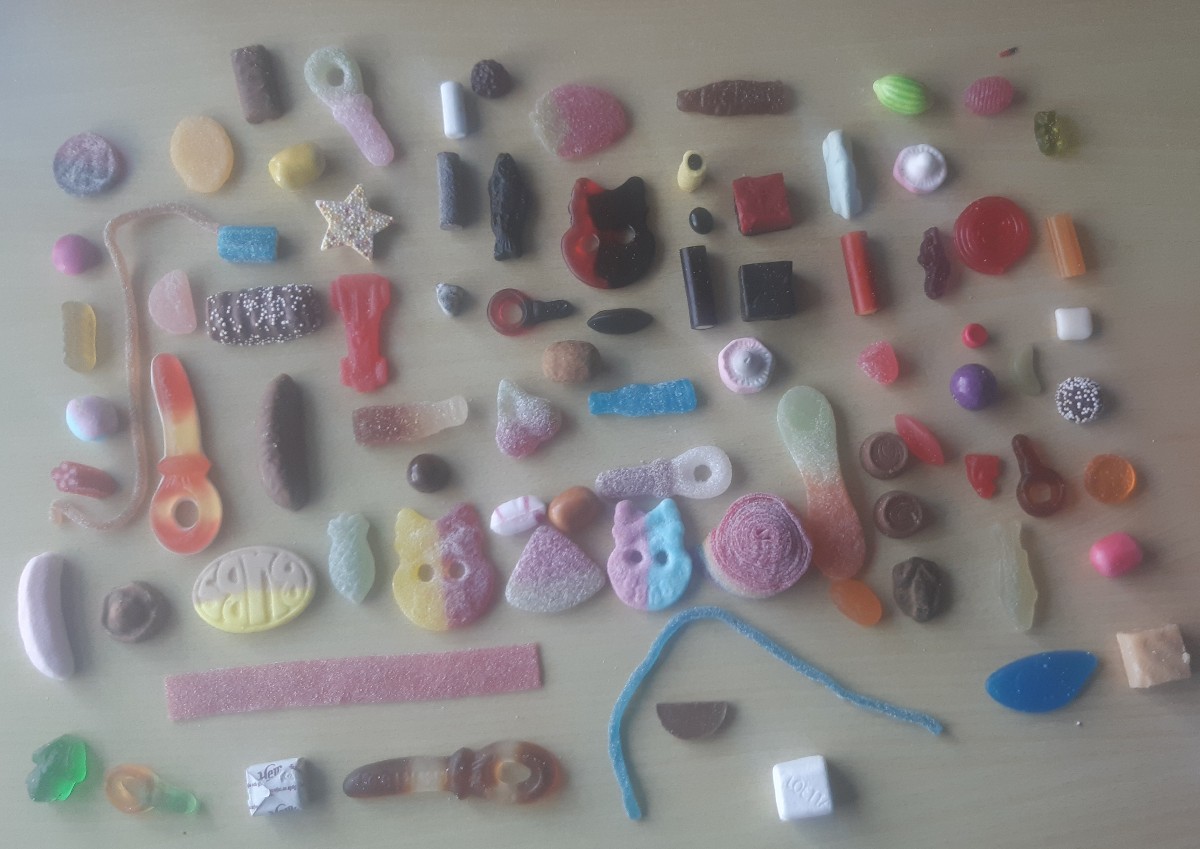
How many more varieties are there?
There are only about 40 sweet varieties reviewed on this list and the bigger Swedish sweet shops offer between 400 and 1,000 , so we have definitely missed quite a few out, perhaps important ones.
We have at least covered all the main shapes, from bottles, boats, and cars, to dummies, mushrooms and bananas, and also the main flavours: sour, salt licorice, fizzy, sugary, fruity, foamy, and chocolate.
Do you have a favourite Swedish candy? Did we miss any out? Please tell us about it in the comments below.
Comments