
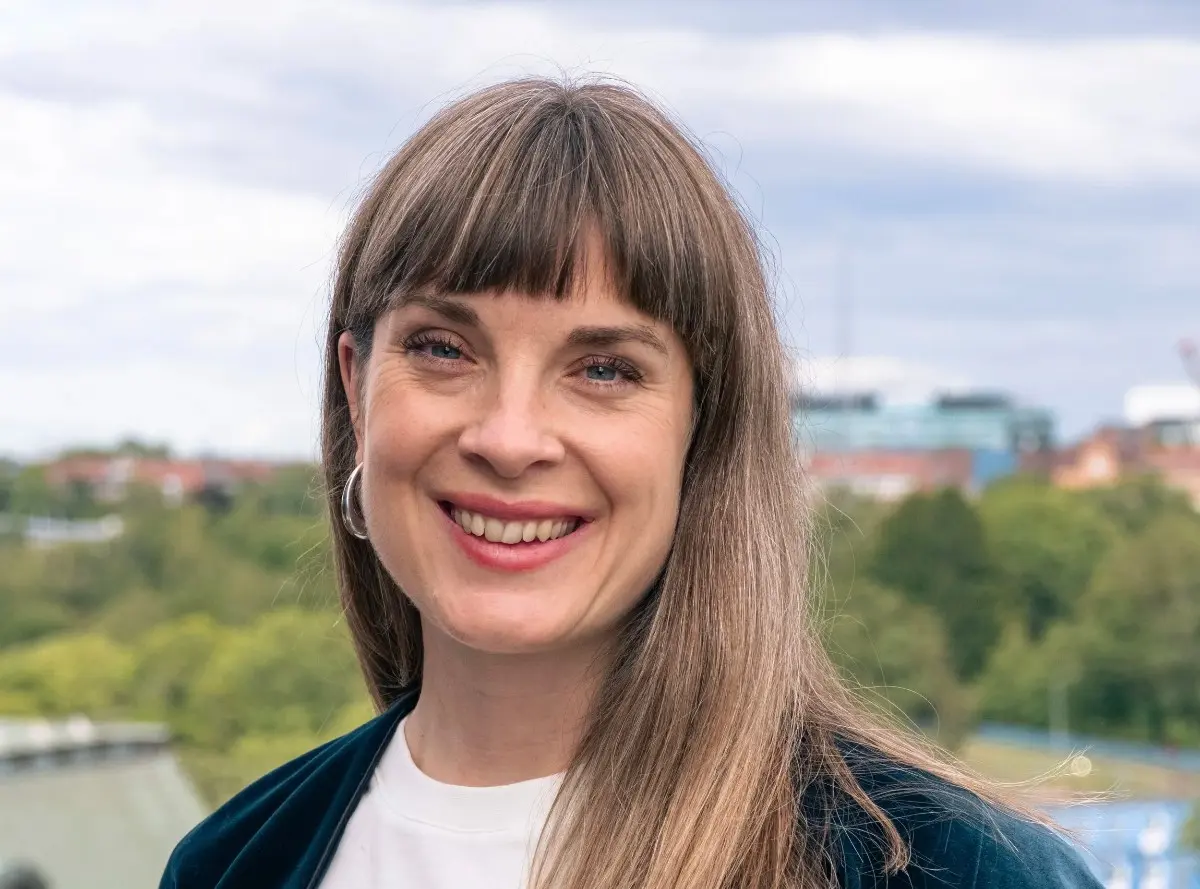
When Molander published an article in Dagens Industri listing all the liberal, green policies the Centre party should ask for in return for backing Ulf Kristersson as prime minister, it was interpreted by many (including The Local) as a sort of test balloon. The Centre Party is the think tank's biggest funder. Was this the Centre Party opening up for a future right-wing government?
Molander, however, dismisses suggestions that she wrote the article at the behest of anyone else, at least from within the Centre Party.
"People seem to think that this was some kind of very strategic thing planted by the Centre Party leadership," she tells The Local. "No one in the Centre Party knew anything about the article before it was published."
What actually happened, she says, was that the editor of the debate section at Dagens Industri asked her to write an article on what it would take for the Centre Party to switch sides, and after knocking around some ideas with colleagues, she did so.
The result, "The Centre Party's road to Alliance 3.0", can be read as both an opening to the right – it assumes that the Centre Party drops its bar on joining or backing a government depending on the support of the Sweden Democrats – and a way of underlining how difficult it would be to reach a deal: the list of policy proposals would reverse many of the Sweden Democrats' most cherished achievements of the past four years.
"What we want to do is more raise the issue and start to make people think about what would be needed, more than arguing for one government or the other," Molander says.
READ ALSO: Sweden's speaker asks Centre Party leader to explore centrist government options
For a deal to be possible, the Centre Party should not only rule out Sweden Democrat ministers, she argues, but also refuse to accept officials wielding power behind the scenes in the government offices.
"To me, a collaboration with the Sweden Democrats is not wrong per se. It depends on what it contains, and to me, it's evident that they can't be in government and that they shouldn't be at the prime minister's office like they have been the last four years, with the scandals, with the connections to Russia, and also, how the party leader talks about Muslims and questions their place in Swedish society."
It's far from certain that the Sweden Democrats would be willing to accept that, but to win over the Centre Party, she argues, they would also need to accept that the government would be a green and liberal one, closer to the pro-immigrant Alliance governments led by Prime Minister Fredrik Reinfeldt than the Tidö Government led by Ulf Kristersson.
"To me, the two main policy areas where you need to have a change is on migration and climate, and that is also why I believe it is easier to form a coalition to the left than to form a coalition to the right if you are a liberal party, because the Sweden Democrats could maybe be convinced to have a more ambitious climate policy, but they don't want a more generous migration policy."
READ ALSO: Region Stockholm reaches centrist governing agreement, freezing out the left
In her article she argues the Centre Party should demand a commitment to abolish the system of salary thresholds for work permits and a return to the liberal system in place before 2023, more lenient rules for family reunion, a return of the 'particularly distressing circumstances' clause which prevented many teen deportations, and an increase in the number of UN quota refugees taken in by Sweden.
She also argues the party should demand that the new government bring in a long-stalled proposed system where municipalities get paid compensation to host wind farms, bring in a green tax reform that increases tax on petrol and diesel and cuts tax on electricity, bring in a subsidy for those on low incomes to lease electric cars, and lower the barriers to an "active and large scale forestry industry" that can provide a renewable alternative to plastics and fossil fuels.
She admits that this list of policies would be difficult for the Sweden Democrats, and perhaps even for the other right-wing parties, to accept. But she points out that the Social Democrats in a similar situation agreed to push through some equally painful concessions in exchange for Centre Party backing.
"Based on the reactions that this article has got, I think the likelihood [of them accepting the proposals] is very, very small," she says. "But the Social Democrats in 2018 made some very, very big concessions when it came to policy, but that also made the Centre Party shift sides in politics, which has been very important for the Social Democrats from a strategic point of view in the long run."
"If Ulf Kristersson wants to be able to form a government going forward, it would be very important for him to get the Centre Party to switch sides, and the same goes for the Sweden Democrats, so they would need to have a long-term perspective. The Sweden Democrats are very good at having long-term plans, so it is a possibility. But I don't believe it will happen."
READ ALSO: Sweden Democrat leader invites Centre Party to 'no-strings-attached' talks
The Sweden Democrats, she adds, have already jettisoned former policy positions on issues like abortion, international adoptions, free schools, and Nato in order to collaborate with the Moderates, so she believes it is not impossible they might do the same on the environment.
"They also changed a large part of their economic policy in order to fit into a right-wing government, but they have not changed their migration policy, so that is the core," she says. "They can compromise on anything else just to get their migration policy through. So I think that they wouldn't like higher fuel prices, for example, but I think that would be possible for them to make a compromise."
READ ALSO: From the obvious to the unthinkable – nine options for Sweden's government
The Centre Party's hard line against Sweden Democrat support gives it a weaker starting point in government negotiations, she suggests.
"Of course it weakens their bargaining position. It's always better to have two different options that you can play out against one another. That's what they did in 2018."
On the other hand, she says, the example of the Liberal Party has shown that once a party joins a coalition dependent on Sweden Democrat support, it is hard to hold a tough line against more illiberal policies.
"They started out as the 'liberal watchdog' against this government going too far. They said 'we don't like the Sweden Democrats and the nationalist populist influence, but it's what we need to do to form a government, and we will make sure to get as much liberal policy as possible,'" she reminds me.
"And four years later, Simona Mohamsson doesn't even have time to see Magdalena Andersson when she's trying to form a government, because she needs to go and watch football with Jimmie Åkesson. They've gone very far and I think that has strengthened the Centre Party's scepticism against going into a right-wing coalition."
The Liberal Party has also been ripped apart internally, losing key politicians and a huge share of their members and voters, something Molander said the Centre Party was also conscious of.
"There is a very big risk of that [if the party switches sides] and that is also part of why I think it is not very likely. But of course, it depends on the way you do this kind of agreement. The Liberal Party has helped push through a very, very aggressive migration policy that doesn't resonate at all with its traditional core voters. Is it possible to do it in another way in a coalition that is dependent on the Sweden Democrats? I don't know."
She does not completely rule out the Centre Party doing a better job of holding the line, even if the far-right party would retain the ability to topple the government at any time.
"That is the tricky part. But if you look at the Social Democrats, they've had that kind of relationship with the Left Party for decades, that they are dependent on the Left Party's votes, but they don't like them...so of course you can have that kind of passive support without getting closer to one another. But I guess the key question here is why would the Sweden Democrats support a government that advances policy that they are very much opposed to."
That, she says, is the main reason why she still believes – assuming Centre Party leader Elisabeth Thand Ringqvist's plans for a cross-bloc centrist government are dead in the water – that the Centre Party is most likely to end up backing a government led by Social Democrat leader Magdalena Andersson.
The Social Democrats, she points out, are as interested in growth and jobs as the Centre Party, while the Left Party has an interest in backing tax reductions and other policies that will benefit small business owners in the immigrant suburbs of Sweden's cities, something that aligns well with the Centre Party's own focus on small businesses.
"I do believe that a left-wing government is still the most likely, and there is a possibility, in my opinion, to form a strong political project for the left-wing parties, drawing on climate change, migration and integration, and also economic policy, which would maybe be the most surprising part."
Comments