
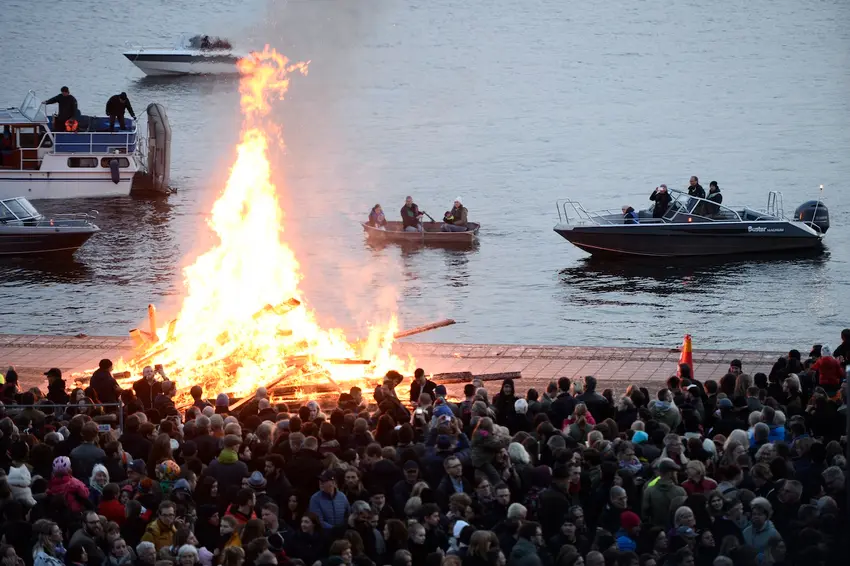
The name 'Walpurgis' (Valborg in Swedish) comes from the English Saint Walpurga, who travelled to promote Christianity across the rest of Europe, particularly Germany. But although she gives her name to the festivities which Sweden borrowed from its German neighbours, bonfires have been lit at the start of spring for centuries beforehand, as a way to celebrate the long-awaited end of winter.
Some Christians in northern Europe celebrated the saint on May 1st, the day she was canonised, and this was traditionally also the time farmers across the region would put their animals out to pasture.
The religious feast day became blended with older rituals aimed at cleansing the land and ensuring fertility during the coming summer. Today, May 1st is a public holiday in Sweden, and the valborgsmässoafton (Walpurgis Eve) celebrations on April 30th retain an important role in the Swedish calendar.
Bonfires were traditionally lit as a way of warding off evil spirits – as well as more tangible predators like wolves, which villagers would also try to scare away by making loud noises: banging drums, ringing bells, and shouting.
These days, any ruckus is more likely to come from crowds of students, for whom the date is a chance for a party after the spring exams, before things start to get serious again ahead of the summer revision season.
Other key features of a Walpurgis celebration include a speech from a prominent local figure, and choral singing (brush up on the lyrics to Vintern Rasat Ut or "Winter has Fallen Away" if you want to join in). Larger festivals will also offer food – nettle soup is a traditional delicacy – and drinks, as well as other kinds of musical performances, often rounded off with a fireworks display. Some will have a political flavour, because of Labour Day the following day.
By coincidence, April 30th is also the birthday of the Swedish king, Carl Gustaf XVI, so you'll see plenty of Swedish flags raised on Valborg as a sign of respect, and if you head to the area around the Royal Palace in Stockholm during the day you might catch some celebratory parades.
Many local councils and neighbourhoods organise bonfires (valborgsbål or majbrasor) in parks, so if you want a low-key festival, check out your municipality's homepage to see what's happening near you. Otherwise, we've rounded up some of the bigger and more novel celebrations across the country in the list below.
In Stockholm
One of the biggest and oldest Walpurgis celebrations in the country is hosted at Skansen, Stockholm's open air museum on the leafy island of Djurgården.
This year Skansen will offer two Walpurgis celebrations on the evening of April 30th: the traditional one, beginning at 8.30pm at Solliden Stage (the bonfire is lit at 9pm), and an earlier celebration for children and families at Sollidenplan.
The family-friendly programme begins at 5pm with traditional choral singing of classic Walpurgis songs, and a smaller bonfire will be lit at 5.30. This celebration concludes at 6pm.
The Skansen park overall opens at 10am, so if you'd like, you can make a day of it with your family by visiting the Scandinavian animals, farmsteads, and replica of a 19th-century town to feel like you're stepping back in time. Be aware of the 240 kronor entry fee for adults. Entry is free for children 0-15, as long as their complimentary tickets are booked in advance.
The popular Riddarholmen bonfire is not going ahead in 2026.
You can also head to the island of Grinda if you fancy a bonfire out on the archipelago. The local tourist board has put together a list of bonfires taking place in Stockholm this year.
In Uppsala
Any students looking for a party, or curious visitors keen for a taste of the 'real' Valborg, should head to Uppsala. The unique part of this event is a raft race along the city's Fyris River from 10am: students build and decorate rafts which they then sail down the water on, while thousands gather to watch from the banks.
Then, the student "nations" (like colleges of the university, but for social activities and housing – and run by students) host traditional lunches of herring and snaps – if you're just visiting, you can participate in this part of the tradition at the Uppsala Konsert & Kongress.
At 3pm in front of the University Library you can watch (or take part in) the Donning of the Caps. The Vice Chancellor waves their own white cap as a signal of spring to the students gathered in the square, who in turn wave their own and then put them on.
This is followed by a performance from a male voice choir on the library steps. There will also be bonfires later in the evening.
In Lund
University city Lund is home to one of the biggest events in the country; tens of thousands of people usually descend on the city park (Stadsparken) to celebrate the arrival of spring to the southern city. Arrive early if you want to get a good spot. Note also that parts of the park will be closed off all day, including the playground, outdoor gym, and skate park. The municipality also cordons off the bird pond and other "fragile" surfaces.
Things kick off with picnicking throughout the day; this is known as spontanfesten or "spontaneous party" since there are no official organisers, but like many things in Sweden, it's actually fairly well planned.
The picnics last until 3pm when things get set up for the official celebrations. These begin at 7.30pm, after which the bonfire is lit. There will also be music and a fireworks show once it gets dark.
In Gothenburg
In Sweden's second-largest city, one of the best known traditions is the Chalmerscortégen (The Chalmers Cortège), a carnival parade run by the Chalmers University of Technology. It's been going since the 1900s, with around 50 floats representing a satirical take on major events that have taken place over the past year. Each April, thousands gather to watch the parade make its way through the city streets, and it starts at 6.15pm. You can find an English description of the event here.
In the evening, the biggest fire will be in Slottsskogen, where "witches" will light the bonfire, and plenty of activities are on offer for families and people of all ages. This year, the programme runs from 5pm to 9pm. The fire will be lit at 8.30pm and extinguished between 10.30 and 11pm.
Elsewhere
Malmö: Malmö kommun doesn't have an official Valborg celebration ‒ presumably because most people looking to celebrate head to Lund instead ‒ but there are local neighbourhood celebrations. If you want to light a local bonfire, you need permission from the municipality.
Umeå: In Umeå, the university hosts its own celebration, Valborg på Campus, which is primarily for students at the university, although it is open to other members of the public. It's a big, loud party. If that doesn't sound like your kind of thing, Visit Umeå has a list of the many other Walpurgis night events happening around town.
Helsingborg: In Helsingborg, a choir traditionally sings spring songs on the terraced steps in the centre of the city, although there's no bonfire at that particular event. The nearest bonfire to Helsingborg is in Ramlösa, where there will be a bonfire in Brunnsparken from 8.30pm.
Linköping: Another student spectacular, this celebration is hosted in Borggården, next to Linköping Castle, from 3pm. There's singing, the donning of the caps, speeches and finally, a bonfire. Earlier in the day, students hold a champagne and strawberry breakfast in the Trädgårdföreningen park. Lions Club Linköping also host a bonfire by Tannefors Slussar, kicking off at 6.30pm. Visit Linköping has a full list of events.
Karlstad: At Mariebergsskogen, there will be events and a bonfire from 7.30pm to 10, with views out over the water, more singing, and plenty of food and drink.
Luleå: In the north of Sweden there's even more reason to celebrate the brighter months, and it's also one of the most beautiful spots to do so. In the Gammelstaden church town, a Unesco World Heritage site, the celebrations begin at 6pm. The bonfire is lit at 8pm.
Article first published in 2018 and updated for 2026
Comments (1)