
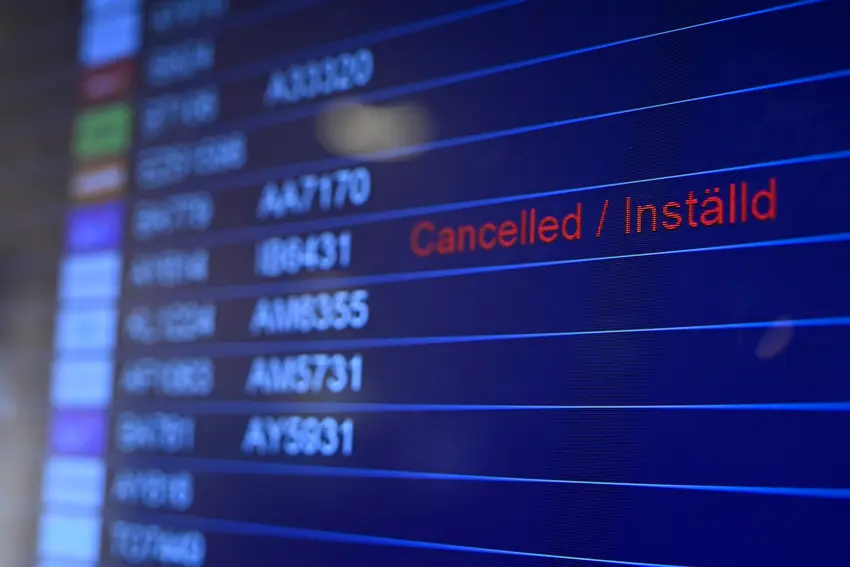
EU legislation protects the rights of air passengers, and in many cases means that you're entitled to compensation in the event of delays, strikes, and more. But the majority of travellers aren't aware of their rights, so here are the answers to the questions you might have about what you're entitled to if your flight is cancelled or delayed.
How do I know if my flight is covered?
EU air passenger rights legislation applies if any one of the following criteria is met:
- Your flight is within the EU and is operated either by an EU or a non-EU airline
- Your flight arrives in the EU from outside the EU and is operated by an EU airline
- Your flight departs from the EU to a non-EU country operated by an EU or a non-EU airline
In the air passenger rights legislation, the term "EU" means the 27 EU countries, including Guadeloupe, French Guiana, Martinique, Mayotte, Réunion, Saint Barthélemy, Saint-Martin (French Antilles), the Azores, Madeira and the Canary Islands, but not the Faroe Islands. "EU" in this case also applies to flights to and from Iceland, Norway and Switzerland.
This means that a journey between, for example, Canada and Iceland, would count as a trip between a non-EU country (Canada) and an EU country (Iceland, counted as an EU country for the purposes of the air passenger legislation).
If you receive compensation for the same disrupted trip under the law of a non-EU country, you are not entitled to claim compensation under EU law.
And if the delay was due to "extraordinary circumstances", you will not be able to claim compensation. More on that below.
Which airline operated my flight?
This is important, because for journeys from non-EU countries to EU countries, you are only covered if the operating airline is based in the EU. Sometimes, the airline you book your ticket with is not actually the airline that operated the flight.
The name of the operating airline should be on your ticket and booking details, or you can contact the airline or company with which you booked your flight to find out.
What compensation am I entitled to if my flight is delayed?
In the case of delays of three hours or more, you are entitled to compensation.
To calculate the delay, you measure the time difference between the scheduled arrival time and the actual arrival time. This means that even if your departure time was over an hour later than scheduled, the flight may not be considered delayed if the pilot was able to make up the time during the journey.
The two factors that determine your level of compensation are length of delay and distance of the flight. The price you paid for your ticket is not taken into account, so you may even receive compensation of a significantly higher amount than you paid for the flight. Various online distance calculators can quickly determine the distance of your flight in kilometres.
For delays of more than three hours on journeys of up to 1,500 kilometres (equivalent to the distance between Stockholm and northern France, or Malmö and southern France), you are entitled to compensation of €250.
For delays of more than three hours on journeys of more than 1,500 kilometres within the EU, or journeys between 1,500-3,500 kilometres travelling to or from a non-EU country, you are entitled to €400 compensation.
And for all other flights covered by the EU legislation, e.g. flights to or from a non-EU country of over 3,500 kilometres, you are entitled to €600 compensation for delays of three hours or more.
However, if you were re-booked onto another flight, this compensation may be halved.
Compensation for delay at arrival (source: European Union)
| Amount in EUR | Distance | Delay at arrival at final destination |
|---|---|---|
|
250 |
1 500 km or less |
3 hours or more |
|
400 |
More than 1 500 km within the EU and all other flights between 1 500 and 3 500 km |
3 hours or more |
|
600 |
More than 3 500 km |
3 hours or more |
Am I entitled to any other benefits?
Yes! For delays of over two hours (in this case, this refers to departure time), the airline is responsible for informing you of your rights and offering assistance.
This means that you should be offered free food and drink (usually in the form of a voucher you can spend at the airport) and the opportunity to make two phone calls or send two emails for free, if the delay meets any of the following criteria:
- a delay of two hours or more for flights of 1,500km or less
- a delay of three hours or more if the flight distance is over 1,500 kilometres within the EU or between 1,500-3,500 kilometres between the EU and a non-EU country
a delay of four hours or more for all other flights covered by the legislation (i.e. if the flight distance is longer than 3,500 km and between an EU country and a non-EU country
The food and drink you are offered should be in proportion to the length and timing of the delay, so a mid-morning delay will usually result in a smaller amount of meal/refreshment assistance than an evening or overnight delay.
For overnight delays, the airline must also provide you with accommodation and transport to and from the airport. Airlines cannot refuse to provide this assistance; if it isn't offered at the time, keep your receipts and a record of what you needed to spend, and make a claim for a refund when you get home. However, it must be proportionate, which means a hotel of a similar standard to the one you stayed in during your trip (or as close to the same standard as is possible).
You can also claim for other damages, such as lost income if the delay meant missing a day of work, and in that case you should supply a note from your employer.
And if your flight is scheduled to arrive at least five hours late to the final destination, the airline must offer you the chance to rebook or reschedule your journey. If you no longer need to take the flight (e.g. if you have missed the event you were travelling to attend) and choose not to take the delayed flight, the airline must refund you for the flight (including other parts of the same booking if you're now unable to use them, such as onward or return flights), and if you are part-way through your journey, they must refund your flight back to your original airport. If you do choose to take the flight, the above compensation applies.
What you aren't entitled to is any special compensation for emotional distress, discomfort or other non-material convenience linked to the delay.
What if my flight is cancelled?
If your flight is cancelled, you have the right to either a refund or rebooking, and the airline must always offer you the choice. That means that if you no longer want to travel, the airline cannot deny you a refund and rebook your flight instead.
If you choose not to fly, the airline must give you a full refund, including for any other flights in the same booking that you now can't use, such as onward or return flights, as well as for a flight back to your original airport if you're part-way through a journey.
If you still want to fly, you have a legal right to be rebooked onto a replacement flight.
If the cancellation delays you more than two hours, for example if you are rebooked onto a flight four hours later, you have the same right to assistance such as food and drink as if the original flight had been delayed (see above).
And if the replacement flight means you arrive two or more days later than planned, or if the airline informed you of the cancellation less than 14 days before the planned departure, you are also entitled to compensation. This ranges from €250 to €600, depending on when you were informed of the cancellation, the length of the delay, and the distance of the flight. You can find the details on what applies to your situation here.
Are there any exceptions?
Unfortunately, yes. The rules about compensation do not apply if the delay or cancellation is due to "extraordinary circumstances", defined as events that couldn't have been avoided even if the airline took all reasonable measures.
If you travelled free or at a reduced price not publicly available, for example if you work for an airline and benefit from staff discounts, you aren't entitled to compensation either. If you paid for the flight using a loyalty programme, you should still be able to claim compensation.
What counts as "extraordinary circumstances"?
Exactly what this includes can vary, but it usually applies in the case of political instability that affects flights, unforeseen safety risks, and extreme weather events. It is judged on a case-by-case basis. It's the airline that needs to prove that the circumstances were unavoidable, and if you think they are wrong in their decision, you can escalate the dispute.
It seems that the "extraordinary circumstances" part of EU air passenger rights legislation will apply to those affected by flight disruptions due to jet fuel shortages resulting from the ongoing blockades of the Strait of Hormuz by Iran/the United States.
"Disruptions caused by jet fuel shortages can qualify as extraordinary circumstances," a European Commission Spokesperson told The Local in an email on April 24th.
"If this is the case, airlines may not be required to provide financial compensation where they can demonstrate that the disruption was directly caused by the jet fuel shortage and that all reasonable measures were taken," the spokesperson continued. "We will provide a detailed guidance very soon so that airlines and passengers alike will have the same understanding of the matter."
Henric Jonsson, legal advisor for the Swedish branch of the European consumer agency (Konsument Europa / ECC Sweden), told The Local that currently decisions on jet fuel shortage flight disruption compensation and "extraordinary circumstances" would be made "on a case-by-case basis".
He also pointed out that "with 'extraordinary circumstances', the burden of proof is on the airline. It’s up to them to prove that they could not avoid it."
The EU Commission Spokesperson also told The Local that airlines are in any case obliged to assist passengers.
"In cases of cancellation or significant delay, passengers are entitled to clear information, assistance and care, as well as the choice between reimbursement or rerouting to their final destination," the spokesperson wrote.
"You have very generous rights when it comes to cancellation of a flight," said Henric Jonsson of ECC Sweden. "You do have a right always to be given the choice between a refund or rebooking."
In the case of flight disruptions to Middle Eastern countries during the current conflict, the EU has an FAQ page to help with common specific questions.
If 'extraordinary circumstances' apply to your flight, you are not entitled to compensation from the airline but may still be covered by any travel insurance policy you have. It's therefore worth getting in touch with your insurance provider to explain the situation.
You may also be able to claim a refund from your credit card company.
How do I make my application?
Contact the airline that operated the flight directly, in writing, and make sure you keep copies of all correspondence in case you need to dispute the decision later on.
The airline should have a form for you to do this on their website, and you'll need to give details including the scheduled and actual arrival times, the departure and arrival airports, and include copies of receipts for any expenses incurred as a result.
There are several online tools which can help you work out what you're entitled to. There are also companies which will make the application on your behalf, however they will almost always take a percentage of the compensation, so it's worth making the claim yourself.
If you aren't satisfied with the airline's response, or if you don't receive a response within a reasonable time period, you can contact the national enforcement body in the country where you're making the complaint. In Sweden, that's the National Board for Consumer Disputes (ARN). They should assess your claim for free if the airline has failed or refused to respond.
ARN's decisions are often respected, but not binding. You can also consider taking the matter to a small claims court as a last resort.
How long do I have to apply?
You have up to two months to apply for compensation, but try to do this as soon as possible. Previously, travellers have been able to claim for flights that took place up to ten years ago, but a Supreme Court judgment from 2018 set a precedent for a two-month time limit.
However, there's no specific time limit in either EU or Swedish law; the Swedish court judgment merely sets out a requirement that passengers apply "within a reasonable time period", and two months or less will always be considered reasonable, so it's still worth worth applying if you've exceeded the time limit (especially if you have special reasons for doing so).
If the delay took place in a different EU country, you will be subject to that country's law. For example, Norway and Finland both have a three-year time limit for making flight compensation claims, whereas in the UK the limit is six years.
What if my tour operator went bust?
If your flight is cancelled because your travel company went bankrupt, you may be able to get compensation via Sweden's Travel Guarantee Act. This means that travellers can get reimbursed if their trip gets cancelled or disrupted because the organiser went bankrupt. It applies to package deals consisting of at least two different travel services, for example transport and accommodation, rental car or some kind of tourism service. Important to note: The travel guarantee does not apply to regular commercial flights.
If you paid for your holiday with a credit card, you may be able to get your money back via your bank, and do always check your travel insurances, including your home insurance. It is common for Swedish home insurances to include travel insurance, so ask your provider what applies in these situations.
One last solution is to turn to the external insolvency officer in charge of the debtor's assets and demand your money back. However, this would spark a legal process that could take years to be resolved.
The Swedish foreign ministry will in some cases lend money to Swedish citizens stranded abroad, so that they can get home in emergency situations. If you are not a Swedish citizen it is worth asking your own embassy to see what kind of help they can offer.
Comments