
The Lutheran Church of Sweden retains a special status in the country, even if church and state were officially separated in 2000.
Nevertheless, it's Europe's largest Lutheran denomination, and worldwide only Ethiopia and Tazmania have larger Lutheran church bodies. Headquarted in Uppsala and led by Antje Jackelén, Sweden's first female archbishop, its main roles are offering church services including weddings, baptisms and funerals, but also offering support to members of its congregations and even aid overseas.
The contenders in the election are sometimes linked to political parties, with the Social Democrats currently the largest represented group and the Centre Party and Sweden Democrats also putting forward candidates. Some other groups are linked to certain political parties, such as the Left in the Swedish Church, the Green Party in the Swedish Church, and the Free Liberals in the Swedish Church.
Other groups without any political party ties also field candidates, including the Non-partisans in Church of Sweden (Posk), which has been the second largest group since the 2017 election, and Borgerlig kristen samverkan, a right-wing group combining the former Christian Democrats in the Swedish Church and right-wing group Borgerligt alternativ, which is running for the first time in 2025.
One of the big questions is how church funds should be spent, but there are also debates on how the Church should be run. For example, the Left want to devote more funds to the Church's social work supporting vulnerable parishioners, the Sweden Democrats are opposed to wind farms on land owned by the church and some parties have also taken a clear stance on whether priests should be obliged to carry out marriages for same-sex couples.
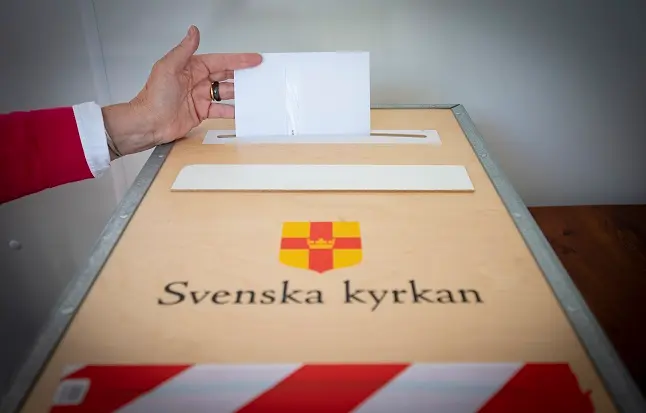
Sweden's church elections were modelled on national elections back at the time when it was a state church, and there are elections to the 249 seats of the Synod, as well as at the the diocesan and parish levels.
The elections take place every four years, just like Sweden's general elections – although they run on different schedules. Even if they ended up scheduled for the same year, (for example if a Swedish prime minister resigns and triggers an extra election), the two cannot be held on the same day due to rules that state elections must be carried out in a neutral way (värdeneutral in Swedish).
The other big difference between the two votes is that while Sweden has typically high voter turnouts for its parliamentary elections, the church elections usually see low turnouts. In 2021, voter turnout was 18.4 percent, while the vote before that saw the highest turnout since 1934 – just 19 percent.
Around half the population has the right to vote, which requires being aged over 16 and a member of the Church. Up until 1996, newly born children were automatically made members unless their parents opted out, but this was changed to opt-in.
READ ALSO:
Comments