
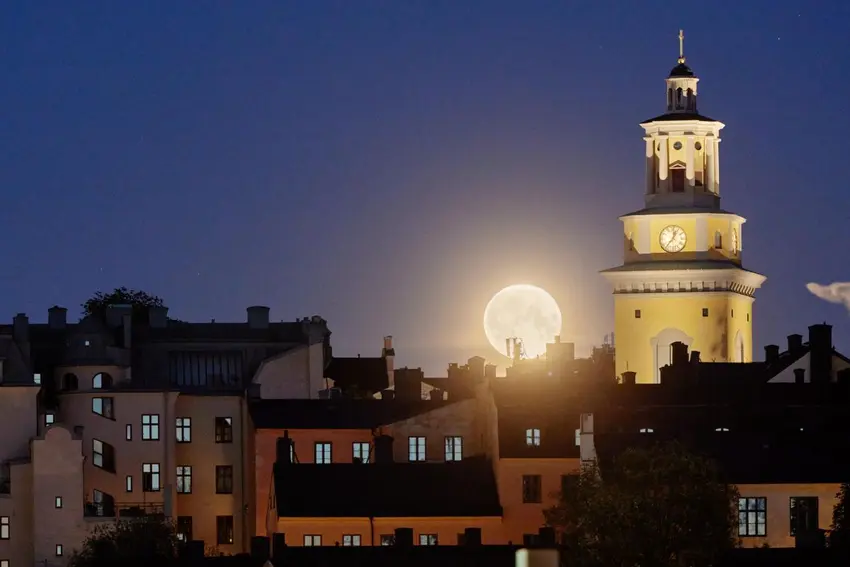
What is a supermoon?
A supermoon is when a full moon coincides with the celestial body reaching its closest point to Earth on its elliptical orbit around us. Some astronomers frown on the term "supermoon" and prefer to use its technical name: "perigee-syzygy of the Earth-Moon-Sun system".
Admittedly not as catchy.
To be more exact, on Wednesday evening the full moon will be 361,969 kilometres from the Earth, as opposed to its usual average distance of some 382,900 kilometres, and will appear to be around 14 percent larger than a "micromoon", when the moon is the furthest away from Earth.
When can I see it?
The supermoon at the end of August will take place on the evening of August 19th.
The moon will rise in the east and move south over the horizon, where it will disappear again before sunrise on August 20th.
It might be a good idea to keep an eye on the weather report to see whether the sky will be clear where you are.
It's not the only supermoon this year. You'll get another chance on September 18th, October 17th (when it will reach its closest point to Earth this year) and November 15th.
Where is the best place to view it?
Like with most astrological events, the best place to spot the supermoon is in areas with clear skies and a low amount of light pollution, preferably high up or on the coast so you have a good view of the horizon, although you do still have a chance of spotting it in urban areas if the weather is good.
The supermoon will be closer to the Earth than usual, so you should be able to see its surface with a pair of binoculars. If you want to take pictures, you should use a camera with a telephoto lens placed on a tripod. To avoid overexposure, you may need to set the exposure manually.
Comments