
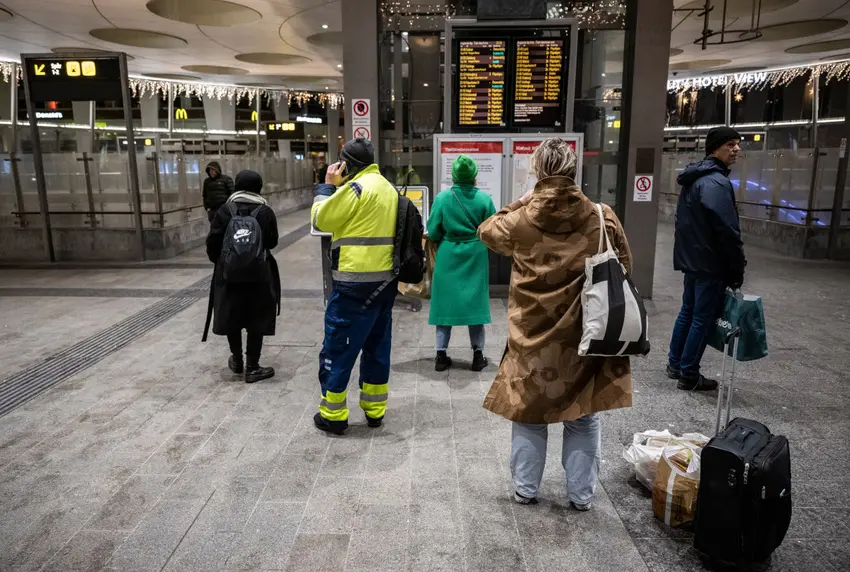
TRAVEL LATEST
- There have been two accidents on the E4 this morning, Tuesday December 23rd. The Swedish Transport Administration warns that it is currently extremely slippery on the roads between Arlanda and Uppsala. One accident occurred at the Brunnby interchange and the other near the Arlanda interchange, where a lane may continue to be closed, slowing traffic.
-
After a fatal accident on the E20 north of Götene, in which a 25-year-old man died, the stretch of the E20 at Brännebrona north of Götene will remain closed for most of Tuesday, one of the busiest traffic days of the year. Road users are advised to follow designated diversion routes.
- If you're travelling on roads in the north, watch out for black ice.
- Make sure to keep an eye out for train cancellations and if you're driving, take it easy on the roads and make sure your car has appropriate tyres.
- Allow plenty of time for travel and keep up to date with SMHI's weather alerts.
Travelling by air
Travellers flying from Stockholm and Copenhagen to London Heathrow Airport using the Scandinavian Airline SAS should watch out for delays and cancelled flights due to a strike threat from UK unions representing cabin crew. SAS cabin crew based in Heathrow will walk out on the 22nd, 23rd, 24th and 26th December unless an agreement on pay is reached in the next few days.
EasyJet ground staff at London’s Luton Airport are also planning a walkout over the Christmas period.
State-owned Swedavia, which operates ten Swedish airports, advises on its website that passengers arrive at the airport in time (a minimum of two hours before departure for flights within Europe and three hours before departure for those outside Europe), and check in online from home or at a self-service machine in the airport.
Be aware that if you have odd-sized baggage, you’ll need to factor in extra time as you’ll have to visit a manned desk to check in your baggage.
They also advise travellers to pack wrapped Christmas presents and any food or liquids in checked baggage, so it won’t need to be unwrapped and investigated or thrown away when you go through security.
Travellers flying to Sweden from outside the EU can make their arrival easier by using the new EES app.
Travelling by rail
Swedes celebrate Christmas on December 24th and many schools and workplaces close after the 19th this year, so many people will be travelling to visit family over the weekend of December 20th-21st, as well as on Monday the 22nd and Tuesday the 23rd.
There are some cancellations to be aware of over the Christmas period (we're not listing weather-related cancellations below).
Some X2000 trains between Stockholm and Malmö, Stockholm and Gothenburg, Gothenburg and Malmö and Stockholm and Västerås have been cancelled between December 19th and 22nd. This is due to a lack of trains after a technical issue with a wheel on one train on December 14th led SJ, who own the trains, to bring the entire fleet in for inspection.
"It's one departure per route and direction each day, so it's a small amount when put into context," a press spokesperson told the TT news agency.
If you’re travelling in the far north of Sweden, specifically the Kiruna-Riksgränsen route, trains are not running at all due to a derailment at Vassijaure, which has caused damage to the line. This is expected to be fixed in early January and replacement buses are running.
There are also some planned engineering works. The main routes which may be affected are as follows:
The Göteborg–Alingsås route will be closed in its entirety during the weekend of January 2nd-4th. The timing of the closure is expected to be between 10:00 PM on Friday January 2nd and 2pm on Sunday the 4th.
You can check the Swedish Transport Administration (Trafikverket) for information on planned engineering works, but it’s best to check with the relevant train company for information on specific departures.
Tickets expensive
Tickets on December 22nd from Malmö to Stockholm are still available for booking on SJ's website, but they are expensive, with the price of a single above 1,500 kronor on some departures. Some single tickets on the Gothenburg to Stockholm route on December 22nd cost over 1,000 kronor.
If you don’t need to travel far and you want to save some money, tickets are usually cheaper on the morning of the 24th.
Travelling by road
This year, it doesn't look like in Sweden south of a line between Östersund and Härnösand will get a white Christmas, which will at least make the drive less challenging for most people.
"From a traffic safety perspective, it is of course better that it is not slippery and that there not is a lot of snow," Felicia Danielsson, a press spokesperson for the Swedish Transport Administration (Transportstyrelsen), told the TT newswire. "However, what we see is that people drive less carefully when there is bare ground. Many people probably think that it is just a matter of hopping in and driving off."
This year, Christmas Eve is on a Wednesday, which is good from a traffic perspective, as travel will be more spread out this year, with some setting off on the weekend, and some waiting until Monday or Tuesday.
Since most schools and workplaces close for Christmas from Friday December 18th, the roads are likely to be less crowded, since people will be travelling on both the 22nd and the 23rd, as well as over the weekend of the 19th and 20th. In general, the busiest travel days in Sweden over the winter holidays are usually December 21–22, December 27 and January 4–5.
"Even if travel is more spread out, you will not be alone on the road. There will be a lot of traffic every day," says Danielsson.
The busiest part of the Swedish road network is likely to be the E4 that runs between Helsingborg via Jönköping and Stockholm, Uppsala, Gävle and Sundsvall. Other holiday traffic hotspots are road 40 between Gothenburg and Borås and the E22 from Norrköping to Kalmar.
Unlike over the Easter weekend, Trafikverket tends not to carry out major roadworks over the Christmas period, as it is too cold for some jobs and also a time when road workers are on holiday. This means any disruptions are likely to be weather-related.
You can keep up to date with road closures on Trafikverket’s website here (the symbol of a yellow circle with a red outline means a road is closed, while the yellow triangle with an exclamation mark inside means some sort of traffic alert).
Trafikverket shows road conditions as coloured sections on the map linked to just above. An explanation of the section colours can be found in the menu on the left. Information on road conditions is updated twice a day or in the event of a significant change, but keep in mind that road conditions can still change between updates.
If you are driving on icy or snowy roads, drive slowly, keep a significant distance between you and the car in front, and avoid braking or turning abruptly. Even if there is no visible ice or snow, be aware that there may be icy patches that are not easily seen (called "black ice" because of how it blends in with the road).
You should also make sure you have winter tyres (and even a chain, if driving in the far north). You should pack blankets or warm clothing in case you get stuck or break down. It's useful to have a motorvärmare, or block heater, which you can plug into your engine to warm it up so it starts in freezing conditions.
And of course you need to have an isskrapa, or ice scraper, ideally one with a brush if it's snowy (a bank card will get rid of the ice in emergencies but it might not work again afterwards).
Comments