
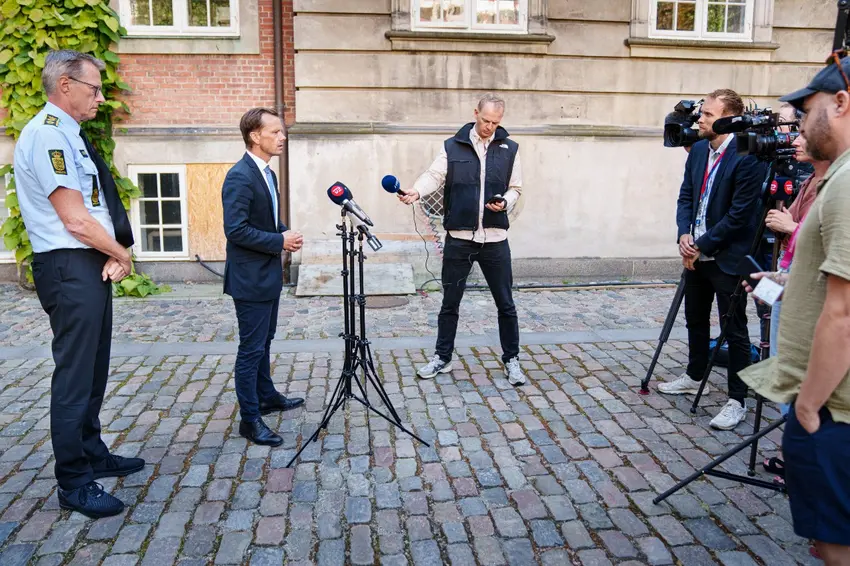
What happened on Monday?
On Monday, Denmark's prime minister Mette Frederiksen called the country's justice minister Peter Hummelgaard and the chief of the national police, Thorkild Fogde, to a high-level meeting to discuss the growing phenomenon of Swedish youth being recruited -- often through social media -- to carry out serious shootings in Denmark.
After the meeting, Hummelgaard told the Danish broadcaster TV2 that he would put pressure on the Swedish government to take action on the phenomenon of youth hitmen, which has been a problem in Sweden for several years.
The events of recent weeks, which have seen at least six Swedish youth arrested for serious gang crimes, were, he said "scary" and made him "really, properly angry".
"We are of course going to put pressure on Sweden to take responsibility for this whole thing," he told the channel. "That something like this has been able to take place and grow into a phenomenon in Sweden reflects a totally sick, depraved culture of violence. We don't want that in Denmark."
Thorkild Fogde said that the Swedish hitmen were being recruited because of a "flaring-up of the gang conflict" which had "underlying reasons which are well known to the police".
"The new thing," he said, was that it was "drawing a phenomenon across the Øresund that we have not been used to seeing in Denmark, namely crime to order."
How bad is the problem?
Hummelgaard said last week that Swedish so-called ‘child soldiers’ had been involved in 25 criminal incidents in Denmark since April alone, following six arrests for serious violent crimes in a matter of weeks.
- On 17 July, an 18-year-old Swedish woman and a 22-year-old Swedish man were arrested in Copenhagen for weapons and drug possession with a view to resale.
- On 31 July, a 16-year-old Swedish youth was arrested after a shooting at Blågårds Plads in Nørrebro.
- On 31 July, a 17-year-old Swedish youth was remanded in custody for four weeks, suspected of attempted murder in connection with a shooting at Vejrupsgade in Kolding.
- On 6 August, a 24-year-old Swedish man and a Swedish woman of the same age were remanded in custody on charges of attempted murder, possession of a hand grenade and having caused an explosion in a kiosk.
What is Denmark doing?
At the end of last week, Hummelgaard announced additional Danish controls on the border with Sweden in direct response to the spate of incidents.
Danish police controls will be increased on trains crossing the Øresund Strait between the southern Swedish city of Malmö and Denmark's capital Copenhagen, the main crossing point between the countries. They will also be increased on the Øresund road bridge linking the two cities, with the use of camera surveillance among other things.
READ ALSO: Denmark boosts border checks with Sweden amid gang violence
On Monday, the discussions were about increasing the use of automatic license plate scanners on the border with Sweden, increased police presence on the border, including on the Øresund trains, and the possibility using automatic facial recognition to review surveillance footage.
Denmark's political parties are soon to start talks on allowing the use of facial recognition software, something the country's police have long been calling for.
How are Swedish politicans reacting?
Sweden's justice minister Gunnar Strömmer said that the increased border controls were a natural step for Denmark to take to counter the growing use of Swedish hitmen in Denmark and said he was in frequent contact with Hummelgaard over the problem.
"This is of course serious and we have a strong common interest in both Denmark and Sweden to stop this development," he said. "I think it is natural on the Danish side to take actions to limit this recruitment, make it more difficult and increase the risk of discovery."
Strömmer has yet to respond to Hummelgaard's more recent statement.
Comments