
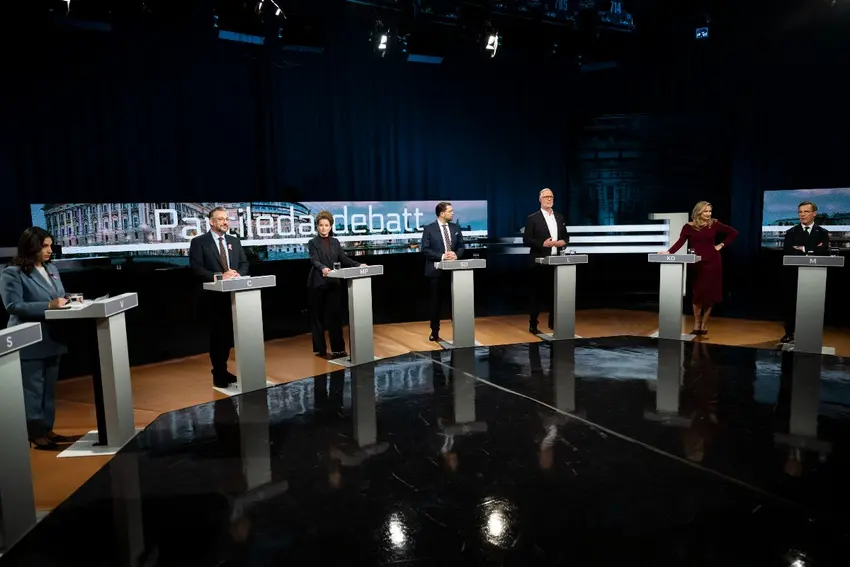
The government's tax-cutting budget, which gives the richest the the biggest cuts, both in real terms and as a percentage of their income, should have been an open goal for the left-wing opposition in the two-hour debate on SVT's Agenda news programme on Sunday.
"This is the most Moderate budget I've ever seen in my life in Sweden's parliament: for Moderates, by the Moderates," declared Nooshi Dadgostar, leader of the Left Party.
She wasn't wrong.
It's no accident that the government chose this budget, right in the middle of its mandate period, to reward the better-off supporters of the biggest government party, the Moderates.
For the Moderates, it came not a moment too soon, after two years where the party's core voters have had to watch their ministers drive through a Sweden Democrat agenda, much of which they disagree with, without getting a lot in return in the way of tax cuts.
After two tight budgets where the priority was dampening inflation, this one was probably the only one where Moderate voters could be rewarded, with the government betting presumably that its gift to the richest in society would be old news by the time the next election rolls around in 2026.
The risk of it all being forgotten was why it mattered so much to the opposition to drive through their points in what was one of the two yearly leader debates on Sweden's SVT public broadcaster.
"The government had laid out the tax ball for the opposition to smash, and smash it is what they did, time and time again," reported Tomas Ramberg, the political commentator for the Dagens Nyheter newspaper.
It was, Dadgostar said, "completely absurd" to be prioritising cutting taxes for the richest at a time when ordinary people's finances were "under heavy pressure", and regional governments were having to cut staff in hospitals and primary care. The government and its support party had, she said, "entirely lost contact with the Earth", and were in "a whole other galaxy" from ordinary Swedes.
Magdalena Andersson, leader of the centre-left Social Democrat party, took the same approach, accusing Moderate Prime Minister Ulf Kristersson of seeming "extremely pleased, despite the current situation, where families with children are having to count every krona".
She also attacked the decision to prioritise tax cuts for the rich on macroeconomic grounds.
"It's like being back in the 1980s and the discussion among the economists then. I'm sorry, but the world's economists have left all that behind: you don't kickstart the economy by cutting taxes for the rich," she said.
If there was ever time when an attack on tax cuts on the rich had to hit home, this debate was it. But the left-wing parties didn't quite manage to pull it off.
Prime Minister Ulf Kristersson brushed off the attacks, saying it was "entirely natural" that those who pay more tax should also get a bigger tax cut.
"The big change is that we want to come back to 'half of it left'," he said, saying the end goal was to bring the top rate of income tax to 50 percent, down from 54 percent today. This, he said, was only "just and right".
Perhaps surprisingly, Jimmie Åkesson, leader of the Sweden Democrats, whose voters tend to be in a lower income bracket, echoed Kristersson almost word for word.
He said he supported a plan to move towards what he called "a just level of marginal tax", set at "about 50 percent". He argued, though, that tax cuts could be combined with increased welfare spending, with "a historic reform of dental care" now afoot. "It's possible to both cut taxes and boost welfare spending," he claimed.
Ramberg argued that the opposition's ability to benefit from the budget had been undermined by the fact that the Centre Party, one of the four opposition parties supporting Magdalena Andersson as a prime ministerial candidate, wanted to cut tax on the rich almost as much as the Moderates did.
"On economic policy the front line is not between the government and the opposition, it cuts right through the bloc supporting Magdalena Andersson," he argued.
Andersson played this down, saying that the Social Democrats had succeeded in coming to an agreement with the Centre Party before and would do so again.
The problem is that a lot of voters probably remember that they did this by agreeing to abolish värnskatt, or the "austerity tax", a tax waged on the country's very highest earners.
Nontheless, it was at least, several Swedish commentators pointed out, a fact-based, or saklig debate, with the parties only later getting on to more emotive subjects like the gang leader at Åkesson's wedding, whether there is more antisemitism in the Left Party or in the Sweden Democrats, or the Social Democrats' lottery scandal.
The question is whether enough of the left-wing criticism hit home for voters to still see the three government parties, and along with them the Sweden Democrats, as representing the economic interest of the richest rather than those of the average person.
Politics in Sweden is The Local's weekly analysis, guide or look ahead to what's coming up in Swedish politics. Update your newsletter settings to receive it directly to your inbox.
Comments (1)