
Sweden's state mortgage lender SBAB said in its October report that it expects the average mortgage rate offered in Sweden to hit its lowest point at 3.1 percent around next summer, after which it expects the average rate to rise slightly to about 3.3 percent, where it will stay for the following two years.
The lender said this was a lower level than it had previously forecast in August, saying this was due to the fact that the Riksbank was now expected to cut its core interest rate faster.
"It's a 'no brainer' that the Riksbank is going to cut interest rates again in November, but whether it will be a double cut is, however, far from clear," the lender's chief economist Robert Boije said in a press release, predicting instead that the bank would wait until December to make a double cut.
The prediction that variable rate mortgages will hit their lowest point in the summer goes against the forecasts of most commercial lenders, who generally expect the variable rate to continue to fall throughout next year. Nordea, for instance, in its most recent forecast from September, said it expected its own variable mortgage rate to continue falling after the summer, hitting 4.3 percent in June next year and then 4.05 percent in December next year.
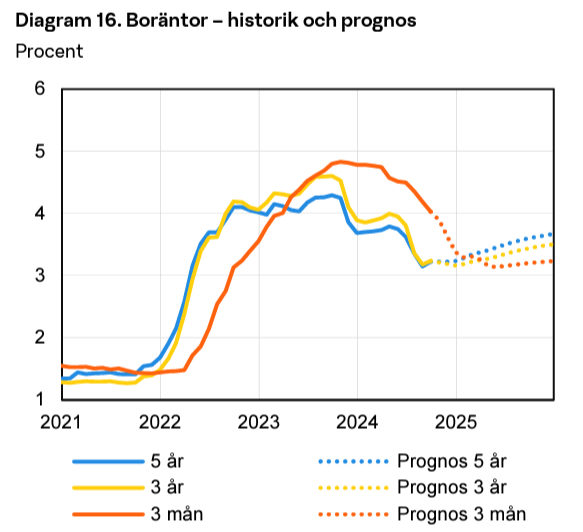
According to SBAB, five-year and three-year fixed rate mortgages have already hit their lowest level. The lender expects them to rise gradually over 2025, with fixed rate mortgages becoming more expensive than variable rate mortgages (which are technically 3-month fixed rate mortgages) sometime next spring.
In the chart below, taken from SBAB's report, you can see how the average rate for a 3-month variable rate mortgage has fallen from the start of this year as the Riksbank has cut its core interest rate from close to 5 percent to around 4 percent. The average rate is expected to fall further to just over 3 percent over the next six months.
So is it worth getting a fixed rate mortgage?
According to SBAB's forecast, although someone signing a variable rate mortgage today would initially pay a higher rate than someone who took out a three or five-year fixed rate mortgage, the variable rate mortgage may be cheaper by summer next year.
On the other hand, people taking out a fixed-rate mortgage today can tie in a rate as low as 3.2 percent. Under SBAB's forecast, this will be slightly more expensive than a variable rate over the summer, but cheaper by the end of next year as the interest rate on variable mortgages starts to creep up again.
In its press release, SBAB said it was difficult to judge whether house-buyers would be better off taking out a fixed rate or variable rate mortgage at the moment.
According to its forecast, it said, it appeared to be cheaper to opt for a variable rate compared with a fixed rate for between one and two years, although three and five-year fixed rate mortgages appeared cheaper than variable ones. The differences, though, were "relatively small", it noted, saying it was possible both that the rate on variable interest rate mortgages would fall faster and lower than predicted, or that the rates on longer fixed-rate mortgages would stay low for longer than predicted.
"The decision on how long to fix your interest rate is not a given in the current situation," Boije said. "It depends on how you as a mortgage borrower relate to risk, what margins you have to be able to handle unexpected changes in the interest rate and how you view the risk of having to pay interest rate differential compensation to your bank."
Comments