
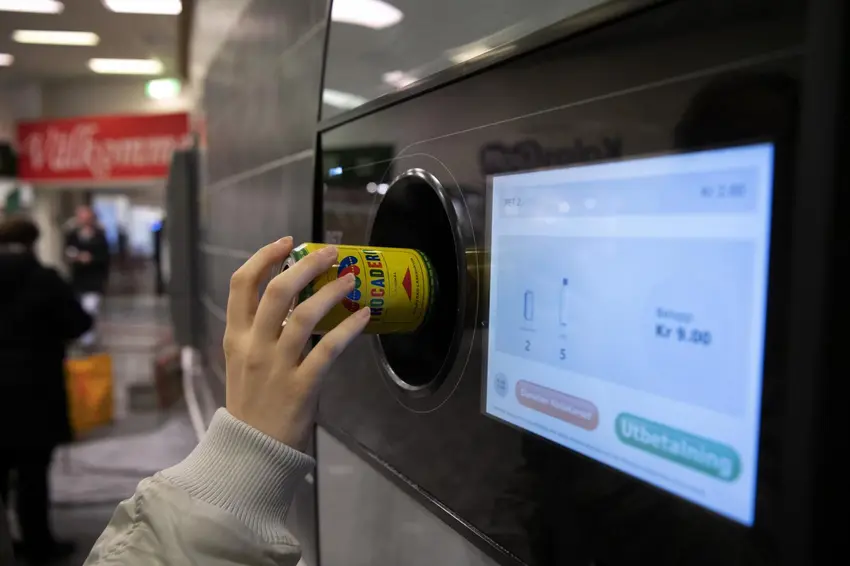
In Sweden, people trudging to the supermarket with their plastic bags full of cans and bottles are a common sight. They insert them into large machines, shiftily look around before ignoring the option of donating the money to charity, press the other button to collect a receipt and take it to the till where it gets refunded.
These drop-off points are integral to Sweden's pant system.
The deposit on the bottles and cans is called pant and the process described above is even a verb, panta, which usually refers to the process of putting bottles in the supermarket's magic machines. More generally, panta means to hand something in and get money in return (such as for example in a pawnshop).
When consumers buy beverages in plastic bottles and aluminium cans, they pay an additional fee (pant) - typically between one and three kroner - as a deposit.
This deposit incentivises consumers to return their empty containers for recycling rather than disposing of them as regular waste.
Most people in Sweden have a designated bin or bag at home for storing containers with pant. Once they fill these up, they take them along on their next shopping trip to a grocery store or supermarket.
Countries such as Germany, Denmark and Norway also operate similar schemes.
Can recycling in Sweden goes back to 1984. Plastic bottles were added to the scheme ten years later in 1994.
Last year, 2.72 billion cans and plastic bottles were recycled as pant (roughly 88 percent of all eligible containers).
In addition to this, 51,400 tons of metal and plastic were recycled, according to Pantamera, who make adverts to encourage people to panta.
Per person, that’s an average of 257 cans and bottles, saving 180,000 tons of carbon dioxide.
But how does it actually work?
By returning empty bottles and cans to designated collection points in stores, where machines scan and sort the containers, you'll be able to reclaim your deposit in the form of a voucher corresponding to the value of the pant.
On average, a regular plastic shopping bag can hold bottles and cans worth around 100 kroner in pant, so using the voucher on the spot to pay for part of your groceries is common.
It’s also a nice little bonus if you host a party. Put out a bin bag for collecting pant and you can return it yourself – consider it your payment for having to tidy up afterwards once everyone has left.
You'll usually find the pant machine at the entrance to supermarkets, but in some stores (especially the larger ones), it'll be located outside - though not too far from the entrance.
If you can’t be bothered with a coupon, you can also donate your pant to charity. There’s usually a choice of a red button (donate) or a green button (pay out) on each machine. Make sure you choose the right one as you can’t change your mind once it’s been paid out.
There’s also a social element, as collecting pant cans is a source of income for those experiencing financial hardship.
It's not uncommon to see people collecting these containers from public spaces to recycle them, and there are often small holders on the sides of rubbish bins with a spot for you to leave your cans or bottles for someone else to collect.
Comments