
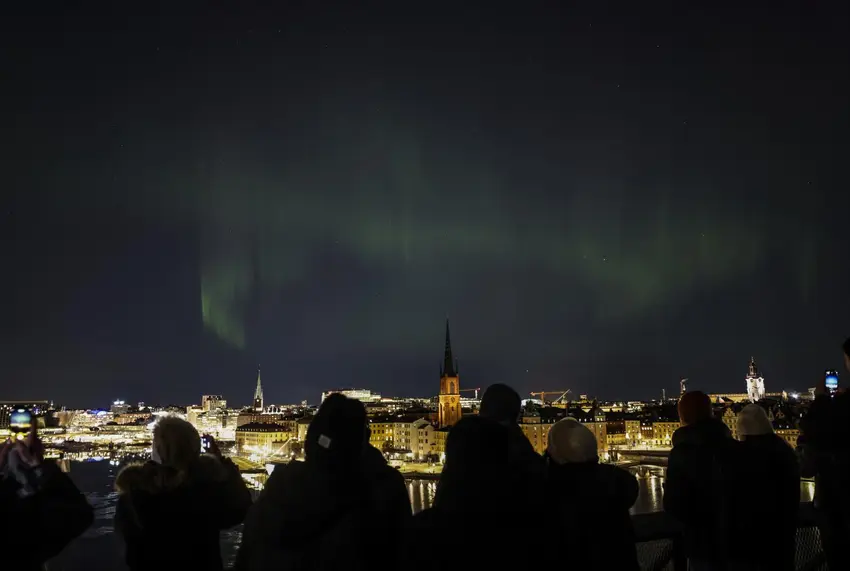
The clocks in Sweden change towards the end of October every year, and the days become much shorter, and by mid-December, the sun in Stockholm goes down at just 3.40pm.
If you’re further north in cities such as Umeå and Luleå, you shouldn’t expect much more than three or four hours of daylight in the midst of winter.
Residents in Umeå and Luleå get off lightly by comparison, as much of northern Norrland is plunged into the polar night between November and December (depending on how far north they are) and may not see a true sunrise for at least a few weeks.
Winter’s short days take their toll on plenty of people, and for many, it can be the hardest time of year.
Some may even struggle with health issues during this period, Seasonal Affective Disorder (SAD) is a condition where a lack of light triggers depression.
Given that many head to work while it’s still dark and don’t get to leave until the sun is setting, getting enough sunlight can be a massive struggle, even for people in the south of the country.
From staying active to taking vitamin D tablets and investing in an artificial light lamp, you can do plenty of things to try to improve things.
However, knowing when the light at the end of the tunnel will appear again can also boost morale.
The shortest day of the year will be on December 21st, 2024.
The bad news is that the sun will set in Stockholm before 3pm, and the day will be just over six hours long.
Gothenburg will see days of just over six-and-a-half hours during this period, while Malmö in the south will get just over seven hours of sunlight, Uppsala will get almost six hours, and Linköping will get slightly more at six-and-a-half hours.
Luckily, the days will start getting longer after this point. By mid-January, sunset won't occur until 3.30pm, and people can enjoy over an hour more of sunlight.
By March 20th, 2024, the spring equinox will arrive in large parts of the country, meaning that the days and nights will be of equal length.
At this point, the sun will rise at 5.50am and set at 6pm in Stockholm. Residents in Gothenburg will also enjoy days more than 12 hours of sunlight, as will those in Malmö, Uppsala, Linköping and even as far north as Kiruna in Norrland.
After this, the days will start getting dramatically longer in the north of the country.
In northern Sweden in cities like Kiruna, Gällivare, Skellefteå, Luleå and Umeå, the sun won’t set between mid-April and the end of August.
The days in the rest of Sweden will get progressively longer until the longest day of the year, which will be Sunday, June 21st.
Comments (1)