
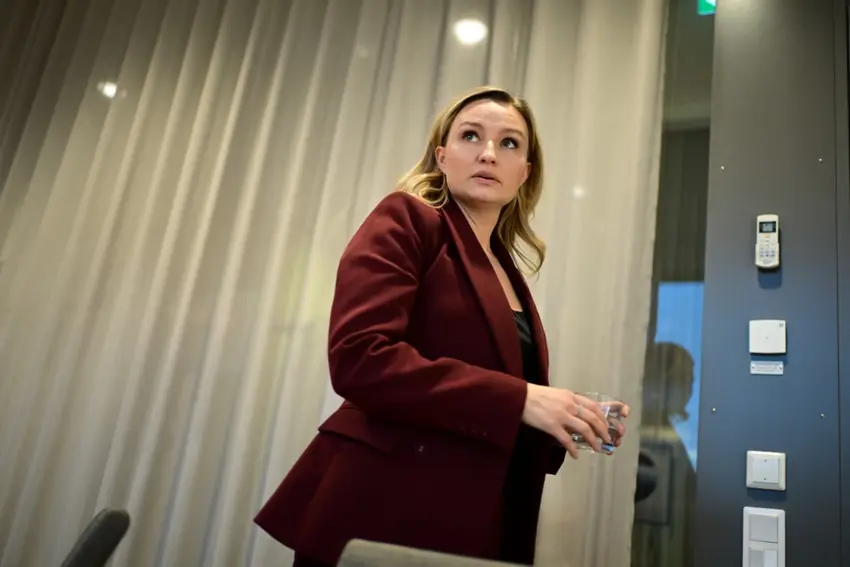
The key moment in SVT Agenda's interview with Sweden's Energy Minister Ebba Busch on Sunday night came when she was asked to respond to the fact that several submissions to the government's inquiry on new nuclear – including from some of Sweden's top engineering universities – had argued that new nuclear power stations were not even necessary to ensure a stable electricity system, that there were alternative ways of achieving this that might be cheaper.
"This is both, I'd say, misleading and [just] an opinion," she said, dismissing the idea without further consideration before returning to the safe ground of blaming Sweden's energy woes on the decision under the former government to shut down two ageing nuclear reactors.
Sweden's government was left with two options after the panning its proposed funding scheme for new nuclear reactors got from leading experts and expert agencies: Put the project on hold and restart from the fundamentals, or just ignore the experts.
That they chose the latter should really be no surprise. New nuclear is the central plank of the government's energy and climate policy. Prime Minister Ulf Kristersson has promised "a spade in the ground" on a new reactor before the next election.
They have risked too much political capital to give up just because Sweden's energy agency, its grid operator, its macroeconomic watchdog and its top engineering colleges don't like the proposed financing plan.
"If you step outside the rather navel-gazing domestic political debate in Sweden, we are praised internationally for having a realistic plan for investment in new nuclear power," Busch declared. "That's why I hope we will get broad support from the parliament in the spring. We are going to stick to our agenda and present a bill in the spring."
The negative consultation responses may not have swayed the government. They have, however, emboldened Sweden's opposition.
After Busch' interview, Martin Ådahl, the economic spokesperson for the Centre Party, was next up on SVT's Agenda.
"I think it's extremely, extremely problematic that they are not listening to the experts, that they are not listening to those who are warning about what this involves," he said. "This is about setting up a solution for 40 years and they're not ready to look at the alternatives. They want to have nuclear plants whatever the price, which in practice is like passing a blank check to the nuclear industry. Then you're going to end up with the most expensive possible alternative."
The Social Democrats' leader, Magdalena Andersson, echoed the consultation responses in an interview broadcast on Saturday on public broadcaster SR.
"The consultation responses... warn that this risks laying a dead hand over all other forms of energy production," she said. "The problem here is that the government has started at the wrong end. They've started by saying 'we want to have ten full-scale reactors whatever the cost'. Then they just drop the taxpayers' wallet on the table and say 'we're ready to pay whatever the cost' instead of asking 'how can we get more electricity here and now by building more land-based wind power and upgrading existing nuclear plants?'."
It's only once you've solved the near-term issue, she said, that you should have "a serious discussion on how to best secure long-term energy supplies as cheaply as possible for people in Sweden".
Her party, she said, had opened up to new nuclear with the Energy Agreement it reached with the current government parties in 2016. She agreed, she said, that new nuclear plants were probably necessary, but said that this could be achieved more efficiently with a technology neutral subsidy scheme which also rewarded other technologies for increasing system stability.
"My judgement is that nuclear needs to be a part of the mix, but because it's the most expensive power source, we shouldn't have more nuclear than we need."
Social Democrats complain plan to tax party lotteries is an effective ban
Sweden's government on Thursday announced its plans to crack down on party-run lotteries. Instead of an outright ban, party lotteries will be subject to the same tax as commercial gambling enterprises rather than the rules for charitable lotteries. They will also have to clearly state which political party they are run by, and people will not be able to buy lottery tickets on credit.
"We are going to put a stop to the culture of fraud which has existed in Sweden and hit our elderly hard," Sweden's financial markets minister, Niklas Wykman, said at the press conference announcing the measures, a reference to the scandal over heavy-handed lottery sales techniques which broke out earlier this year.
"The exemption from a gambling tax for party lotteries can be seen as extra-state support that only the parties that have chosen to have lotteries may take part in," added Robert Hannah, the cultural policy spokesperson for the Liberals, one of the three government parties.
In her interview on Saturday, Magdalena Andersson reminded listeners that when the government first announced its plan in 2023, the Sweden Democrat MP Tobias Andersson had said that the aim was to "turn off the tap of financing" for the Social Democrats, which earned 135 million kronor from its lotteries in 2023.
"We would do well to remind ourselves that when this was launched, the Sweden Democrats said that the aim of it all was that there should be shorter processions on May 1st [when left-wing parties traditionally march]," she said.
Because of the different rules for commercial and charitable lotteries, she said, taxing party lotteries like commercial ones, "will have in practice the same effect as banning it".
Government's citizenship slowdown plan gets heavy criticism
Six of Sweden's most senior lawyers, academics and migration leaders have written a joint opinion piece in Dagens Nyheter calling for government agencies to refuse to enact any aspects of a future government plan to slow down the award of citizenships if they believe the order is illegal or if it requires them to sideline their legal duties.
The article, titled "Sweden's government is not above the constitution" was signed by Anders Danielsson, former Director General of the Migration Agency, Anna Ramberg, former Secretary General of the Swedish Bar Association, Hans Corell, a former head of legal affairs at the Justice Department, Anna Skarhed, a former Chancellor of Justice, Anna Ekström, a former Social Democrat school minister, and Joakim Nergelius, professor of constitutional law at Örebro University.
They argue that if the government pushes ahead with its plan, the Migration Agency, the Säpo security police, and the courts should resist.
"Swedish agencies should of course follow the regulatory letter and other instructions which come from the government," they wrote. "But if these instructions contravene the law, or if the agency cannot follow the instructions without breaking the law, the agency must follow the law and not the instruction given by the government."
Liberal leader hints that he could drop opposition to Sweden Democrats in government
Johan Pehrson, leader of the Liberal Party, sparked protests from within his party when he seemed to waver in an interview with the Dagens Nyheter newspaper on the party's congress decision that it would not be part of a government that included the far-right Sweden Democrats.
"The Liberals have no other position than that we do not consider ourselves a party that thinks that the Sweden Democrats should sit in a government," he said. "That is the Liberals' position...but having said that I have to as the party leader...be ready that whole time to do certain reassessments, just like the Social Democrats have done on Nato or nuclear power."
The statement drew protests from within the party, with Anton Holmlund, chair of the LUF youth party telling the Svenska Dagbladet newspaper that the majority doesn't even want a "chink in that door". "It's a shame and regrettable that we got such a statement from Johan," he said.
Sources within the party then complained that they "had no trust whatsoever" in the party leadership on the issue of cooperation with the Sweden Democrats, especially given some of Pehrson's statements internally.
"Johan Pehrson is always saying that the point of the party is not to be a discussion club but to get power and that cooperation with the Social Democrats is ruled out," one Liberal source told the Dagens Nyheter newspaper.
"Many in the party feel that we more or less stood and lied to voters in the last election campaign when we trusted what Johan Pehrson and the party leadership were saying. There are a lot of people who don't want to be involved in doing that again."
Politics in Sweden is The Local's weekly analysis, guide or look ahead to what's coming up in Swedish politics. Update your newsletter settings to receive it directly to your inbox.
Comments (3)