
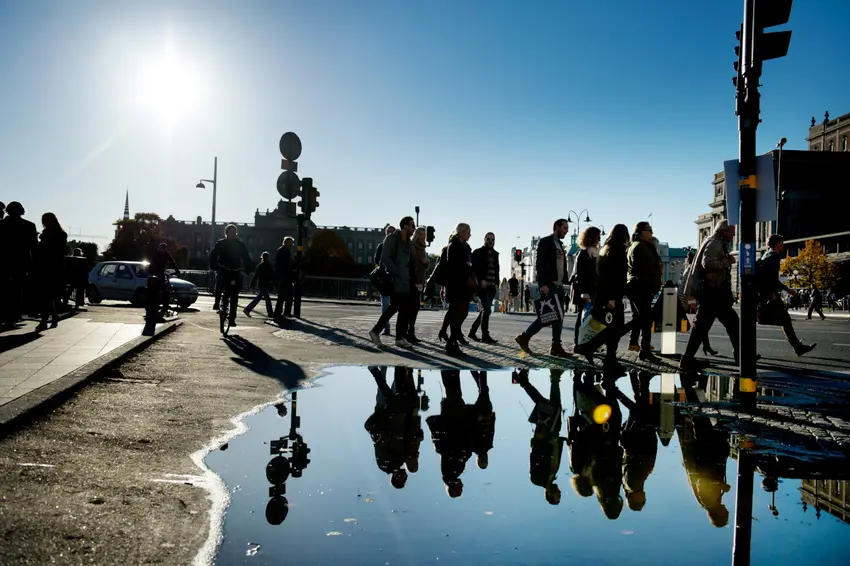
Asked whether they thought life in Sweden would get better or worse in 2025, two in three of 36 respondents to The Local's reader survey thought things would get worse, one in four thought they would get better, and one in ten thought they would remain about the same.
The survey was not scientific, but it gives you a rough idea of their feelings.
Among those who thought things were going to get worse, many cited economic issues, such as rising cost of living and a slow job market, and anti-immigration policies.
“I think that life in Sweden in 2025 will face increasing challenges,” said Teodor, a Macedonian software architect based in Stockholm.
“The cost of living will continue to rise, making it harder for families to manage. Integration efforts for expats may slow down, leaving many feeling isolated. Economic uncertainty could lead to fewer job opportunities, and social divisions may deepen,” he continued.
“We will also see more people leaving Sweden, as many internationals have already started packing their bags, affected by the current situation of a bad economy and bad job market.”
Suresh, an Indian reader working in Gothenburg, was worried that the issues on the labour market, as well as tighter rules for residence permits and citizenship, would make Sweden a less attractive place for international talent.
“For foreigners, it will be definitely bad since the rules of citizenship and permanent residency are changing frequently, and layoffs are becoming very common,” he said.
“So getting a job and then sustaining it until you get citizenship would be very tough for the year 2025. If the job market is not good, then definitely Sweden will not be prioritised by highly skilled individuals.”
One American respondent worried that the economic downturn could have knock-on effects on other aspects of Swedish society.
“I think the downturn in the economy, weak krona, and fewer higher and lower skilled labourers will result in genuinely more difficulty getting things done. Waiting longer in lines or on hold, having to do more for yourself.”
He wasn’t completely convinced that this would be entirely a bad thing, however.
“It could encourage a simpler life, on the bright side.”
READ ALSO:
And the outlook isn’t all gloomy when it comes to the economy. A number of respondents listed economic factors such as lower inflation and lower interest rates as something that gave them hope for the future.
“I expect further reductions in the Riksbank’s base rate,” wrote a 34-year-old R&D engineer from India, who thought things would get better next year. “Sweden officially out of recession and an improvement in the job market. Stability on the real estate market and property prices to start going up. I also think there could be improvement in tax cuts.”
Despite this, he did still have some concerns for 2025, listing amendments to citizenship laws as one of his major fears.
“Things have been very unclear as to how and what will change, especially after statements from politicians.”
LIVING IN SWEDEN:
Mark, a Brit based in Örebro, was worried about political drama detracting from the real issues in society.
“Unfortunately I don’t see any strength in the middle ground of Swedish politics. Strong voices from the right continue to spout their populist mantras while the left sees the opportunity to get a foothold in the next government by threatening to oust the Social Democrats’ leader if they don’t get their way.”
“The tiresome debate continues and detracts from the real issues. Healthcare, social care, energy and security. 2025 will be a worrisome year for ‘vanligt folk’ [ordinary people] who simply want to live their lives without financial or cultural shocks every time they read or watch the news.”
His personal hope for 2025 was that he would finally be granted Swedish citizenship after three years of waiting, but added: “I’m not holding my breath!”
An Indian software engineer in Gothenburg thought that although the anti-immigration debate would push highly qualified immigrants away in 2025, making the issue top of the agenda would yield lower results for the right-wing coalition than before.
“With more and more right-leaning governments across the globe, I see Sweden looking for a more balanced approach, having recent experiences with both extreme left and extreme right governments (by Swedish standards) that caused more problems than they solved,” he said.
He, like several others, predicted that the economy would hopefully get better, but not yet.
“The economy being the way it is means it will be harder to find jobs in the near future, or get a raise (…) but I expect things to stabilise and things to be put in motion for long-term recovery, the results for which may not be obvious by the time 2025 ends. Yet, we are still doing better than a lot of countries post-pandemic and recovery would be relatively quicker for us.”
Kader Jazairi, a Syrian-Swedish national in southern Sweden, thought that more Syrians, unless established in Sweden, would return to Syria if it forms a more stable government. He thought their leaving might gradually ease pressure on housing and lead to a drop in prices, as well as reduced demands for goods and services.
“While the government may save money on social security payouts, the overall economic activity is likely to decline. In response, immigration policies may need to adapt, potentially focusing on attracting new residents to counterbalance the population decrease. This could lead to a reassessment of anti-immigration agendas,” he said.
Several readers were worried about the job market, especially how it will affect Sweden if more skilled immigrants choose to leave or are forced to, whether that’s because they lose their job or are pushed out by tighter work permit rules.
An Indian Northvolt worker who had kept his job despite the recent round of mass layoffs at the battery maker, a major employer of international talent in Sweden, said he was still worried he would have to leave the country if he did lose his job.
“I’ve been living in Skellefteå for the last two years. If the company does well, I get to stay in Sweden and see the New Year’s Eve of 2026 and if it doesn’t I get three months to find a job, which is extremely difficult. So I’m hoping for the best and preparing for the worst,” he said, saying his life in Sweden had so far been on an upward curve.
MORE READER INSIGHTS:
Despite a general unease, readers also hoped for things to improve in 2025.
William, a pensioner from Ireland, said he was hoping for “a complete change of direction by the Swedish people to restore the Swedish high standards of community education and health services”.
“Look at what we have as a society, the range of people and skills and cultures, and look at the possibilities that gives us as a country. Sweden had a good model in the past that gave people hope and a fair chance,” he added.
“My greatest hope for 2025 is that Sweden becomes a more supportive and inclusive place for everyone, where people can find stable jobs and feel valued, and let me not forget, bring value and knowledge,” said Teodor, the software architect from Macedonia.
“I hope to see a stronger job market, better integration for internationals and a sense of community where no one feels left behind.”
Comments