
There will be a bombardment of government proposals on Swedish citizenship over the coming weeks.
Thursday's directive to the Migration Agency on security checks will be followed next Wednesday by the conclusions of an inquiry into tighter citizenship rules, with a committee also set to report this month on how to change the constitution to allow dual citizens to be stripped of their Swedish citizenship.
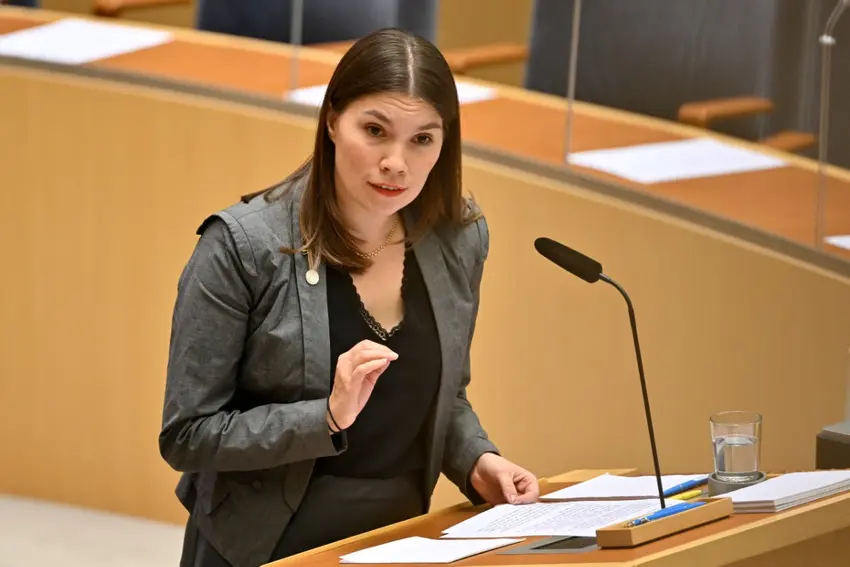
The Green Party's migration spokesperson, Annika Hirvonen, has been the politician doing the most to campaign for a more liberal approach on every one of these issues. But as a dual Finnish-Swedish citizen, it is the last of them which touches her most personally.
When the Sweden Democrat leader Jimmie Åkesson argued last month that it should be possible to strip Swedish citizenship from dual citizens who were born in Sweden, Hirvonen said she reacted strongly against it.
“This is not the way that I view citizenship,” she told The Local in an interview for the Sweden in Focus podcast before Christmas. “Citizenship isn't a reward or a punishment. Citizenship, in my view, is the fundamental basis of democratic rights...and the threat of taking it away shouldn't be something that is used as a punishment."
The increasingly radical rhetoric on citizenship from the Sweden Democrats and even from their allies, she said, had made her fear for the first time in her life that even her own long-term right to live in Sweden might be under threat.
“Knowing what agenda they are pushing, the way that they talk about political adversaries as traitors, I'm very worried about what developments we might see," she said. "I myself have dual citizenship, and to be honest, I never thought that the day might come where I would no longer be welcome in the country I've been living in since I was born."
The problem with changing the constitution to make it possible to strip Swedish citizenship from people who commit "serious crimes", as the government wants to do, she argued, is that it will then be a much shorter step to expanding the punishment to cover other crimes.
"I realise that the day might come where actions that are meant to protect human lives are viewed as threats to the country and might lead to me and other people being exiled from Sweden," she continued. "This is a very scary thought and I never thought it would come to me. I think that opening this door up is a really dangerous path."
Fundamentally against the constitution
Hirvonen on Thursday told the broadcaster TV4 that she planned to report the government to the Committee on the Constitution, the most powerful committee in the parliament, for the directive ordering the Migration Agency to take "additional and powerful actions to as much as possible prevent that people who represent a security risk or live under a false identity are granted citizenship".
She said that she had already asked Maria Mindhammar, the agency's Director-General, how she would respond to such a directive, during a meeting of the agency's oversight committee on which Hirvonen sits.
"She said that she will not act based on what is written in the newspapers, but she will act on the law and also on the regulation letters that the government is sending to the Migration Agency," she said.
But if the agency does follow the directive to carry out extra checks and interviews, she said, there was only a limited amount politicians like her could do to stop it, even if it did lead to a slowdown in decision-making.
"If the agency wants to take different measures to slow down decision-making and sort of follow the government's lead, we don't have any concrete way to hinder it," she said. "What we can do is make requests for the constitutional committee to review the government, ask questions to the head of the agency, and ask further questions to the ministers in the parliament."
Individuals applying for citizenships could, she said, do something, recommending that anyone affected make a request to conclude if they have had to wait more than six months for a decision on a completed application.
Race to the bottom
Hirvonen said Sweden had seen an abrupt change in the political consensus on immigration since 2016.
"We are very quickly racing to the bottom and we are doing it from a point where we used to have consensus between the big parties on very basic humanitarian principles," she said. "They are trying to rewrite their own histories, but the truth is that they've changed their opinions a lot. I think that if they go on chasing these more racist voters, then that's what we're going to see."
She said that the government's efforts to reduce the number of work permits issued were evidence that the crackdown on migration was not about failed integration or budgetary concerns, but about reducing the number of foreigners in the country.
"We're going to expel people from Sweden who are needed in the workforce, who are contributing and who are well-established in the society, and it's going to make Sweden poorer," she said. "In my opinion, this is clear proof that this anti-migration agenda isn't about making Sweden more prosperous or improving integration. It's about throwing out a lot of immigrants."
The only party which openly expresses this underlying reality is the populist Sweden Democrats, she said.
"The Sweden Democrats have said it to me in the parliamentary chamber very openly: This is to make Sweden more homogenous. It's basically a racist agenda and the other parties are playing along and letting it happen."
A big problem for the Swedish economy
The decision to increase the minimum salary for a work permit to 80 percent of the median salary, or 28,480 kronor a month, was, she said, already damaging Sweden's economy.
"The level is put so high so that people with normal incomes and normal jobs where we have lack of skilled workers cannot get permits to work here. This is going to be a big problem for the Swedish economy," she said. "We don't only lack engineers and very highly skilled labour, we also lack people that can work on the factory floors, we lack people with upper secondary education."
If the minimum salary is increased to 100 percent of the median salary, or 35,600 kronor or a month, as the government proposed last year, Swedish employers will face even more serious recruitment problems, she continued.
She said that she hoped that the government would not push ahead with this, after a proposal put out last February was heavily criticised by businesses and employers' groups.
"I get some signals from the Confederation of Swedish Enterprise that the government might realise that this would be a detrimental blow to industries in the sectors that we want and need to grow, so I really hope that they come to their senses," she said.
"I've spoken to some people that really talk to [the government] a lot about this and they have been a bit hopeful that the government is listening."
Membership+ subscribers can listen to the full interview with Annika Hirvonen in next Wednesday's edition of the Sweden in Focus podcast.
Comments (1)