
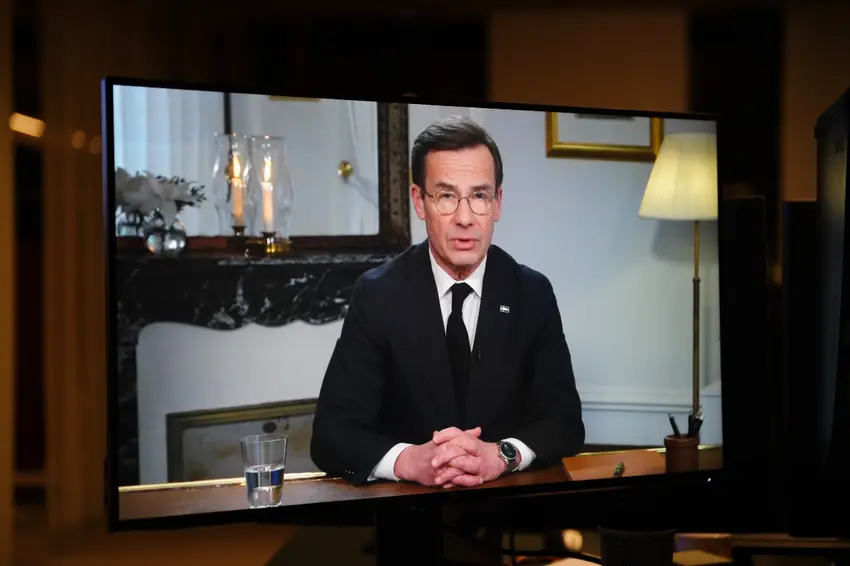
When Ulf Kristersson, towards the end of his first year as prime minister, stood grave-faced before a Swedish flag and delivered his first speech to the nation, he was panned.
Delivered after three people died in gang attacks, he sought to score political points, accusing the governments that came before him of "political naivity and cluelessness", and claiming, arguably misleadingly, that he had been among those who saw the problem coming. "This was a speech for the 'paradigm shift', not for uniting the nation," concluded DN's political commentator Tomas Ramberg.
There was also a sense that the situation did not warrant it, that he was using too lightly a tool Swedish prime ministers have in the past only drawn out in events of the utmost national significance: the anti-immigrant shootings carried out by the "Laser Man", the assassination of Foreign Minister Anna Lindh, the Covid pandemic, Russia's invasion of Ukraine.
The attack at Campus Risbergska in Örebro, though, the worst mass shooting in Swedish history, certainly meets the bar.
Kristersson, more even than in his speech to the nation to mark Sweden's accession to Nato, rose to the challenge, hammering home his message of unity by using the word "we" no fewer than 27 times.
"You are not alone," he said to those who had lost loved ones. "We are standing here next to you. The whole of Sweden is bearing the sorrow together with you."
He then struck a message of unity.
"Because when it really counts, there's only ONE Sweden: No us and them. No young and old. No born here or born overseas. No country or town. No right or left," he said.
As The Local's editor, Emma Löfgren, argued in an opinion piece on Monday, this may have "left a bad taste in the mouth" for some, given that just over a week earlier Kristersson had been blaming Sweden's gang crime problems on immigrants.
It also may have struck a wrong chord because it's quite likely that for the killer Rickard Andersson, there was a difference. At least eight of the victims had foreign backgrounds.
So while Kristersson's speech has been praised this week for being samlande ("bringing people together"), arguably the more statesmanlike thing to do would have been to drop the talk of unity, of how all Swedes are in this together, and acknowledge that in this case they are not. That this was a massacre of immigrants, an attack on a minority.
"Let us not speculate," Kristersson said last week when it came to the question of motive.
In his speech to the nation on Sunday, he at least belatedly said that people with immigrant backgrounds felt a "special sense of vulnerability". But even then, he still did not spell out the reason why.
Maybe he senses that this is the aspect of this brutal school attack where he and his government are most at risk of criticism.
So far, the aftermath of the atrocity has been marked by borgfred (literally "castle peace", when political parties cease attacking one another during a national crisis). Kristersson on Monday invited all the other party leaders to a ministerial meeting in the Rosenbad Palace, where they all held a minute's silence.
Once the truce ends, the government is open to criticism.
If it turns out that Andersson was motivated by a hatred of immigrants – or even if no more convincing motive is uncovered – it is only a matter of time before someone in the opposition lays part of the blame on the polarising, anti-immigrant rhetoric of the government.
This may be tricky for the Social Democrats, who are currently seeking to neutralise the government parties' anti-immigration policies with their own harder line approach. Their party leader Magdalena Andersson has so far been talking more of stricter gun control laws. But it would be an open goal for the other three opposition parties. It isn't even the only possible line of attack.
The Social Democrats can claim to have launched an inquiry when they were in government on how to prevent exactly this type of school attack, the conclusions of which the government then failed to enact.
Kristersson said at the first press conference after the attack that "this is not the place for politics in any way whatsoever". It will be to his advantage if it stays that way.
Politics in Sweden is The Local's weekly analysis, guide or look ahead to what's coming up in Swedish politics. Update your newsletter settings to receive it directly to your inbox.
Comments