
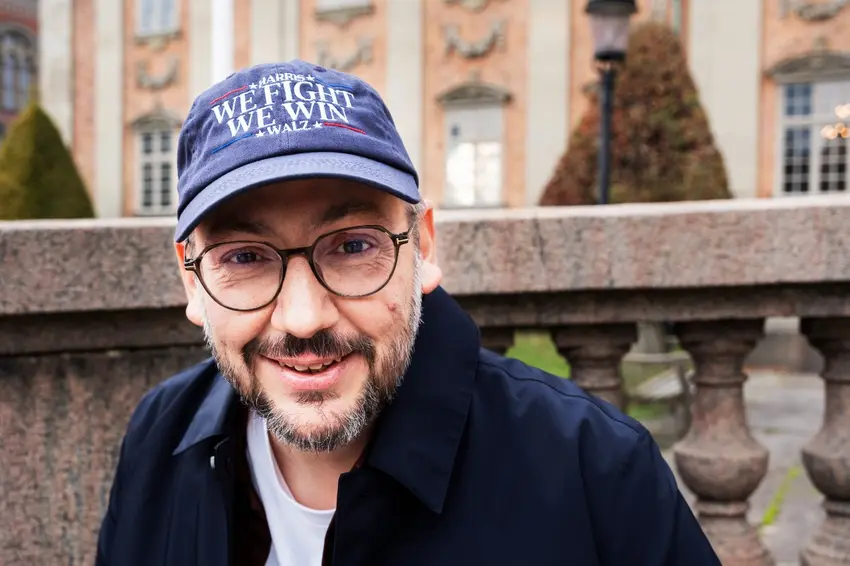
From the very start Muharrem Demirok, the genial but low-profile former city councillor from Linköping, was an odd choice to lead the Centre Party. He represented neither the party's urban liberal wing, with its combination of right-wing economic and socially liberal ideas, nor the rural voters left over from its origins as Sweden's farmers' party.
He was the child of a Swedish mother and a Turkish father who grew up in the Stockholm suburb of Valby, but he was a pragmatist compared to the rest of the party's ideological Stockholm faction.
So it may have been harder for him than for another leader to steer the party out of its tricky political corner. But it would have been tough for anyone.
This is a party whose members largely view themselves as centre-right, at home in an alliance with the Moderates, but whose voters see themselves not, perhaps, as natural allies of the Social Democrats, but at least as implacably opposed to the far-right Sweden Democrats.
Whether another candidate would have succeeded in solving this puzzle, we will never know. But Demirok clearly did not, leading to his resignation.
According to the Expressen newspaper, the decision came after Demirok received calls to stand down from several of the party's most powerful districts, including Skåne, Jämtland and Halland, and then failed to rally party colleagues to support him.
His critics within the party claim that the issue has always been his leadership, rather than his apparent wish to ally the party to Sweden's left-wing opposition and that their opposition had nothing to do with a desire to take the party back into a historic alliance with the centre-right parties.
"Leading centre party figures...point to Demirok's weak leadership and that he never managed to grow into the role," the Dagens Nyheter newspaper's political reporter Annie Reuterskiöld, wrote. But the party's problems, she argued, run much deeper that. Leading it was, she argued, a "kamikaze mission".
"That the Centre Party's voters want one thing and large parts of the party leadership want another, is a much more uncomfortable conclusion to come to, and one that it will be the next party leader's big task to solve."
The question, if the next leader were to follow the Liberal Party and drop its opposition to working with the far-right Sweden Democrats, is what this would mean for each bloc's chances of forming a government after the 2026 election.
In the latest poll, published by public broadcaster SVT, the opposition parties (Social Democrats, Green Party, Centre Party and Left Party) together had a 5.1 percentage point lead on the so-called Tidö Parties (the Moderates, Christian Democrats, Liberals and Sweden Democrats).
The Centre Party has the support of 4.6 percent of voters. So if you assume that all the Centre Party's voters remain loyal despite a decision to ally with the Sweden Democrats, then switching sides would put the government-supporting parties more than four points ahead.
That's a very big "if", though.
Opposition to the Sweden Democrats was arguably the main reason to vote for the Centre party in the 2022 election. The risk for any new leader announcing an intention to switch sides is that many of the party's current voters would instead vote Social Democrat, or even for the Green Party.
Moreover, crossing the bloc divide would put Centre in direct competition with the Liberal party for the same centrist voters. In the 2022 election, the Liberal Party was already reliant on tactical votes from Moderate Party supporters to nudge it over the 4 percent threshold to enter the parliament. If Centre switched sides, it's far from certain that both parties would clear it in 2026.
While Social Democrats to the right of the party, such as its leader Magdalena Andersson and its finance spokesperson Mikael Damberg, might prefer to keep the Centre Party as an ally, those on the left would shed few tears if it changed sides. The Centre Party has historically refused even negotiate with the Left Party, let alone join it in a government coalition. Once it is out of the way, the path would be clear to a three-party coalition which could enact long-blocked reforms.
The right-wing parties would use the spectre of an unconstrained left to scare current Centre Party voters into following their party over the divide, but they might have a hard job painting Andersson and Damberg as far-left radicals.
So even if Demirok does end up being succeeded by a new leader more open to cooperating with the Sweden Democrats and joining the current government in a second term, as seems likely, this new leader might not find it any easier, either to keep the party united or to improve its poor performance in the polls.
Rather than bringing the clarity on the government issue that Demirok has been accused of lacking, his successor is likely to be vaguer still, perhaps opening up to supporting a government reliant on Sweden Democrat backing, but postponing any decision on which bloc to join until after the election.
So will the next leader of the Centre Party be in a position to choose Sweden's next prime minister? It's not so simple.
Could the Social Democrats change their name?
Two veteran Social Democrat politicians on Sunday raised eyebrows with their proposal, in an opinion piece in the Aftonbladet tabloid, that the party change its name. They weren't talking about going in for a total rebrand and ditching the name "Social Democrats". This was about adjusting the party's official name, Sveriges socialdemokratiska arbetareparti, or "The Swedish Social Democratic Workers Party".
They proposed calling it instead Löntagarpartiet Socialdemokraterna, arguing this would expand its potential supporter base beyond blue collar workers to all löntagare, a word that includes anyone who receives a lön, or "salary".
"If we continue to label ourselves as only a workers party, we are giving 2.1 million white-collar workers a reason to ask, 'why should I vote for a party which isn't trying to represent me?'," Björn von Sydow, a former trade minister and parliamentary speaker, and David Lundqvist, a former chair of the Social Democrats in Sigtuna, wrote.
Migration Minister speaks up for multicultural Sweden
Sweden's Migration Minister Johan Forssell told SVT on Thursday that he believed that immigration had enriched Sweden, expanding on comments he had made in an interview with Aftonbladet.
“In many ways there are a lot of things about it which enrich our country,” he said. “The fact that we’re not all the same, that we have different cultures, different religions even. The fact that we celebrate different holidays.”
“That doesn’t need to be an issue, as long as we can manage to unite together around some very important values. That’s what has not worked in recent years.”
Jimmie Åkesson, leader of the far-right Sweden Democrats, criticised Forssell for insisting that Sweden would remain a multicultural society, calling it a "capitulation".
“Sweden should not be multicultural,” he said. “Sweden should be Sweden. The people who have chosen to settle here should adapt to Swedish norms and values, and should strive to be part of the nation.”
Politics in Sweden is The Local's weekly analysis, guide or look ahead to what's coming up in Swedish politics. Update your newsletter settings to receive it directly to your inbox.
Comments