
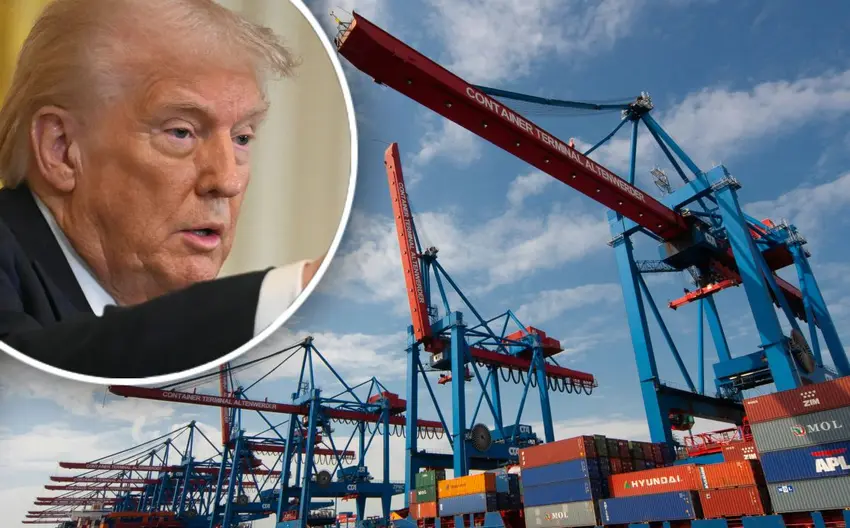
On January 20th, the new US administration announced that it would begin a review of US trade policy and look into the need to introduce tariffs against any country that is perceived to be disadvantageous and taxing US imports.
Speaking at his first cabinet meeting, US President Donald Trump announced a plan to hit the European Union with 25 percent tariffs.
"We have made a decision and we'll be announcing it very soon. It'll be 25 percent," he said.
At present, there is no formal decision on the aforementioned tariff, but the announcement is expected to be made on April 1st.
The European Union (EU) vowed to respond "firmly and immediately" to what it considers "unjustified" trade barriers and, earlier in February, a European Commission spokesperson emphasised that the EU "will always protect European businesses, workers and consumers from unjustified tariffs."
READ MORE: Europeans hit back after Donald Trump says EU was born to 'screw' US
Minister Dousa: 'Everyone loses from tariffs'
The Swedish government has expressed its concerns over the proposed tariffs on multiple occasions.
Benjamin Dousa, Sweden's Minister of International Development Cooperation and Foreign Trade, told The Local Sweden that tariff wars have no winners.
"The introduction of tariffs is worrying. We obviously do not think this is a good thing. As the government has repeatedly pointed out, everyone loses from tariffs as they create unnecessary economic disruption and are very costly. Let me underline the importance of continuing the work for free trade," he said.
Dousa also reaffirmed Sweden's commitment to working within the EU framework to formulate a measured response.
"The EU will respond in an appropriate manner. It is important for Sweden that any countermeasures that are jointly decided in the EU are proportionate and well-balanced and that we naturally safeguard our Swedish interests in these discussions.
"From the government's side, we have a continuous dialogue with the EU Commission, Swedish business and other member states," Dousa told The Local.
READ ALSO: EU vows firm retaliation if Trump unleashes tariffs
Both Sweden and US economies could feel tariff-related pain
While Sweden is unlikely to emerge unscathed from a tariff war, the US tariffs would primarily impact American businesses and consumers, Per Altenberg, a trade strategist at the Swedish National Board of Trade (Kommerskollegium), told The Local.
"Tariffs always hurt the economy imposing them the most, in this case, the US, but it would probably also have a negative effect on Sweden's economy. Our previous simulations (of a general 20 percent US tariff to all countries plus a 60 percent tariff on China) indicate a very small negative effect on GDP for Sweden (only minus 0.02 percent of real GDP).
"But that simulation does not take into account EU countermeasures or so-called dynamic effects on productivity and investment. If we take those factors into account, the negative effects would be larger for the Swedish economy, and for individual firms, the effects can be negative even without any additional assumptions beyond those we made in our simulation," Altenberg said.
Several Swedish sectors vulnerable
Certain Swedish industries stand to be more affected than others.
"The largest Swedish export product categories to the USA are the automotive and pharmaceutical sectors," Altenberg explained.
"In addition, timber and paper are also relatively strongly exposed to the US market."
If these sectors face increased costs due to tariffs, Swedish manufacturers and exporters could struggle to remain competitive in the American market.
How consumers might be affected
For Swedish consumers, the direct effects of US tariffs may be minimal, but EU countermeasures could influence both prices and availability of goods.
"Indirectly, Swedish consumers could be affected if EU firms seek to expand market shares in Europe for products that have become unprofitable to sell in the US market," Altenberg said.
"The prices on those products would likely fall, at least in the short run. On the other hand, US production would increasingly have to serve US domestic demand as a result of tariffs, so US exports would likely fall, too – as our simulation shows.
"That would then reduce availability and put upward pressure on the price of some goods previously exported from the US to Sweden."
Not so reciprocal
Kommerskollegium's trade strategist also pointed out a notable shift in US policy.
"As an overall comment, I might add that a 25 percent across-the-board tariff would be far from the previously reported 'reciprocal tariff' proposal.
"Since EU tariffs are low (2-3 percent on average, depending on how you count), reciprocal US tariffs would have been much lower than 25 percent.
"So the new pledge is very different from what was reported last week, both in terms of structure and level of the US proposed measures," Altenberg said.
Comments