
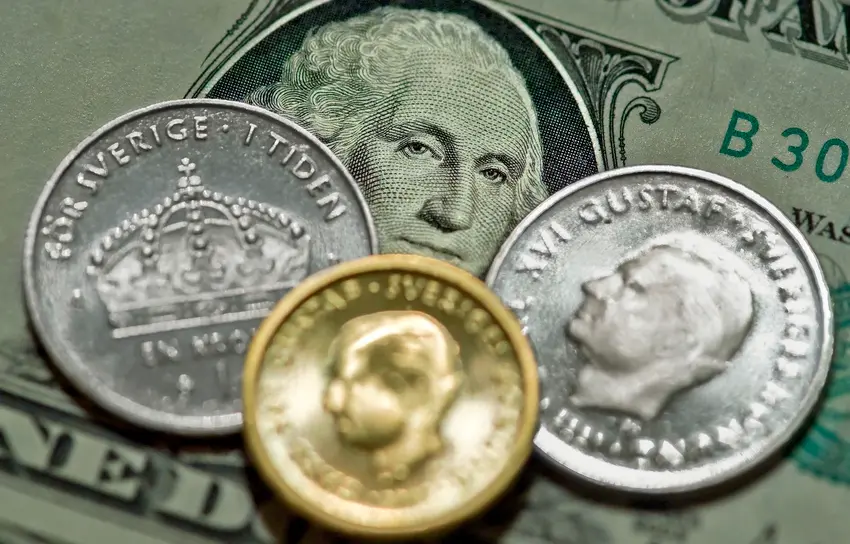
How high is the krona right now?
This year, the krona has risen almost 20 percent against the dollar, making it the best-performing currency among the G10 countries.
G10 stands for Group of Ten, despite being a group of eleven countries. It is made up of Sweden, Belgium, Canada, France, Germany, Italy, Japan, Netherlands, Switzerland, the United Kingdom, and the United States, with all countries collaborating on financial matters of global importance.
Why has the krona increased in value?
It's hard to say. It could be because inflation has dropped faster in Sweden than in other countries, meaning that the Riksbank central bank has been able to cut the interest rate faster.
Another factor could be that Sweden has good public finances, which means that it has more leverage when financing future investments, for example in defence.
What could this mean for foreigners in Sweden?
It depends on their individual financial situation, the currency they earn their salary in or hold assets in, and which currency they have the highest outgoings in.
For people who live in Sweden and who are paid in kronor, the past few years have been painful when travelling abroad or sending money back home, as their Swedish money hasn't gone as far as it may have in the past.
The good news is that a stronger krona means that we can expect this situation to change. You'll be able to buy more for your krona when shopping in another currency, whether you're on holiday, sending money to family back home or buying goods from other countries.
On the other hand, if you have savings abroad in dollars or euros, then they are likely to be worth less if you convert them into kronor now than if you'd done so when the krona was weaker.
What can foreigners living in Sweden do if the strong krona is bad news for them?
Think about the currency you're paid in
It may seem like a good idea to be paid in Swedish krona if the krona is strengthening against the dollar and euro, and that may be the case in the short term, but in the long term the best way to protect against currency exchange shocks is to make sure that you're paid in the same currency that you spend in.
This means that if most of your expenses are in dollars, you should try and make sure you're paid in dollars, for example.
If most of your expenses are in Swedish kronor, you should make sure you're paid in Swedish kronor, so your euro or dollar paycheck doesn't suddenly shrink as the value of the krona rises.
Reconsider work abroad
If you've been working as a freelancer abroad or part-time for a foreign company who pays you in dollars or euros, your income may have already started to shrink.
It might be worth trying to find more work in Sweden, increasing your fee for work abroad, or, if you can't get work in Sweden, looking for work in other countries where the exchange rate against the krona is still beneficial for you.
Time major spending for the best point in the market
If you have savings in dollars or euros and are considering, for instance, buying a holiday house in Sweden, it is probably worth waiting until the dollar or euro has strengthened so you don't end up paying more just because of the exchange rate.
Similarly, if you have savings in kronor and have been planning on buying a property outside of Sweden, now might be a good time to consider doing so.
Get a multiple currency account
It can be helpful to have an account in multiple currencies, such as those provided by banks such as Wise and Revolut. Keeping any cash in a combination of dollars, euros and kronor can reduce your exposure to any single currency.
The advantage for foreigners living in Sweden is that you can set up accounts in multiple currencies, such as US dollars, euros and British pounds, each with their own local bank number, which you can use to receive and make payments domestically in each country.
As the krona strengthens against the euro and the dollar, it may be a good idea to convert some of your kronor to these currencies, so you can get more for your money.
Comments