
The sheer cost of the scheme for financing new nuclear proposed last autumn by Mats Dillén, the economist appointed to lead the inquiry, certainly came as a shock.
Dillén suggested that the government would need to borrow a colossal 450 billion kronor at peak if it wanted to build four new nuclear plants, with this money then lent on to the private consortia building the projects. The new plants would also be compensated if the electricity price fell below 80 öre a kWh, tying in very substantial subsidies for as long as 40 years.
The sheer scale of the burden on the state, the lack of analysis of alternative systems, and the risk of skewing the market and deterring investment in other types of power generation, were all also condemned in the responses to the consultation, with much of the criticism coming from the government's own agencies.
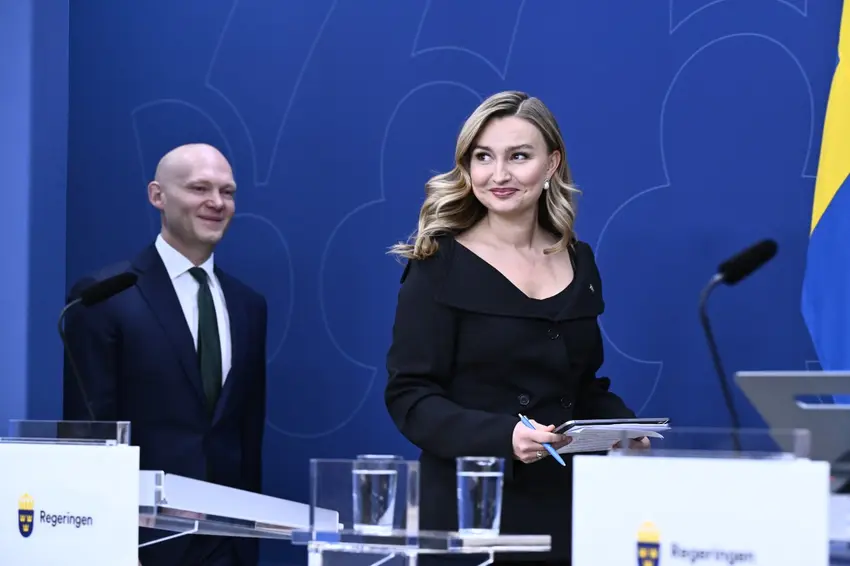
When Ebba Busch, Sweden's energy minister, and Niklas Wykman, Sweden's financial markets minister, announced the final funding proposal in a press conference on March 27th, they dismissed many of the criticisms from the consultation as "ideological".
"The people who have been critical of this are those who have always been critical of nuclear power," Wykman said of the criticism of the fact that the system might distort the market. "I think it's sad that the energy debate is so ideologically loaded and that people who have been against nuclear power for decades just grasp at any argument they can find."
They also identified a new way of sidestepping the uncomfortably large sums involved: refusing to mention them in the press conference altogether.
They gave no figure on the size of the loans that would be given to private consortia that come forward to build new nuclear power projects, and also avoided any mention of what guaranteed power price they would be offered, below which they would receive compensation.
The proposal "did not include the price cap we have spoken about or how big the projects need to be", Wykman said, because this would depend on future negotiations with the companies.
The full extent of the initial subsidy would not be known until the European Commission has accepted whatever preliminary agreement Sweden's government reaches with a project consortium, potentially after first asking for changes.
When it came to the other chief criticism of the government's nuclear plans: that it had been unrealistic to promise that construction on a new plant would begin before the 2026 election, Busch simply denied outright that she had promised any such "spade in the ground".
"I have never made any such election promise," she declared, challenging the questioner to find a quote. "We have said that we will pave the way for new nuclear power in Sweden and that during this term we will do everything we can from a political perspective. There will be a lot of 'spades in the ground' during this period."
While Busch may not have made such a promise, others from the government certainly have.
Finance Minister Elisabeth Svantesson in 2023 promised "a spade in the ground" on a new nuclear plant by the time of the 2026 election, Environment Minister Romina Pourmokhtari, said in a press conference in August 2023 that "there will be a spade in the ground before the election". Prime Minister Ulf Kristersson made the same promise a year later.
When Busch was pressed on how different the current reality seemed to be from the quick, simple roll-out of new nuclear power voters had been promised in the election campaign, she became combative. "I note that quotes are being attributed to me in an incorrect way, and I don't think that's fair," she said.
The one way in which the government did appear to have taken on board the criticism was in limiting the support system to 5,000 GW worth of capacity, or about four nuclear power plants, which Wykman argued would, as well as limiting the state's liability, limit any distortion to the power market or disincentive to build wind power.
"If it had been unlimited support for any amount of nuclear power at all, it would have been easier to understand the arguments on suppression effects," he said. "This is an important part, but a limited, or I should say, very limited, part of total Swedish energy construction."
If the decision not to give figures on the size of the loan or the price to be guaranteed was strategic it worked. The coverage in Sweden's media was surprisingly muted given the scale and duration of the likely impact on Sweden's government finances.
The opposition was predictably critical, but their criticism barely made the headlines.
"We would be buying a pig in a poke [grisen i säcken in Swedish] if we backed this proposition," Fredrik Olovsson, the Social Democrats' energy spokesperson, said. "An enormous amount remains unclear: they're not saying how much it's going to cost or who's paying, or for that matter when the ground will be broken or when this will all be in place."
Daniel Helldén said that the government had done none of the cost-benefit analysis you would normally do when preparing such a huge investment. "It's going to significantly delay the green transition. The fossil-free alternatives which we know exist and that government agencies say are possible are being pushed out and are not happening."
Richard Nordin from the Centre Party said it would be "extremely hard" to back a proposition which looked at only one technology, ignored alternatives, and would "leave enormous costs for generations to come".
It's not certain that their opposition will make any difference.
The parties backing the government have a majority in the parliament, meaning the proposal will pass parliament anyway.
The state-owned power company Vattenfall and the Finnish government-owned power company Fortum, meanwhile, both welcomed the funding proposal (which perhaps suggests it's too generous), with Vattenfall saying it intended to submit a project and funding proposal in the autumn, and Fortum saying it hoped to do so in 2026.
The question is whether they will be willing to start building if a future Social Democrat-led government might stop the project should they win power in 2026.
What else has been happening in Swedish politics?
Liberal carnage
It's been a week of carnage at the Liberal Party, with resignations, calls for resignations, and general recrimination.
One of the party's five ministers, Paulina Brandberg, on Monday said she was resigning "to spend more time with her family". Her announcement was followed only hours later by the announcement that Jakob Olofsgård and Oscar Wåglund Söderström, the party secretary and chief official of the party, were both also standing down.
The resignations came only days after Carl B Hamilton, the Liberal Party grandee and former MP, mercilessly laid into the party's leader Johan Pehrson, calling for him to resign, and make way for a successor in an intemperate post on Facebook (now deleted).
He was even more brutal in his attack on Environment Minister Romina Pourmokhtari, criticising her response to criticism from the Swedish Climate Policy Council.
"It is extra distressing that it is a liberal turncoat who is shamelessly spouting platitudes about a fake policy," he said. "History will judge her, among others, of course."
Moderates and business leaders school Left Party
An unlikely collection of lecturers, including Jacob Wallenberg, the scion of Sweden's most powerful business family, and the former Moderate Party finance minister Anders Borg, came to one of the largest rooms in the Swedish parliament on Monday to educate Left Party MPs and regional politicians ahead of them potentially joining a future government.
"We don't always think the same way," Nooshi Dadgostar said of Wallenberg's involvement. "But if you're sitting in the government, you need to be able to talk to everyone and listen to people who are important to Sweden and have a lot of power."
Moderate youth wing calls for higher pensions age to fund defence
Douglas Thor, chairman of the Moderate party's youth wing, Muf, has called for the pensions age for some pensions to be raised from 63 to 67, with the savings used to fund defence investment.
Politics in Sweden is The Local's weekly analysis, guide or look ahead to what's coming up in Swedish politics. Update your newsletter settings to receive it directly to your inbox.
Comments (3)