
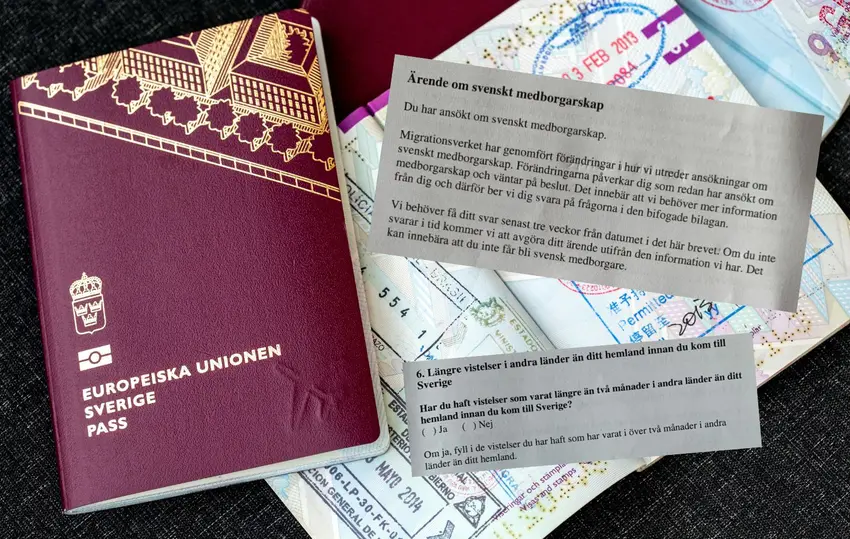
The Migration Agency currently has over 86,000 applications for citizenship in its queue, with the agency sending out requests to submit additional information to certain applicants from April this year.
This is in the form of an 11-page questionnaire, seen by The Local, which gives applicants three weeks from the date the questionnaire was posted to return it. If they miss the deadline, the letter reads, then the Migration Agency will make a decision anyway, warning that this could mean their application is rejected.
What information does the questionnaire ask for?
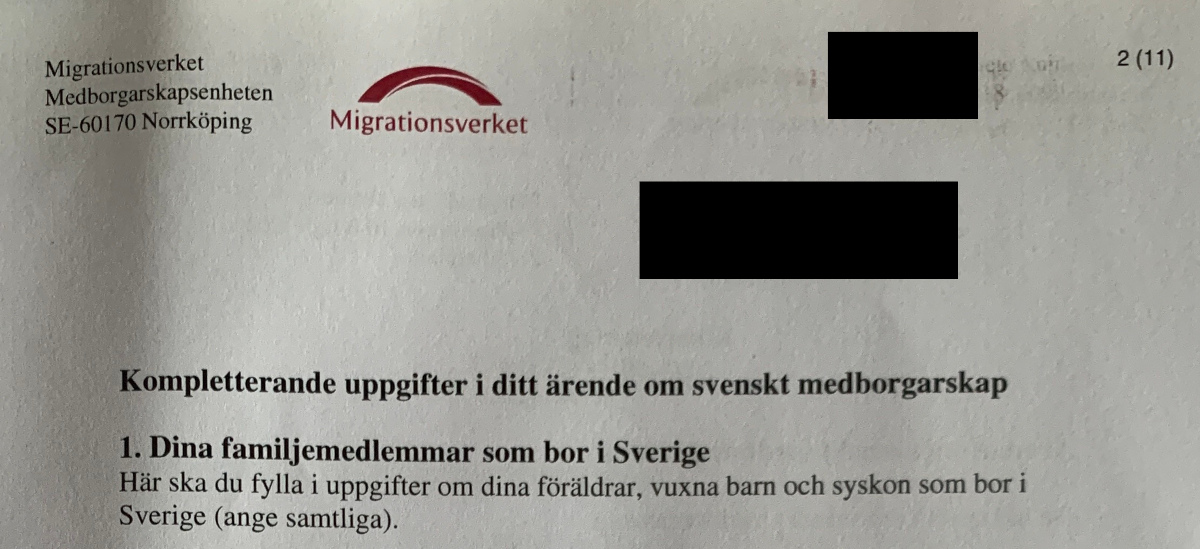
There are seven sections to the questionnaire, titled Kompletterande uppgifter i ditt ärende om svenskt medborgarskap, or Supplementary information to your application for Swedish citizenship, covering different topics, with the last section, number 7, asking for the applicant for their signature and the date they filled the form out.
Let’s look at the individual sections.
Family members living in Sweden
The first is about your family members living in Sweden, where you’re asked to fill in information on any parents, adult children or siblings who live in Sweden. This includes their names, date of birth and citizenship.
If you don’t have any adult family members living in Sweden, you can leave this blank or write that it doesn’t apply to you.
Identity
In the second section, you’re asked questions about your identity – this section, the questionnaire says, is for anyone who applied for citizenship prior to October 1st, 2024.
This includes whether you’ve ever provided Swedish authorities with another birth date, name or citizenship than those included in your application.
If you have, you’ll need to tell them what piece of information was different, what it should be changed to and why. This could, for example, include changing your name since you applied for citizenship, for example if you got married, or if you for some reason have lost or gained another nationality.
You’ll also have to answer questions about your passport and/or national identity card. How did you apply for it – was it in person? Which authority did you apply to?
You’ll also need to tell them how you received your passport or card, for example whether you picked it up in person and if so, which agency you collected it from.
If you did not collect it in person – for example, if it was sent to you via post – you’ll have to explain this too.
The agency also asks for details here on whether you left Sweden to apply for or collect your identity document, including the date you left and returned to Sweden, which country you travelled to and how you travelled (for example by plane, bus, car, etc.).
Character
The third section is titled skötsamhet, a Swedish word referring roughly to your diligence or good character.
This section has a number of questions about your behaviour, both in Sweden and before you came to the country. They are in a yes or no format, with space underneath to provide more information if you answer yes to any of the questions.
Here are the questions:
- Have you committed a crime in your home country, Sweden or any other country?
- Have you been sentenced to a crime in your home country, Sweden or any other country?
- Are you suspected of a crime in your home country, Sweden or any other country?
- Has any country issued an order to have you extradited?
- Have you ever been deported or expelled from any country?
- Have you ever been part of a group or organisation which has committed systematic, widespread and serious abuses of other people?
If you answer yes to any of those questions, you will have to provide information such as any countries which are involved, details of any crimes and when the crime, deportation or expulsion occurred.
Travel outside Sweden
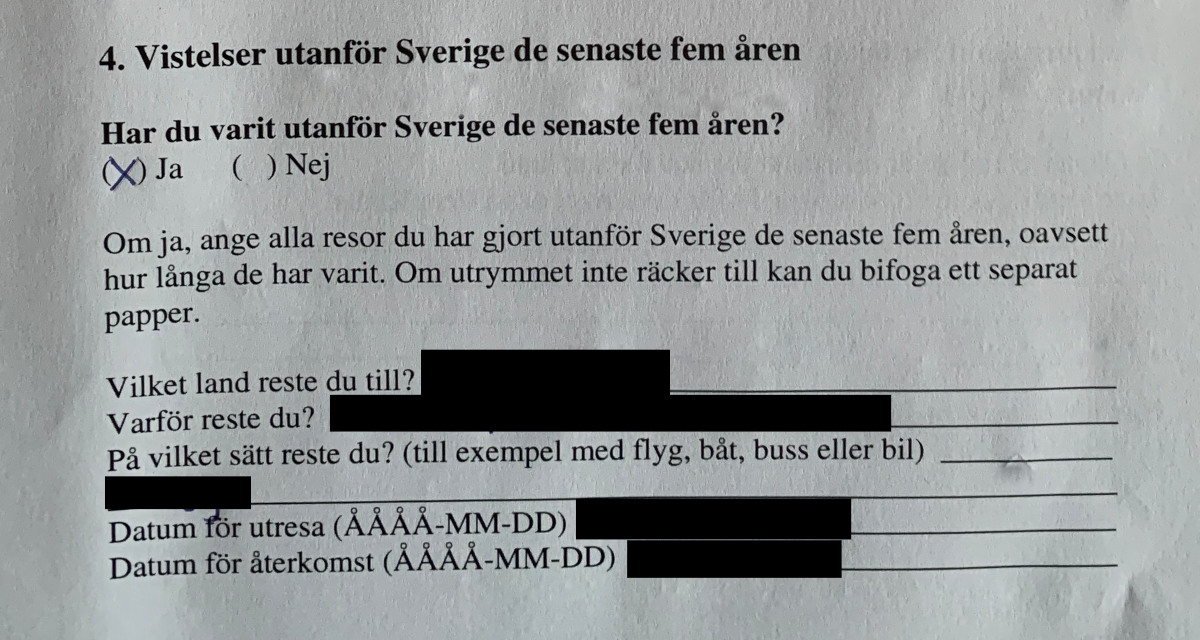
Perhaps the most time-consuming section for most applicants, the fourth section asks for information on every trip outside Sweden in the past five years “no matter how long it is”. There is space for five trips, with the agency writing that you can add details of any more trips on an extra piece of paper.
For each trip, you need to write which country you travelled to, why you travelled – it’s not clear here exactly how detailed you need to be, but you could write for example "work", "leisure", or "renew passport" – which mode of transport you used and the date of departure and return.
A Migration Agency spokesperson told The Local that it’s “important that you fill out the forms as correctly as possible. If there are questions or things that aren’t clear, the Migration Agency can ask for additional information or need to further investigate the case”.
When this writer, who happens to be one of the 6,500 Swedish citizenship applicants who has been asked to submit this additional information, called the Migration Agency’s helpline to ask if I had to include details on every short day trip I’ve made from Malmö to Copenhagen in the past half decade, I was told it would be OK to include a vague statement such as “travelled to Copenhagen roughly once a month in this period for work” and then the agency could ask for more information if necessary.
If you are unsure of what exactly to include, you can call the Migration Agency’s contact centre for advice.
What did you do before you came to Sweden?
Another time-consuming section for many applications is section five, which asks for information on your studies or employment prior to coming to Sweden. This covers your entire life before coming to Sweden, not just the past five years.
Under the "studies" section, there is space for three different entries, each asking for the name of the university you attended, the country it is situated in, what you studied and at what level, and the dates you attended.
The "work" section starts with a "yes/no" question on whether you worked before you came to Sweden.
The next question asks if you have worked in the police, as a security guard or other guard or as a member of the armed forces before coming to Sweden. If yes, you’ll have to provide information on your employer or which part of the armed forces you worked for, the level you reached and the dates you worked there.
You’ll then be asked to give information on whether you’ve worked in the civil service or the government, including whether any of these roles included work in intelligence or security agencies.
Finally, you’ll have to provide information on any other work you did prior to moving to Sweden, whether as an employee or in your own company. You’ll need to list everything here, so if you had an established career before moving to Sweden you may need extra paper – there’s only space for three different jobs.
Next, you’ll need to say whether you have carried out military service or another form of conscription before moving to Sweden, as well as provide details. You’ll also have to tell them if any of this work was within intelligence or security agencies, with details of country, rank and dates.
Longer trips outside of your home country since coming to Sweden
The final section covers trips of more than two months outside your home country before you came to Sweden – again, this is throughout your entire life, not just the past five years.
It’s not clear exactly how "home country" is defined – for example, what counts as abroad if you have dual citizenship and have spent time in each country – but there are options for four different trips.
For each of these you’ll need to say where you went, what you were doing there (e.g. work, studies or tourism) and when you travelled and returned home.
Date and signature
Finally, you’ll need to write your location (city is fine, it doesn’t have to be an address), the date, your signature and print your name, then send the form off to the address listed.
Don’t forget to include any extra pages – it can be a good idea to write your beteckning number on these (in the top right hand corner of the form) and your name so they can be reunited with the rest of the form if they get lost.
If you want to be able to track the letter and make sure it arrives safely you can send it as a rekommenderat brev (registered post) although this isn’t a requirement.
If you’ve also been asked to send any documents, like your passport or residence permit card, don’t forget to include them.
Comments (13)