
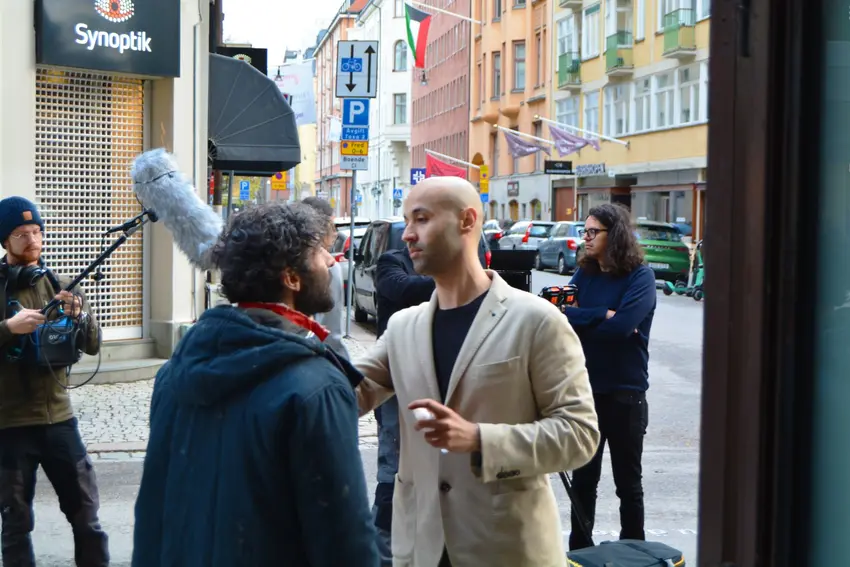
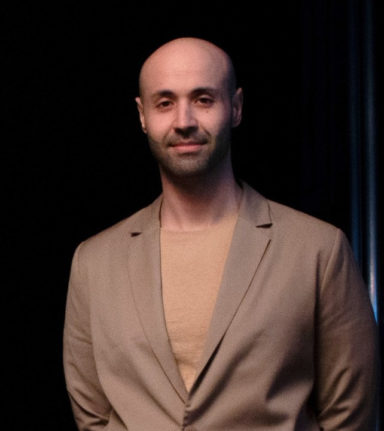
Walli grew up in Damascus, where he was nearing the end of a degree in journalism when war broke out in 2011.
"I had two courses left, and then I had to leave for Egypt, not knowing what to do," he tells The Local. "It was very spontaneous, I just wanted to run away."
He applied for scholarships in a number of different countries, eventually receiving a few offers, including one in Uppsala.
"I took that because it was in media and communication, so for me it was a relevant kind of education that would make it faster for me to get my bachelor's degree and just keep going. But my aim was always to try and study filmmaking, try to make a career in that. And I went back to that later in life after moving to Sweden as an exchange student and working as a journalist for a short while."
"For me, coming to Sweden was a new start. I had to succeed in what I'm doing so I can build a life, also running away from the trauma of war in Syria."
Walli was originally granted a temporary residence permit for a year as a result of his scholarship, but this quickly became permanent once the Swedish government granted all Syrians in the country permanent residence permits due to the war just a few months after he arrived.
'It takes time to understand Swedish culture and become part of it'
Sweden was "like a paradise" when he arrived, he says, although the reality of adapting to a new country and a new culture quickly set in.
"I loved how beautiful it was. It was summer, in August, and everything was glittering, and it was sunny at the time in Uppsala. Uppsala is quite international, because they have exchange students from many different parts of the world, so it really felt amazing. I loved Sweden."
"I also thought Sweden was very liberal, progressive and opening... very welcoming in a way."
Reality was different, he says, but not necessarily in a bad way.
"There is a strong Swedish culture, and it's very embedded in the country's history, and in the language also, but it takes time to understand it and actually become part of it," he says, adding that he still feels he has more to learn about Sweden after over a decade here.
"I don't think it's possible to understand any culture fully, but I live the Swedish lifestyle, whether I like it or not. And I actually do like it," he says.
"There are great values in Sweden, although they may not be practised all the time by everyone. People to some point can tolerate each other. Despite all that's happening around us, it's still a nice place to live. In Sweden you can also communicate with others who are very radical and have very radical views compared to you."
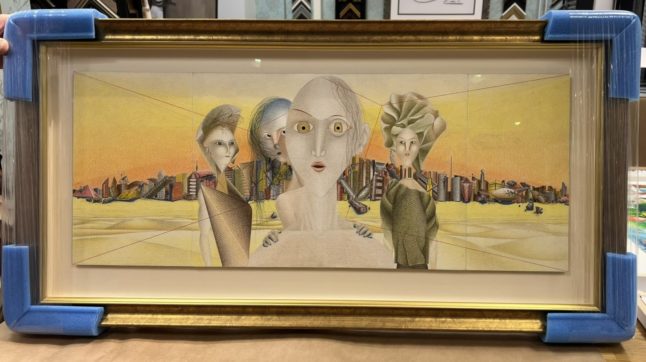
He also appreciates Sweden's freedom of expression, which means it's possible to make artwork that challenges or can stir a debate.
'There are institutions, and a structure, and context for almost everything'
The main downside of living in Sweden for Walli is the loneliness, partly due to the fact that he's spent much of his life in Sweden living alone.
"Because everything is structured and everything follows a schedule, it also becomes harder to try and be spontaneous with people. And that makes loneliness feel even harsher."
He believes the best way to combat this is by working.
"Swedish society is built differently than other countries. There are institutions, and a structure, and context for almost everything. So you need to try to be part of the context, or try to create that context to make life less lonely."
"If you don't have a job, reality hits – for some immigrants and maybe also for Swedes – there is less context, so you are alone and trying to look for work. And when there is no work, you are lonely for longer. So it becomes a kind of vicious cycle that just runs and runs."
'I felt like I was talking to myself'
As a journalist, he documented the stories of those fleeing persecution as part of a project for The Local where he interviewed asylum seekers in Arabic about their new lives in Sweden and how they were adapting.
"In a way, it felt like I was talking to myself, because I also came as an immigrant."
He felt like his own story was "not that interesting", but appreciated the opportunity to highlight stories of other Syrians arriving in Sweden.
"We met a lot of people who had some really challenging journeys, so it was beautiful, but also it hurt to listen to some of these stories, some people who lost their loved ones and who took boats on the Mediterranean sea, and things like that."
Despite the tragic stories, he says that the ones he remembers the most a decade later are the funny ones, like a Syrian teenager in Germany who decided to make porn movies, or a man who found it awkward to swim without wearing underpants.
"It was like a sign of integration that you actually need to take off your underpants! That was a good story. There were many of them," he says.
He describes his own transition from Syria to Sweden as "not necessarily smooth, but gradual", which he expects is due to the fact that he was in the country on a student permit at a Swedish university, making the bureaucracy side of things easier.
'I wanted to live in Sweden, I wanted to become Swedish'
Learning the language and building a life in Sweden was a bit more of a challenge, although it took a while for him to start as the international environment at the university meant that he could get by speaking English.
It was only after working at The Local he decided to take the plunge.
"I said to myself: now it has been two years and you can only say 'hej, hejsan, tack, hejdå'. That's shameful. You should start learning Swedish. Because in my mind, I wanted to live in Sweden, I wanted to become Swedish. So I took the decision: from now on, it needs to be Swedish."
He moved in with a friend, telling her to only speak Swedish with him, even if he sounded "stupid or childish".
"And from then on I actually started the journey of integrating."
'We don't need to be 100 percent like each other'
Walli is now a Swedish citizen, but believes that being a citizen on paper and in reality are two different things.
"I think for me, if I really want to be a Swedish citizen, I need to be treated as an equal, but I also need to be seen as a Swedish citizen. And for that to happen I need to speak the language, I need to be able to be part of this society, interact with it and try to influence it also. And believe that I really am a Swedish citizen."
This doesn't mean that immigrants have to completely adapt to fit in, he says.
"We don't need to be 100 percent like each other. I think we need to be different in some ways too, because there are some aspects of the Swedish culture that I don't like."
One example of this, he says, is the fact that Swedes can be reserved in communication, and it can be difficult for people from more social societies to make friends and fit in.
"But going back to language, when you speak the language and can communicate with people and get a job, then you can really build a relationship with Swedes and really become friends forever."
'The rhetoric is quite different than it was in 2013'
He feels that the attitude towards immigrants has changed in the years since he arrived.
"When I first arrived in 2013 it was great," he said. "But now the rhetoric is quite different. And it's sad, because so many people might not have the kind of experience I had, and might have a different view of Sweden or Swedish society, which is not really true. Because Swedes are really nice people. Not everyone obviously, we can't generalise."
Despite the change in rhetoric, he believes that Swedes, at their core, are still welcoming people.
"Sweden has for a long time been a humanitarian society, and there is still a lot of humanity in this society, despite everything. But societies are also affected by certain waves or situations that affect the public opinion."
"At the time of the crisis, there were so many people dying in the sea, drowning, and then there was that little kid who drowned and washed ashore on a beach in Turkey, Alan Kurdi, and people saw that and were shocked."
Later, he says, the tide began to turn, as challenges with integration started to surface.
"I think there was a true will among large parts of society to help and welcome immigrants, but then in reality, integrating immigrants has not been that smooth, and part of the problem is finding work in the job market, because the job market works differently here, and then you have these problems with what's happening in the world around us, so people get affected by that, and their views change."
The government recently announced that it would be raising the repatriation grant for refugees to 350,000 kronor, effectively paying them to return to the country they came from. Walli can see how this makes sense "in mathematical terms", but thinks on a personal level it may put people off trying to integrate into Swedish society.
"Maybe the way they think about it is that an immigrant who is unemployed and unemployable can go back to their homeland and start a new life again, and is maybe more profitable for the country in the long run rather than staying here and living on welfare," he says.
"But if you are someone who is really trying and wanting to become an active and positive part of the community, and then you feel that you're not wanted because they are giving you money just to get the hell out of here, that is very discouraging. And on a psychological level, I don't think it really helps with integration."
'You don't want me here? Yeah, sure, I don't care'
Personally, he doesn't feel that affected by the harsher rhetoric towards immigrants, particularly those, like him, from the Middle East.
"Of course I think about it, because I watch a lot of news every day, so when this rhetoric is repeated all the time I feel addressed by it. But I don't feel discouraged, because now I see myself as a Swedish citizen. You don't want me here? Yeah, sure, I don't care. That's what you think. But I think I want to be here, because I love this country and I am part of it now."
Among his Syrian friends, he doesn't know anyone who is considering taking the money to move back home.
"Some of them can't find jobs, and are trying to find jobs in different countries – Spain or Portugal – which is sad, because they are highly educated and actually have skills in areas where there is a labour shortage. Why not take advantage of that? So I do have a couple of friends who find that disappointing."
"Despite all that, I have never been in contact with a Syrian person who actually just said directly they would take this money and go back."
Walli left Sweden himself once, working abroad for "a short period of time", but ended up moving back again.
"I've been living here for almost 15 years, that's almost half my life. Sometimes I get bored of my life here as well, but then I go abroad, and I miss what I had in Sweden, and I think 'look how Swedish you've become'. So I'm here to stay."
Interview by Paul O'Mahony, article by Becky Waterton
Listen to the full interview with Jamil Walli in the May 7th episode of Sweden in Focus Extra, a podcast for The Local's Membership+ subscribers
Comments