
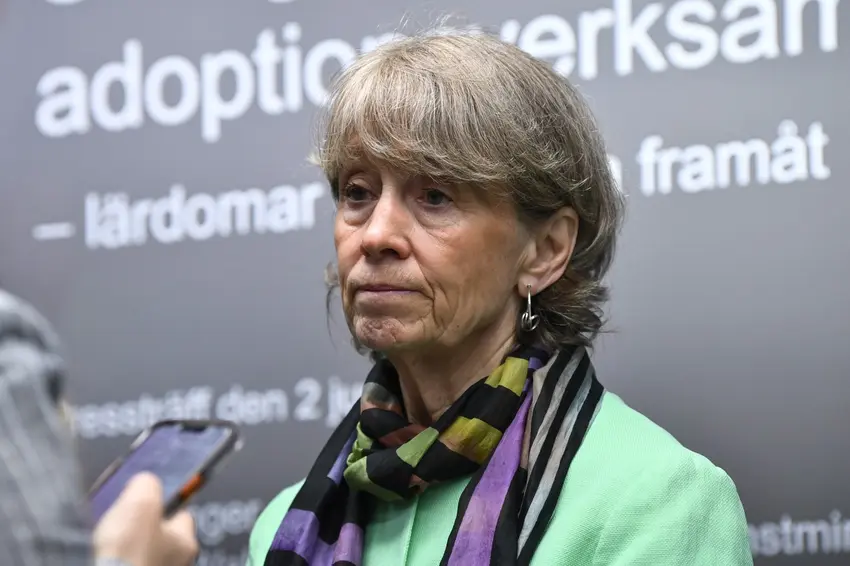
The inquiry head, civil law professor Anna Singer, told a press conference that there have been “irregularities” in international adoptions to Sweden.
“There are confirmed cases of child trafficking in every decade from the 1970s to the 2000s, for the most part in private and individual adoptions,” she said. “There are confirmed cases from Sri Lanka and Colombia in the 70s and 80s, Poland in the 90s and China in the 90s and 2000s.”
She added that children were “in a number of cases” adopted without voluntary and informed consent from their biological parents.
“Children have been declared dead, given up for adoption by someone other than their parents, and in some cases handed over by parents who have not understood the consequences of consenting to international adoption.”
Even in cases where the documentation has been correct, Singer said, an adoption to Sweden was not always necessarily the best solution for the child.
Singer called for Sweden to ratify the UN’s International Convention for the Protection of All Persons from Enforced Disappearance, which despite being signed by Sweden in 2007 is still being processed by Swedish government offices.
In addition to this, the inquiry called for Sweden to issue a public apology, admitting the human rights violations which occurred as a result of international adoptions as well as apologising for the consequences these have inflicted on adoptees and their families.
It also proposed setting up a national resource centre for adoptees, offering therapy, support for adoptees wishing to find out more about their origins, support in cases where the adoptee or their adoptive parents suspects that “irregularities” have occurred, and advice online and by telephone with issues surrounding archives, DNA testing and legal questions.
On top of this, the inquiry proposes offering up to 14,700 kronor to adoptees wishing to travel to their country of origin.
“When it comes to international adoptions in the future, my proposal is that the practice of mediating children for adoption to Sweden is stopped,” she added.
International adoptions in cases where there is already an existing relationship between the adoptee and their prospective adoptive parents would still be permitted, she said.
International adoptions have taken place in Sweden since around the 1950s, and the number of currently living people in Sweden who were adopted from other countries is estimated to be just under 60,000. This includes adoptions which took place abroad and people who were not adopted as children. International adoptions were most common in the 70s and 80s, with the number falling significantly in recent years.
Adoptions to Sweden have taken place from most countries worldwide. The country with the most adoptions is South Korea, followed by India, Colombia, China, Sri Lanka, Chile, Thailand, Vietnam, Poland, Ethiopia and Russia.
If Sweden were to ban international adoption, it would be the latest in a series of countries that have gone down a similar path, including Norway, the Netherlands and Denmark.
Comments