
As a general rule, i means ‘in’ and på means ‘on’. Simple enough, right?
Well, not really. Although most of the time you can use these prepositions in the same situations in English and Swedish, there are a few exceptions, and indeed a few cases where i or på means something else entirely – which unfortunately don’t always make a lot of sense.
På skolan but i huset
One example which often catches English speakers off guard is the use of på to mean ‘at’, in phrases like på skolan (at school), på biblioteket (at the library) and på jobbet (at work).
Broadly speaking, you would use på in cases where you are in some kind of public area – aside from the examples above you can also use it for locations like på bion (at the cinema), på banken (at the bank) and på sjukhuset. You could even use it if you were out in the countryside – på landet.
For a private area – like a house or summer house – you’d usually use i, although even then there are some exceptions.
If you wanted to say you were inside the house or apartment (as opposed to outside or in the garden), you would say i huset or i lägenheten. If you, however, wanted to say you were at home more generally, you would usually just say hemma.
If you’re at someone else’s house, you would probably use the word hos, for example jag är hos mamma och pappa (I’m at mum and dad’s house/apartment).
I badrummet but på toaletten
You would also use i for specific rooms: i köket or i badrummet, while you would use på for the toilet specifically – if you said you were i toaletten that would mean you were standing in the toilet bowl.
I soffan but på stolen
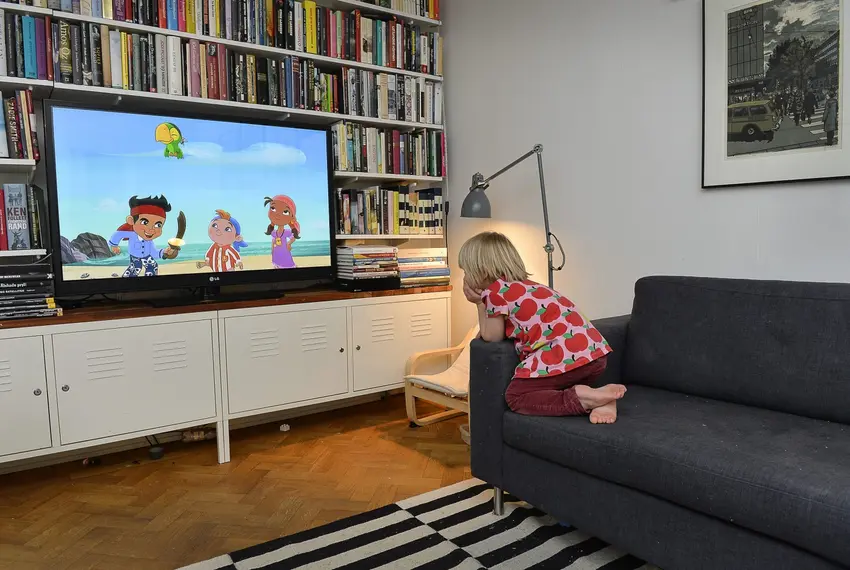
Another confusing one is i for sofas, armchairs, or other (usually soft) chairs you might relax in. It may sound a bit odd to say you’re sitting ‘in the sofa’ rather than ‘on the sofa’ but it kind of makes sense if you think of the sofa as something comfortable that’s surrounding you.
If you’re sitting on a less comfortable chair, like a dining chair or office chair, then you would usually say på stolen (on the chair) instead.
På bussen but i bilen
Different forms of transport use different prepositions – although these rules are somewhat similar to the på skolan vs i huset example above, and are indeed quite similar to the rules for transport in English.
For trains, buses and planes you would usually use på rather than i.
So, just like in English, you’d say you were på tåget, på bussen or på flyget (on the train, bus or plane).
Just like in the house-related example above, the exception would be if for some reason you needed to tell someone that you were inside rather than outside (maybe they’re looking for you on a train platform and you want to tell them you’ve already got on the train), in which case you would say i tåget.
You would also use på for your bicycle, which is pretty self-explanatory ‒ although I suppose if you had a cargo bike which you were able to sit in you might get away with saying you were sitting i lådcykeln.
For your car, you would use i rather than på, just like in English.
I for body parts
Swedish also uses the preposition i for parts of the body in many situations – for example instead of saying ‘my leg hurts’, you would say jag har ont i benen, or literally “I have pain in my leg”.
If you’ve injured a part of your body, you have a few options.
You could use i – jag slog mig i huvudet (I hit my head), or mot – jag fick ett slag mot huvudet, which is more passive (I received a hit to the head). Confusingly could also say you had a skada på huvudet, literally an injury on the head.
Also, if you hold someone’s hand in Swedish you should use the proposition i, even if it makes it sound like the person in question is so small they fit into the palm of your hand.
You might tell a child håll mig i handen (literally ‘hold me in the hand’), if you were about to cross a busy road.
I taket or på taket?
Another interesting i vs på situation has to do with the fact that roof and ceiling are both the same word in Swedish: tak.
In order to distinguish between the two, Swedish uses different prepositions when describing them. If you wanted to say something was hanging from the ceiling (like a spider or a light, for example), you would say it was in the ceiling, i taket.
If, however, you wanted to say something was on the roof, like a cat or Karlsson in the Astrid Lindgren children’s series Karlsson på taket, you would use på.
Use i for time
Finally, there are a lot of time-related phrases where you should use i. These include when telling the time, in situations where you might use ‘to’ in English, for example klockan är tjugo i fem (the time is twenty to five).
You’d use över for ‘past’, so tjugo över fem would mean twenty past five.
These aren’t the only situations where you would use i – you also use it for time phrases (although there are some other rules here you should keep an eye on, like adding an -s when you’re talking about something happening in the past).
You would, for example, say i morgon for tomorrow, or i morse for this morning.
I sommer means during the summer, while i somras would be summer last year, and there are equivalent phrases for other times of the year.
You would also say i går (yesterday), i år (this year), i kväll (this evening) and i natt (tonight).
For specific days, however, you would usually use på, for example på julafton (on Christmas Eve), på midsommar (on Midsummer) and på din födelsedag (on your birthday).
Did you find this Swedish grammar explainer useful, or do you have more prepositions you want us to go through? Let us know if you’d like more similar content in the comments below.
Comments (4)