
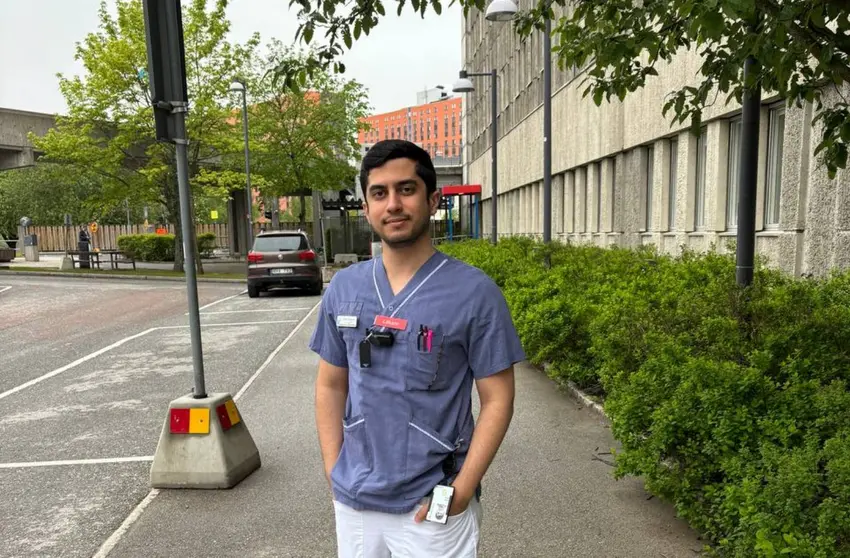
Kazemian resigned from his job at Järna vårdcentral, south of Stockholm, in September and moved back to Iran, leaving his girlfriend and apartment in Huddinge behind him, aiming to move back to Sweden on the back of a fresh work permit application.
"I left Sweden voluntarily because I was frustrated over the process, and then I thought maybe leaving Sweden and doing what they asked me would solve the problem," he told The Local from Tehran. "That's why I quit my favourite job in Stockholm, a really perfect working place with perfect colleagues."
He then found a job that met the qualifications for the EU blue card, which among other things requires a salary of 52,000 kronor a month, moved to Iran and sent in a new application to the Migration Agency.
"One month later, nothing had happened. Then the officer asked me to withdraw my case in the court to take a faster decision, which I did, and then two or three days later, they gave me a rejection.
"When I looked at it I was shocked. I found that they had given exactly the same reason that I had appealed to the court, so it's like a game."
In its response, the Migration Agency says that it considers that Kazemian worked illegally for seventeen months because, as his initial work permit was valid for less than six months, he was not entitled to continue working while waiting for an extension.
"The Migration Agency's judgement is that you, through your actions, should be considered as representing a threat to public order because you worked without a work permit for a long period," reads the rejection letter, seen by The Local.
"The consideration that you are a doctor and that this will have consequences for healthcare patients and an organisation has no bearing on this judgement."
As The Local reported in May, Kazemian's work permit extension was initially refused because the Migration Agency said it had no record of receiving an extension application.
Kazemian, on the other hand, claims to have submitted the application in person before his initial permit expired and to have then repeatedly asked for confirmation that the agency had received the documents, with the case officer confirming that it had.
The agency claims, however, that the case officer had been referring to other documents Kazemian sent in, and not to the application itself.
Because of this, the agency argues his work permit application was in fact submitted on February 21st, 2024, after they contacted him to inform him that his work permit had run out and that he should reapply if he wished to stay in Sweden.
As his first permit expired at the end of 2023, the agency is treating the application to extend as a new work permit application, meaning that Kazemian, in their view, did not have the right to work after his old permit expired, and had therefore been working illegally in Sweden for seventeen months.
In an interview with Swedish Radio, Vadim Riabinine, head of one of the Migration Agency's work permit units in Stockholm, said that Kazemian had also not paid the application fee in time, an argument Kazemian rejects.
"There's a link that you have to send me so that I can pay the fee, but he didn't send me anything, so how should I pay it?" he asked.
Kazemian's case has been covered by Swedish state broadcaster SR, the Dagens Nyheter newspaper, and the Läkartidningen medical newspaper, as well as by The Local.
This week, Internationella Läkarförbundet, an interest organisation within the Swedish Medical Association representing international doctors working in Sweden, launched an online petition to raise awareness of his situation, which you can sign here. Kazemian has previously served as vice president of the association.
Since returning to Iran, Kazemian says he has been downcast and has not been working.
"I'm sitting in bed and thinking about what happened as a result of five years of hard working, paying 110,000 kronor for my course, and going through the really hard process of registration in the medical field," he said.
"Because of this one simple bureaucratic fault that could have be fixed in five minutes if the officer had mentioned it to me in time, I have had to go through this torture for three years."
"They are supposed to look at each case as a new case. But instead, they didn't take a look at my request, they just dig back to three years ago, and said 'you didn't send in the extension application'."
Kazemian has not given up. His lawyer is appealing the Blue Card rejection, and there's still a chance that it could be overturned.
"The only option I have is sending an appeal," he said. "I've invested a lot of time, money, and in my career in Sweden. I bought a house, which I'm paying the loan on right now. Meanwhile, I have no income, and then they're doing this to me."
Several other overseas doctors are facing a similar situation, which Kazemian attributes to the fact that Sweden lacks a dedicated work permit process for doctors.
"There are many other examples in neighbouring countries, such as Denmark, Norway or Germany, which have a special kind of visa for people like me," he said.
Several doctors in Sweden, he said, have reported discovering that their children are set to lose the right to live in Sweden when they turned 18, often forcing their entire family to leave.
"It's a lose-lose game, both for people like me, and for Sweden and Swedish taxpayers."
Comments (4)