
The solstice really does mean darkness ‒ 17 hours of it if you’re in Malmö, 19 in Sundsvall, and round-the-clock if you’re in Kiruna ‒ but I actually love the winters here. My first visit to Sweden was in December, at the darkest time of the year, and I spent it mostly in the north, in Umeå, where, although the sun does rise at the winter solstice, it never really seems like proper daytime.
Since the sun is 'up' for only a few hours and remains very low in the sky, just above the rim of the earth, the scant hours of December daytime here in Umeå feel like the fading evening before dinnertime ‒ except that it’s noon.
You’d think that such an introduction to this country wouldn’t make me eager to come back, let alone move here, but I found it magical, and peaceful ‒ and now, four Decembers later, I still do. Here's why (plus some tips on how maybe you can too).
The lights
Wait, what light? Isn't the point that it's mostly dark?
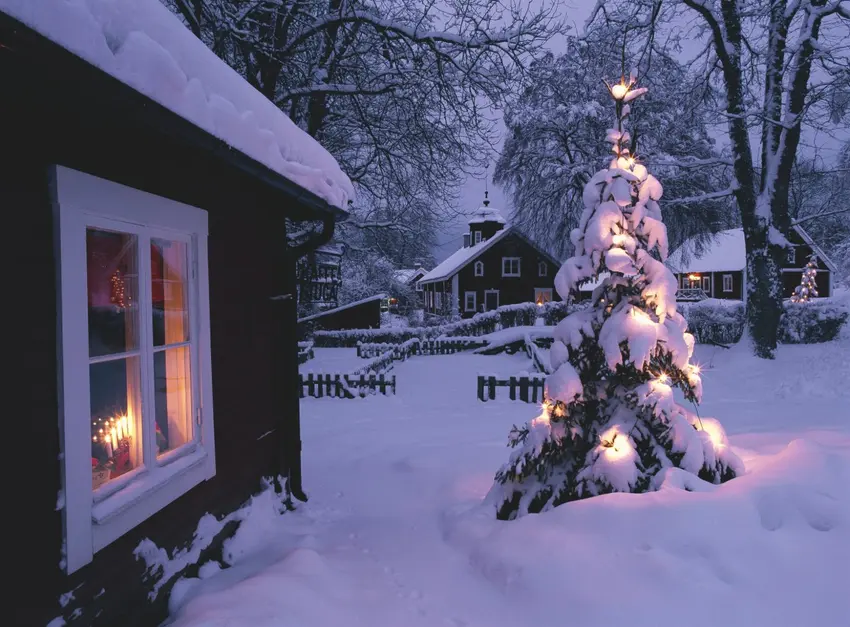
True, there's precious little sunlight, but that makes the human-created light shine that much brighter. From torches or little fires in the snow, to strings of Christmas lights on houses, to the warm yellow advent arches in nearly every window, Sweden has developed many beautiful traditions of bringing light to the darkness.
I find that keeping my eyes off my phone while walking in winter (see: winter walks) and looking instead at the twinkling lights in windows and public squares, and at the flames framing shop doors, brings me a sense of warmth and community ‒ even when I'm alone.
Taking daily time to notice these traditions of light every winter reminds me that I am not by myself in the experience of darkness: that it is a large group of people, a whole country in fact, and they are putting up these illuminated signs of communal survival, reminders that we are all here, alive, and in this together, even when it doesn't seem like it.
It's a sense of community that I find doesn't exist in the same way in the social, ebullient Swedish summers, when everyone is off enjoying their own version of happiness, and I love it.
Winter walks
A top tip from Swedes about surviving dark winters is to take a walk, no matter how short, during the brief window when the sun is up. It's a good tip, but in my experience it can be just as pleasant to walk in the winter when the sun is down.
Either way, winter surroundings have a special magic to them. If you're out while there's natural light, there's a decent chance the sky will be painted in swaths of pastel colours that don't show up during summer ‒ a pale kind of noontime twilight.
If you're farther north, full-on 'pearl clouds' (technically called nacreous clouds) are not uncommon, but even in the south the daytime sky can have a pearlescent quality.
Then, when the sun is down, you can enjoy the cozy lights shining in windows and burning outside front doors, along with the calm quiet that snow brings to a city. And if you're in the north, there are the northern lights (norrsken in Swedish) ‒ those strangely shifting bright green lights showing up seemingly at random.
Whether in the daytime or in the long night, I find that being outside in winter in Sweden, even for a short walk, can have a mystical and peaceful quality (although maybe not when I accidentally step up to my ankles in icy slush).
Commiserate with a Swede
No one is more pleased to make small talk, however brief, about winter darkness than your average Swede.
Not only have they probably grown up with these dark winters, but they've also inherited a cultural habit of talking about the weather ‒ and particularly the light, or lack thereof ‒ as a way of coping with (or celebrating, in the case of summer) the extremes of light that happen every year in Sweden.
Whereas in Toronto, where I come from, it's standard to reserve small-talk winter-weather complaints for days when there's a snowstorm or temperatures have dropped below -15, here in Sweden it seems like pretty much everyone exchanges comradely complaints about the darkness between October and January.
So don't be shy about commenting to a work acquaintance, or to your child's preschool teacher, about how dark it is, or that it seems particularly dark on a given day (maybe because there's no snow, or it's been overcast).
The Swede in question may not raise the topic themselves, but they will almost certainly be pleased to have the opportunity to share a commiserating nod and a "ja [or 'jo' here in the north], så är det."
Embrace the mys
The Swedish concept of mys is more than coziness ‒ it's a whole mood. And it comes from generations of people learning how to enjoy long winters by creating warm and bright little nests indoors.
Since mys is an atmosphere as well as physical coziness, how you do it is up to you. What makes you feel warm and cozy, inside and out? Is it green tea with piles of blankets, music from home, and reading by candlelight? Or is it glögg in an oversized hoodie while watching your favourite fluffy show?
Whatever it is, Swedish winter is the time to lean into it. The long darkness is a very good, and very legitimate, excuse to prioritise your favourite creature comforts ‒ another thing that's harder to do in the summer, and which makes winter in Sweden special.
So, put your phone down and go out for a winter walk to enjoy the many unique lights of winter, perhaps exchanging a sigh about the ice with a neighbour before you come back inside to snuggle up with your comfiest sweater and preferred beverage, and you might just start looking forward to the darkest time of the year.
(Oh, and make sure to get a bottle of high IU Vitamin D and take it daily from mid-September through mid-March. There is of course a physiological aspect to feeling emotionally low in the absence of sun, so remembering to top up your 'sunshine' chemicals is important.)
Comments (1)