
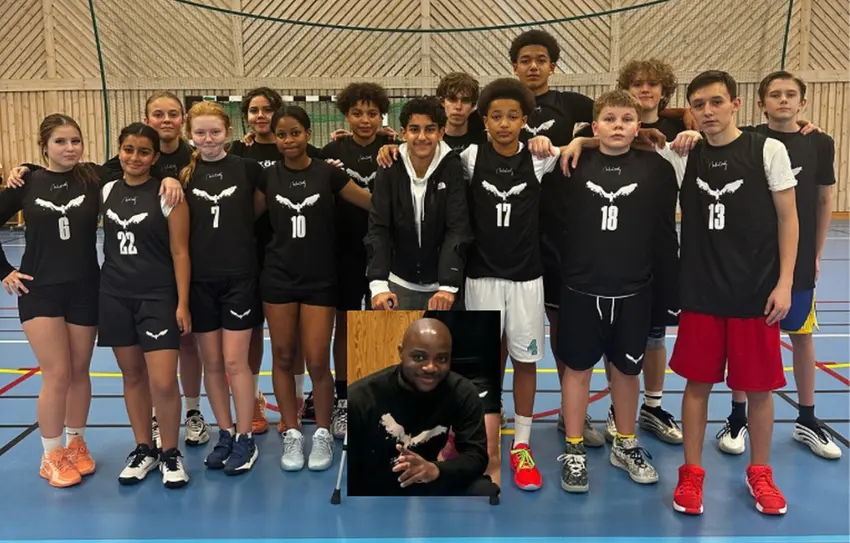
Until he was seized a month ago, Nsubuga coached basketball at the Fryshuset Basket club in Hammarby Sjöstad, and he was deported despite an energetic campaign from Fryshuset, which won coverage in the Aftonbladet and Dagens ETC newspapers.
It is only thanks to Fryshuset raising 100,000 kronor for him, and the parent of one of the kids he coached, who put him in touch with a connection who worked at the Swedish embassy in Uganda, that his situation in Kampala, Uganda's capital, has not been even worse.
"I got nobody here," he told The Local from Kampala. "I was really lucky that some people in Sweden, from the place where I coached basketball, happened to know a colleague who worked at the Swedish Embassy, and they asked him to help me get a place to live. But, am I OK? No. I haven't been OK for more than a month now."
Kampala, he said, was "a really strange place for me to be". "It's a culture shock, for real. I just don't feel safe. They're probably nice people, but it's just that this is not what I'm used to."
Nsubuga's father walked out on the family not long after they arrived in Sweden in 2014 and he and his brother were brought up by a distant relative of his father's ex-wife, who had Ugandan heritage.
"We're not really related at all," he said. "She's just somebody who was there for us when we needed help."
Throughout his upbringing, he says, he was totally unaware that he had no legal right to live in the country.
"I went to school from fifth grade all the way through gymnasium. Nobody told me! Something would have happened if they had told me earlier," he said.
"My personal number was working and I never needed an ID when I turned 15, because I'm not a person who goes out. I'm not a person who parties. It has always just been school, basketball, go home, school, basketball, go home. And then I became a coach, so I never really went out."
He used a bank card connected to an account his father had set up, so he never got his own bank account or BankID.
It was only about two years ago when his brother was stopped by the Swedish police that the two of them began to realise that they had a problem.
"They asked him for identification and all of that and they checked his personal number, and they told him that he had no right to be in Sweden, and then he called me, telling me this," he remembers.
"That's when I figured it out. I was thinking, if my brother doesn't have it, do I really have it myself? Do I have a right to be in Sweden? That's when everything hit. I tried to get a job right after that and they said I had no right to work, so after that, we just went, my brother and I, to the Migration Agency to apply for asylum."
After his asylum application was rejected, he was seized and held at the Migration Agency's detention centre in Flen, which he said was "really, really horrible".
"It's not a good place to be. Nobody wants to be there. You're locked up without having done anything wrong, like I haven't killed anybody, I've done nothing." After three weeks there he was put on a plane to Kampala.
While he was at Flen, one of the other coaches at Fryshuset launched a petition to the Migration Agency, asking for him to be allowed to stay, that got more than 16,000 signatures.
He is now considering his options. He might appeal the rejection of his asylum case to the European Court of Human Rights.
At the same time he is looking for a job that will allow him to get a work permit to live in Sweden, although he is not hopeful of finding one that meets even the current work permit salary threshold of 29,680 kronor a month, let alone the 33,390 kronor a month that it will rise to next June.
"I want to do that, but you have to find a job [with an employer] willing to pay that, and I'm looking. I want to get back to my country, because I see myself as Swedish, even a little kid that I talked to here in Kampala said that, 'I can see that you don't really belong here in this country'."
Comments (1)