
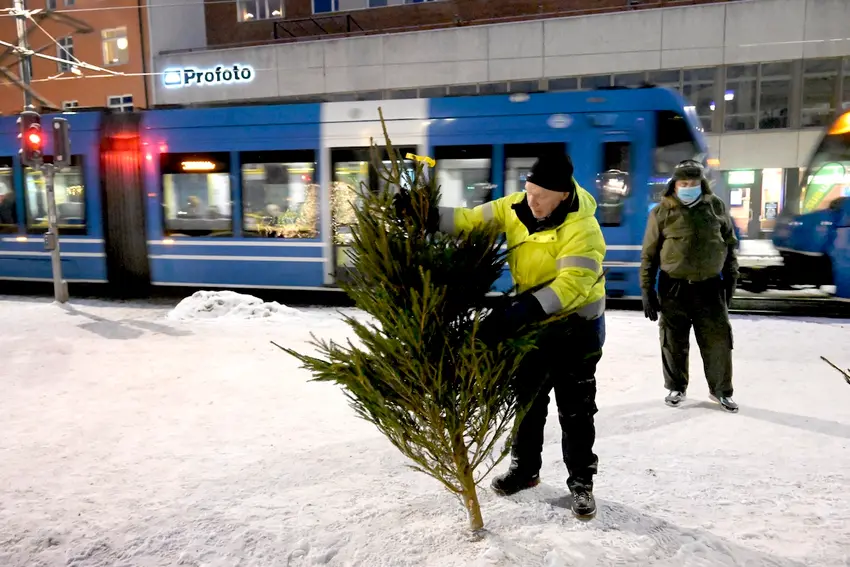
According to the state-owned forestry company, Sveaskog, around 62 percent of Sweden's households buy a tree, with most going for a rödgran or Norway spruce, which is the traditional Christmas tree, although the kungsgran, or Caucasian fir, is growing in popularity.
When do you buy your Christmas tree?
Traditionally, Swedes bought their Christmas trees on December 23rd, just one day before the big Christmas celebrations on the 24th.
Now, however, most buy their tree earlier than that in order to enjoy it for longer, with the earliest possible date usually the first Sunday of Advent, which was November 30th this year.
It's also worth thinking about how long your tree will be on display for before you decide which type to buy.
A Norway spruce, for example, normally only holds its needles for about three weeks, so you shouldn't really buy one until the second week of Advent or you'll be dancing around bare-looking straggly branches on the big day. To be really on the safe side, it's best to wait until two weeks before Christmas.
A Caucasian fir can hold its needles for about five weeks, so if you want a Christmas tree on show for the full Christmas period, that's your best bet.
Whichever one you get, remember that they last a lot longer if they're watered, so it's a good idea to buy a stand for your tree which can fit at least a few litres.
READ ALSO: How to decorate your Christmas tree like a Swede
Where can you buy your Christmas tree?
There are few Christmas activities more atmospheric than trekking to your local square with your young family in tow, spending a few minutes debating the merits of the various trees on offer, and returning with one slung over your shoulder (especially if it's a little snowy).
But the joyful memories you are creating for yourself and your family come at a price.
A decent-sized Christmas tree at most town squares can set you back as much as 700 kronor, and even a small one will cost 300 kronor, with prices varying depending on the type and size of tree, as well as whether it's organic or not.
You can buy cheaper options at places like DIY supplies company Byggmax, which offers a smallish Norway spruce for 129 kronor. Bauhaus will sell you a slightly bigger one for 250 kronor. Biltema has a tiny one in a pot for 149 kronor.
In the south of Sweden ‒ where Christmas tree growing is a popular side hustle for local farmers and, indeed, anyone with a bit of land ‒ you can also go out and buy trees directly from the grower. You can even, in some cases, fell your own tree.
Drive around the countryside in December and you will see home-painted signs saying julgran, which will take you down a small road to a farm where you will often find ready-cut trees waiting to be bought. This will still cost you a few hundred kronor, so more than what you will pay at an out-of-town shopping centre, but your tree is likely to be fresher, meaning it will last longer.
Especially in Skåne, it's fairly common for growers to set up a "saw-your-own", självhuggning, Christmas tree plantation, such as here at Kågeröd near Helsingborg, or here at Äspinge, near Hörby, or here near Skurup, or here, near Höganäs.
This turns getting your tree into a fun day out in the countryside.
READ ALSO: How to dispose of your Christmas tree in Sweden
Can't I just cut down a wild spruce in a forest?
Around 70 percent of Sweden is forest, and spruce trees account for about 40 percent of the total volume of wood, so why, you might think, do you have to buy a tree at all? Why not just go out into the forest and cut down a wild one?
Some unscrupulous Swedes do, indeed, do this. But not many, because it is, of course, illegal. Pretty much every stretch of forest in Sweden is owned by someone and cutting down a tree and taking it home is no different in principle from stealing one from a branch of Byggmax.
Sweden's law on public access to nature, allemansrätten, also brings with it a responsibility to neither disturb nor destroy the forest, so while picking berries or mushrooms is allowed, sawing down trees is not.
God Jul så småningen!
Comments