
What has Sweden's finance minister said?
Svantesson's reassurance to Sweden first appeared in an interview with the Dagens Industri newspaper on Sunday and then repeated the line in a post on X on Monday.
"My message is that the Swedish economy is Trump-proofed and that our government finances are strong," she wrote. "This gives us room to support the economy further if needed. Therefore, we can feel calm and confident even in this difficult situation."
Mikael Damberg, finance spokesperson for the opposition Social Democrats, speaking before Trump dropped his tariff threat, was quick to dismiss Svantesson's statement as "a little naive".
"It's obvious that if this develops into a full-scale trade war between Europe and the US, it could have major effects on the Swedish economy, on our growth and jobs. And that is why I am a little concerned when the Minister of Finance says that Sweden is 'Trump-proof'," he said.
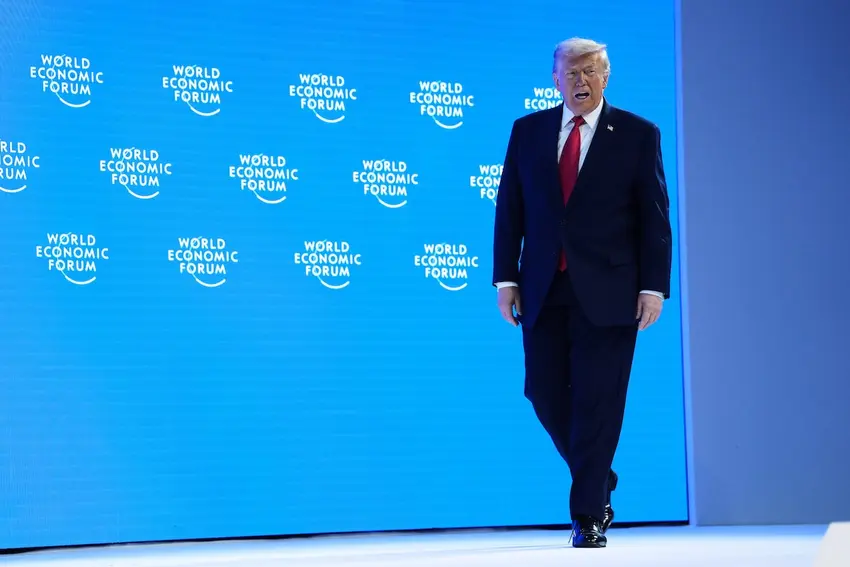
Trump defused the situation in his speech to the World Economic Forum in Davos on Wednesday, saying that he no longer planned to impose the 10 percent tariffs. In the same speech he also seemed to rule out using the military to seize Greenland.
But Trump is such a disruptive and unpredictable force that there's every chance that he will revive the tariff threat again in the coming year.
Does Svantesson have a point?
Yes. Sweden's government debt was 34.5 percent of GDP in 2025, and is only expected to hit 38.6 percent in 2028, even with the current expansive fiscal policies and heavy defence spending. This is compared to Germany's debt-to-GDP ratio of 62 percent to 64 percent, France's of 113 percent, and the UK's of 101 percent.
This means that if tariffs or some other action by Trump causes a global economic crisis, Sweden's government is in a better position than almost any other country to stimulate the economy with infrastructure investment, or other means, and to support those who lose their jobs.
Inflation also hit 2.1 percent in December, which is more or less in line with national bank Riksbank's 2 percent target. The halving of VAT on food, which comes into force in April, is expected to pull inflation well under the 2 percent target, meaning the bank is likely to keep interest rates stable, and even perhaps cut them if required.
On the other hand, Swedish households are heavily indebted, with private debt at about 83 percent of GDP.
Isn't Sweden's economy dependent on exports to the US?
Yes, depending on how you measure it, the US is either Sweden’s largest export market, or the second largest after Germany. Swedish exports to the US took a big hit in 2025 due to the last round of Trump tariffs, plummeting by 16 percent from April to November 2025 compared to the same period in 2024.
According to Sweden's National Board of Trade, if Trump imposed a ten percent tariff or a 25 percent tariff on Sweden, it would cut Swedish exports to the US by 16 percent and 28 percent respectively over a three to five year period. If tariffs already in place today remain in place, the decrease would be only 6 percent.
A chunk of these exports would instead go to other markets, with the board estimating that a 10 percent tariff would cut Sweden's total exports by 0.8 percent and a 25 percent tariff by 1.3 percent, so it would hurt but it wouldn't be a catastrophe.
What does big business say?
Jan-Olof Jacke, CEO of the Confederation of Swedish Enterprise, said while Trump's tariff threat had been "very serious and worrying" for Swedish companies, that the Swedish economy was in a strong position.
"I completely agree that the Swedish economy is very strong. We are better equipped to handle a difficult situation than most others," he said.
What do economists say?
Economists at Sweden's big banks are predicting strong growth for the economy this year, as the global economic recovery increases demands for exports, and lower interest rates and an expansionary government budget boost consumer spending.
Nordea is predicting that Sweden's GDP will grow by a healthy 3 percent in 2026 up from 1.9 percent in 2025, while Swedbank and Handelsbank expect growth of 2.6 percent and 2.9 percent respectively.
But all three said that if the EU and US were to be pulled into a trade war, these predictions would not come to pass.
Economists at Handelsbanken predicted that Sweden "would be hit hard" if Sweden and Europe got provoked into a trade war with the US.
The worst case scenario, a serious trade war (in red below) could cause "stagflation" in Sweden ‒ pushing growth down to well below 1 percent and fuelling inflation at the same time, as a result of high import prices and disruptions to supply.
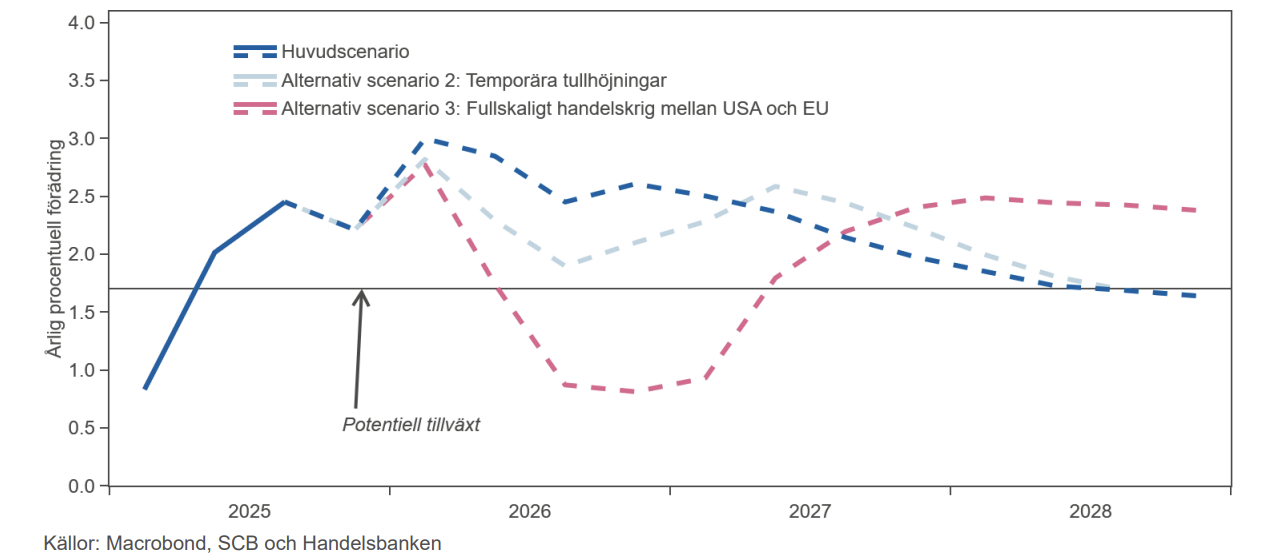
"The US' new tariff threat connected to Greenland has risen up as a big possible concern," Handelsbanken wrote in a report on the state of the Swedish economy, published before Trump dropped his threat.
"The direct effect of the tariff increases and the increased uncertainty would significantly reduce growth, while inflation would also increase due to higher import costs and the negative supply disruption. Sweden would also be hit hard," they wrote.
Annika Winsth, chief economist at Nordea, said that her bank's forecast of 3 percent growth also depended on there being no trade war or other major disruption.
"If they ended up challenging NATO, well, then we have a completely different game plan," she told TT. "Then we will have to recalculate everything Then this report is wrong," she said.
Swedbank's chief economist Mattias Persson also warned in the bank's January forecast that "further escalation could affect global security, and have consequences for trade and investment flows and demand for US assets".
Comments (4)