
Does Sweden have to join the euro?
Technically, yes. When Sweden agreed to join the EU in 1994 it also became subject to the rules of the Maastricht treaty, which means that it has to join the eurozone once a set of necessary conditions are met.
Two countries negotiated an opt-out agreement when they joined the EU – Denmark and the UK – retaining their own currency, but Sweden did not.
This means that, technically, Sweden has agreed to adopt the euro at some point in the future.
Why hasn’t Sweden joined yet?
In pure technical terms, Sweden has not yet joined the euro because it hasn’t fulfilled one of the necessary criteria – joining the European Exchange Rate Mechanism, also known as ERM II. Any country adopting the euro can only do so after joining ERM II and staying a member for at least two years.
Sweden has not joined this mechanism, arguing that this is voluntary, and that it will only do so if a referendum on joining the euro passes, effectively finding a loophole to keep it outside of the eurozone indefinitely until the country decides to join.
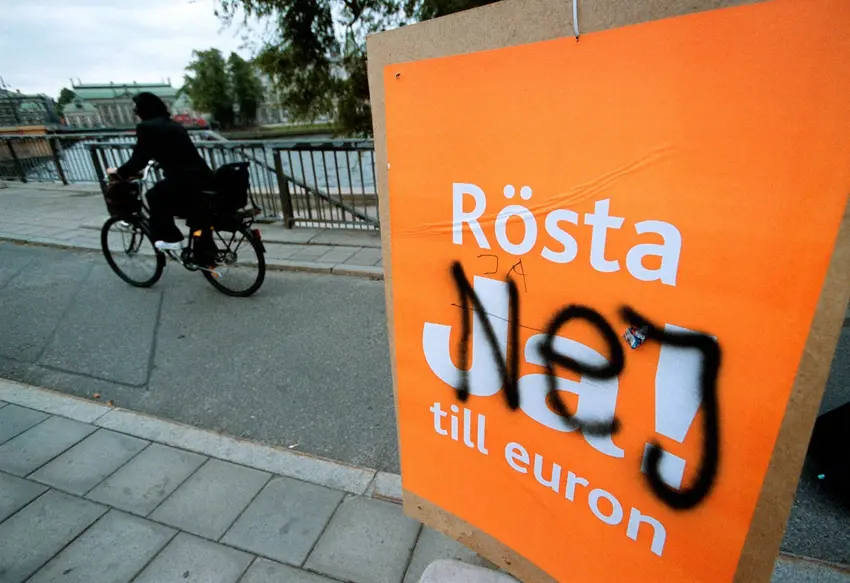
The country held a referendum on joining the euro in 2003, where 55.9 percent voted no and 42 percent voted yes, despite the Moderates and the Social Democrats – Sweden’s two largest parties – both being in favour.
Which parties want the euro?
Since the referendum in 2003 the question of whether or not to join the euro has been more or less on ice, with no one but the Liberals calling for Sweden to adopt the currency.
Support for joining the euro started to grow among Swedes last year, as the krona weakened, with the issue seeing the strongest public support since 2009 last spring, and the Moderates, Centre Party and Christian Democrats are all open to adopting the currency – or at least launching an investigation to look into whether it could be a good idea.
Does this mean Sweden is going to join the euro soon?
It looks very unlikely. Although four of the eight parliamentary parties are considering joining (or at least they are in favour of investigating the issue more closely), those parties are split among the left and right blocks. Among the four so-called Tidö parties, the three government parties are in favour but the Sweden Democrats, who they rely on for support, are against.
Among the left-wing block, the Centre Party is in favour, while the Green Party and Left Party are against. Sweden’s largest party, the Social Democrats, has not officially chosen a side.
It's also worth saying that the party most in favour of joining the euro, the Liberals, is currently polling at less than 1.5 percent, which means that there's a high chance they could drop out of parliament entirely at the next election.
The Liberals have made a pact with the Sweden Democrats to support the far-right party holding ministerial posts if the Tidö parties win the next election (that again is a big if, considering the Liberals' polling figures), which among other things includes a Euro referendum set to take place in 2030. That pact will obviously mean very little if the Liberals drop out of parliament and the Tidö parties lose power in September's election.
At the same time, although public support for the euro is rising, it’s still far off the majority needed for a referendum to pass. Figures from the summer from Statistics Sweden show that 49.5 percent of Swedes are against joining the euro, but only 32 percent are in favour. That all means that no politician would risk campaigning for a new referendum on the subject.
Why are Swedes against joining the euro?
Usually, support for the euro rises in times where the krona is performing more poorly and drops when the krona is stronger.
It also rises in times of geopolitical insecurity, as people become more interested in joining larger international institutions as a kind of counterweight – just like Sweden’s decision to join Nato after Russia’s full-scale invasion of Ukraine in 2022.
In a debate on joining the euro held on January 27th, finance minister Elisabeth Svantesson said that it was important to take into account the will of the people when discussing the issue.
“I think the fact that so many people are still sceptical about the euro is partly to do with identity and culture. As finance minister I don’t take that lightly,” she said.
Svantesson has said that the security situation is one of the reasons she wants to open an investigation into adopting the euro if she is still finance minister after the election in September.
 James Savage

Comments (4)