
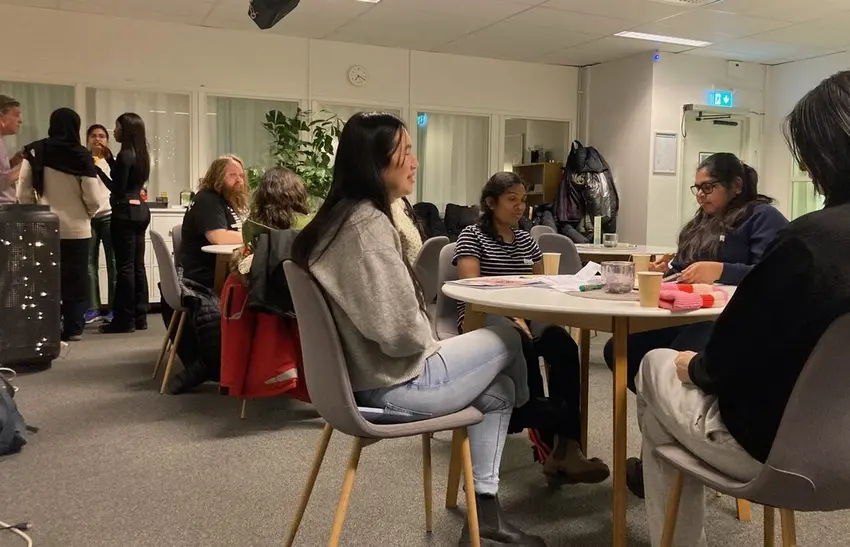
What is a språkcafé (“language café”)? Confusingly, it’s not a café – although, since this is Sweden, there will be fika available. It’s a structured way to practice speaking a language in a conversational setting. You sit around a table with other participants and, sometimes with the help of set questions or little games, speak Swedish as best you can.
You can find språkcafés all over Sweden (and in other countries too), either as part of an established language program (like SFI, Svenska för invandrare, the government Swedish course for immigrants) or organized by local non-profit community organizations.
The språkcafé that meets every Monday evening in Umeå’s Ålidhem neighbourhood is organized by two community organizations: a local group called Vän i Umeå (“Friend in Umeå”) and Bilda, one of Sweden’s eight lifelong learning “study associations” (Swedish: studieförbund). In addition to Swedish language conversation circles, homework help is offered in an adjoining room. It’s all run by volunteers.
On the evening I visited there were four university exchange students participating, all attending the Ålidhem språkcafé for the first time. One of them was Kaiyla Chau, from Canada, who is in Sweden for just one term abroad. Even though her psychology studies at Umeå University are in English and she’s only been in the country for a few weeks, she wants to learn Swedish.
“Swedish is very hard for me,” she says. “Some of the sounds we just don’t have in English. I was trying, with the help of a Swedish friend, and I physically couldn’t pronounce them. I figure the only way I’m going to get a handle on the pronunciation is to practice regularly in conversation.”
Peter James Walton, from Norwich in England, has lived in Sweden for three years and can testify that språkcafés work. He attended at least two (including the one in Ålidhem) per week for years; now he volunteers to help others with their Swedish.
“It really helped to build up the vocabulary I had,” he said. "My second time here I sat beside an older Swedish gentleman who talked about history for a long time; I understood maybe every third word. A year later I met that same guy and I understood everything.”
Another regular volunteer is Hamzi Hussein Ahmed, who came to Sweden from Somalia with his mother when he was 7. He started volunteering because he thought it would be fun to help people learn Swedish, just like he did when he was a kid.
“I can relate to those who try to learn Swedish now. Maybe they can’t pronounce everything correctly, but, still, they are expressing themselves," he says.
But språkcafés can offer a lot more than learning Swedish.
“It’s not easy to socialize in Sweden, but here it’s easy”
Sadiya, who came to Sweden from Somalia alone in 2010, when she was seventeen, has been coming here for the past three months with her two children; her kids get homework help while she joins the conversation groups in the adjoining room. She’s now a nurse and speaks Swedish fluently, so, like many people, she comes here for the conversation.
“It’s not easy to socialize in Sweden, but here it’s easy,” she says. “You can talk with whoever, because everyone wants to learn Swedish."
Peter Walton agrees. “People come to learn the language, but you learn the language by getting to know people better,” he says. "It's great for when you’re new to a country and you don’t know anyone. It's really nice to have a network, a place to meet new people, maybe new friends.”
"I really think places like the Ålidhem språkcafé are important to help prevent loneliness," says Isabell Gustafsson, a structural engineer from Lycksele who moved to Umeå after university for work and has been volunteering with Vän i Umeå since she came to the city three years ago. She is now one of the two main organizers of the Ålidhem språkcafé, and regularly participates in the conversation groups herself.
“People come here to meet people, not just because they want homework or language help," she says. "They come to exchange knowledge and ideas.”
“It’s important for us Swedes to get a broader perspective. Not everything here in Sweden is perfect either.”
Språkcafés like the one in Ålidhem, Gustafsson told me, often attract nearly as many Swedes as they do newcomers to Sweden. "So many people want to come and be volunteers," she said, that the ratio is often "60-40 or 70-30 newer Swedish speakers to Swedes – and sometimes the other way around."
Swedes come here to broaden their horizons and social circles, Gustafsson says. A case in point is two new volunteers I met, there for their second week in a row: a pair of young men from Piteå and Luleå, two cities farther north. Gabriel Tallfält Sundström and Gustav Lundberg are new students in Umeå, and they told me they wanted to challenge themselves to get out of "the Swedish bubble."

“We want to learn new cultures and meet new people,” Lundberg said. "We think it’s so fun that people here are open and want to talk to us.”
Sundström said that talking openly with strangers “isn’t a normal thing in Sweden,” and that it has been really meaningful for both him and his friend to find a place like the Ålidhem språkcafé where people from a wide variety of backgrounds talk comfortably together.
Like everyone I spoke with at the Ålidhem språkcafé, Sadiya told me about the diversity of people and perspectives she encounters here – and how valuable it is.
“You learn a lot of things you didn’t know before. Like last week, I met this guy who came from Russia. It was the first time I’d met someone from there. I learned about different food and a different culture. And then he offered to give my son a haircut at his salon, so we got to do that too.”
Gustafsson also spoke about how much she values talking openly with such a wide range of people.
“I get to see new perspectives, get to learn about other cultures, about different types of art, architecture, religions. I get to see things from other viewpoints. I’m aware that we will not always think the same way, we will disagree, but I think it’s important to hear other perspectives.”
Hamzi Ahmed, the long-time volunteer, agrees: "here, you can get different perspectives on how people see Sweden. It is valuable to discuss different things, to find things you agree or disagree on, and then find something you maybe have in common.”
A different picture of what Sweden is – and could be
The neighbourhood of Ålidhem is the northernmost of the "Million Programme" (Swedish Miljonprogrammet) housing developments built by the Swedish government in the '60s and '70s. But unlike most of the other Miljonprogrammet areas throughout the country, Ålidhem is not designated as a "vulnerable" or "risk" area by the Swedish police (Swedish: utsatts områden, literally, "exposed areas").
Ålidhem has the same characteristics as the other Miljonprogrammet areas across Sweden – lower average incomes, a high percentage of foreign-born residents, labyrinths of large apartment blocks – but, so far at least, none of the serious criminal gang problems.
Why is that? Part of the answer is simply geography: it's harder for the gang networks to make inroads farther north, and, with a smaller population, less lucrative. But if you ask the people who live, work, volunteer, and come to the local activities in Ålidhem, it also has a lot to do with the open and active community life here.
In Sweden, this means föreningar (singular förening), a word for non-profit civil society groups big and small – from eight buddies gathering weekly for fika and board games to national sports organizations. Civil society community life (föreningsliv in Swedish) is strong in Ålidhem, and if you ask local leaders, it's what keeps it out of the utsatta områden category.
Luka Anic heads the northern region of Studiefrämjandet, another "study association" like Bilda (the co-organizer of the Ålidhem språkcafé), with offices next door to where the Ålidhem språkcafé is held. He firmly believes that "one of the main reasons why Ålidhem feels good is that so many activities from civil society happen here. There are a huge amount of föreningar permanently in the neighbourhood, not just dropping in then leaving again."
Everybody participates in the Ålidhem föreningsliv, Anic says, "students, older Swedish people, new immigrants."

"We want everyone to feel at home here"
Ulla and Bjerre Ljungberg are on the board (Swedish: styrelse) of Vän i Umeå and have been volunteering with the Ålidhem språkcafé for nearly a decade. Bjerre says that when he sees hate and division rising in the world at large, and in Sweden's own politics, he feels he has to do something in his own community, however small, to "build small networks of positive energy."
| Banner ad |
He tells me about a Swedish idiom that captures what he means, gräva där man står. It literally means "'dig where you stand,'" he says: "if you want to change something you have to begin somewhere – so it might as well be where you are.”
Another committed volunteer is Christopher Voltaire Semakula. Because he was raised in Umeå but born in Uganda (he was only a few months old when his parents came with him to Sweden), he feels he can be a bridge to Swedish society for newcomers from a similar part of the world.
"As humans we seek community," he says, and at the Ålidhem språkcafé "people bond through learning something together." He describes it as a place where volunteers want everyone to feel at home, and for Swedish-language learners to “be able to make mistakes and not feel stupid.”
"It’s very hard to go to a new place and try to find your way," he continues, saying that it is important to show a side of Swedish society that is "not representative of what our government is doing" on immigration.
"I think it’s important to counteract the government messages and actions, to say, “'you are welcome here.'”
Comments (2)