

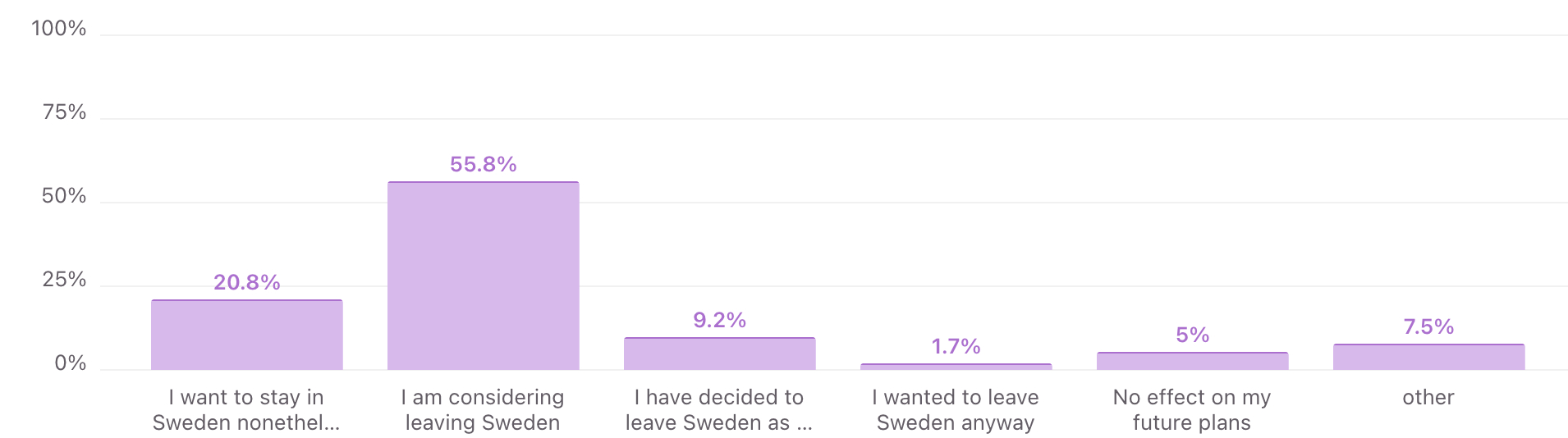
Well over half of the 120 readers who responded to The Local's one-day survey, the vast majority of whom were highly skilled workers, said that they were considering leaving Sweden as a result of the stricter citizenship rules and the way they have been implemented.
A further 9 percent said they had already made the decision to move elsewhere. Only a fifth (21 percent) said they were determined to stay in Sweden despite the stricter rules.
"I am done with Sweden," wrote Ricardo, a software developer based in Stockholm. "I planned a long-term life here based on citizenship and now I see all my plans ruined. I am tired of the Migration Agency deciding on my destiny. I want to live on a place that I am not afraid of the government changing the rules all the time."
"After completing my PhD I won’t fight to stay and contribute to a country that wants to make things harder for me," said Jacob Rukavina, a doctoral student living in Uppsala.
"I have the opportunity to move abroad and I’ll take it rather than wait to complete five years in Sweden, because now waiting 8 years in total is too much," said a software engineer from South America based in Lund.
The word respondents used again and again was "betrayal".
"The Swedish 'dream' has felt more like a betrayal," said a project manager at Volvo Cars, who said he was considering leaving. "We left high-paying roles at top global companies for the promised work-life balance, but we lost our peace of mind the moment we arrived. The only reason we haven't left is our children—this is the only home they’ve ever known."
"It’s unfair and a betrayal of the trust I had in Swedish values and society. I regret coming here," said Pascal, an IT professional. "I should have accepted the offer I got from a German and Canadian company."
"Having been a resident with no issues with the law ever who was looking forward to become a Swedish citizen, I feel betrayed when immigration, or the issues pertaining to it (whether genuine or due to Sweden's bad handling) is generalized and residents are punished with stricter laws nonetheless," said an Indian engineer based in Gothenburg.
"It is insanely frustrating, as I have spent about seven years in Sweden. My student years don't count towards citizenship in spite of me contributing to the Swedish economy by paying university fees and working part-time jobs that include paying taxes."
"The Swedish government has lost its trustworthiness," agreed a software developer from Uppsala. "If I had known that the rules and laws were so unstable, I wouldn’t have moved here. Highly skilled labor is attracted to stability and economic incentive. Neither of them exist in this country now."
Retroactive application is the worst aspect
A clear majority of respondents rated the retroactive application as the worst aspect of the legislation, with 38 out of 66 ranking it the worst of five elements The Local provided.
Most of the rest – 22 out of 66 – chose the increase in the residency requirement for citizenship from five years to eight years as the worst aspect of the legislation. Only two respondents ranked either the new language and civics tests or the 20,000 a month self-sufficiency requirement as the biggest issue.
"The retroactive application of new rules is unfair and unjust," said Craig, a tech worker in Stockholm. "When people envisage and build a life overseas that they uproot partners, sell houses and plan around particular timelines, moving the goalposts can be dramatically impactful."
"I find it deeply unfair to apply the law retrospectively, especially given the already extreme waiting times at Migrationsverket," said Dmitri, a Product Owner from Malmö. "In practice, this would mean that around 40,000 people will be forced to re-apply again in three years, recreating the same backlog and prolonging waiting times even further."
"The retroactive application of rules depict a fundamental logical and ethical failure here," said Hassan, who has a PhD in computer science from Uppsala University. "The state is using its own administrative inefficiency to disqualify people who met every single requirement at the time of their application. How can a country that prides itself on rättssäkerhet (legal certainty) justify changing the rules of the game?"
Punishing well-integrated taxpayers
Several respondents complained that the government was failing to live up to its rhetoric of wanting to attract highly skilled hard-working foreigners and to reward those who integrate, learn Swedish and get good jobs.
"What they are doing does not match with what they are saying," said an autonomous driving expert based in Gothenburg. "First, their narrative makes it sound like that every single problem is caused by immigrants. Then they make people think that 'immigrant' means 'refugee'. But we are highly skilled workers, and I used to have several options in other countries as well. If these changes were in place back then, I'd have picked one of the other options."
Another respondent, a sound designer based in Stockholm, said that the rules were an "arbitrary blanket solution that seems like a lazy attempt at fixing all of Sweden's problems".
"Meanwhile," he said, "they are punishing tax-paying, law-abiding, culture-embracing professional immigrants who chose Sweden partly, mostly, or fully on the basis of a straightforward and relatively quick path to citizenship."
"I understand why Sweden wants to toughen its migration laws and I am not against it," said someone who described themselves as a 'hard-working EU Blue card holder'. "But the way it is being done is absolutely racist, ridiculous and unfair."
"There is no distinction between problem-makers and hard-working, educated high tax-paying immigrants, and no regards to people who have already integrated and have Swedish-speaking jobs," he said. "It is utterly stupid for a country with such a high IQ on average."
"I used to love Sweden more than my own country," he continued. "But this shows that the colour of my skin will never let me integrate."
'Way less high-skilled labour'
Most respondents said they thought that the stricter citizenship rules would have a significant impact on the number of highly skilled workers choosing to move to Sweden.
"There will be way less high-skilled labour," said one respondent who chose to be anonymous. "A Swedish passport and citizenship is the driving factor for a lot of people."
"It will 100 percent reduce it," the sound designer said. "I was incredibly attracted to Sweden because of the citizenship pathway. Take that away and Sweden becomes less attractive and loses a big advantage over other European countries."
"Professionals will choose countries that offer clearer, faster, and more predictable pathways to citizenship and long-term integration," said Onur from Turkey. "Germany is a relevant example: although the residency requirement was once increased to eight years, it was later reduced again, and specific criteria were introduced to allow high-skilled individuals to obtain citizenship in a shorter time."
Rahul, a technology professional based in Gothenburg, said that for many skilled workers with "multiple global options", the longer citizenship wait would be a deal-killer.
"For this group, citizenship is not a formality – it represents long-term security, predictability, and trust," he said. "When the path becomes more rigid or uncertain, people factor that into their decision and often choose countries with clearer, more realistic integration models. Over time, this will reduce Sweden’s ability to attract and retain the talent it needs to remain competitive."
Comments (12)