
Hej alla,
For a British person brought up with the chaos and cacophony of the parliament in Westminster, Sweden's Riksdag is bracingly efficient.
The vote last Wednesday to remove the notification requirement for parental leave took 13 seconds. The fuel tax cuts in the spring amendment budget, a complex decision with multiple points, passed in three minutes.
The reason I've spent Saturday morning watching parliamentary videos is that – thanks to the efforts of the Fair Transition campaign group – the detail of how the Swedish parliament works is relevant.
This coming Wednesday, MPs vote on the government's proposal to tighten citizenship rules, increasing the residency requirement from five to eight years and bringing in language and civics tests.
The bill is certain to pass, but there's a chance – it's hard to judge how big or small – that the opposition parties will manage to get transitional rules added.
For the more than 100,000 people waiting for a citizenship decision this could be the difference between getting a Swedish passport in a few months or waiting years.
That's why our founder James Savage will be there, in the building, interviewing the most active MPs on the issue and following the debates. Once the vote is taken, we'll try to get the result up on the site straight away.
We also want present our readers' opinions on the issue to the MPs before they vote in an article. If you want your views included, fill in this form.
So what will happen?
For the counter-proposal adding transitional rules to pass, at least two MPs from government parties need to join the opposition in voting for it.
MPs in Sweden almost always vote along party lines. But, as we wrote a few weeks ago, several MPs from the Liberal Party are planning on leaving politics after the election due to their party's decision to share government with the Sweden Democrats. They have little to lose.
There are also six independent MPs, one former Social Democrat, three former Left Party MPs, and two former Sweden Democrats, who don't have a party line to follow. Could they break with their former colleagues, either out of conviction or as revenge? I can't see the two former Sweden Democrats voting for a less restrictive citizenship law, if they're even present. It's not impossible, though.
There will be a short debate on the proposal at around 11am. At the time of writing only one MP, Jamal El-Haj, who was expelled from the Social Democrats in 2024, is on the speakers' list, and only eight minutes has been apportioned. This is likely to change. You can watch the debate here.
At some point after 4pm (probably closer to 5pm) the vote will take place, squeezed between a vote on reforming the Riksbank and another on residency rules for researchers.
The speaker or a deputy speaker will start by announcing it as a numbered point on the agenda, citing the report from the Social Insurance Committee. The government's proposal on each contested aspect will then be put against the counter-proposal from the opposition.
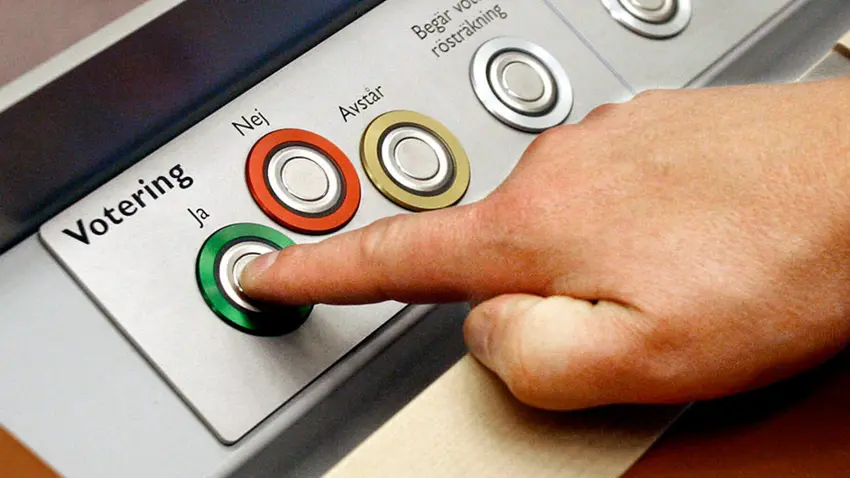
The speaker often asks verbally if the parliament accepts the point, scanning the room visually for opposition, before announcing, "the answer is 'yes'". In this case, an opposition MP will probably request a vote, so each MP present will press a green, red, or yellow button on their desk to indicate "yes", "no", or "abstain".
The result then immediately appears on a board in the parliament. Once all the points in the bill have been voted on, the speaker will slam Talmansklubban, the speaker's 150-year-old birch gavel, down to mark the vote passed.
It will all be over in less than three minutes.

Migration news
We covered two interesting surveys, one on Swedes' views about immigrants and the other on immigrants' views about Sweden.
The first, by the polling company Novus, found that the government's moves to tighten migration rules, which are largely supported by the opposition Social Democrats, go beyond what most Swedish voters want.
Anders Bergh, associate professor at Lund University, who was involved in the study, told us that while voters want to deport foreign criminals, they think foreigners who work and contribute should get to stay. This includes 60 percent of voters for the far-right Sweden Democrats.
The second survey, carried out by Statistics Sweden for an inter-agency project promoting labour migration, found that the chief attraction of Sweden for high-skilled foreign workers was the work-life balance and the high level of support for family life.
I would have expected salary levels to rank higher, but this was not as surprising as the finding that over 80 percent said they "quite satisfied" or "very satisfied" with the Swedish Migration Agency (can this really be right?).
We've reported over the past year on the deportations of the young adult children of highly skilled workers but we haven't written much on the inconveniences faced by those who manage to stay. Our reporter Mandy Pipher this week told the story of the 19-year-old Paola Claudio, who had to take a 23-hour flight to Mexico at short notice simply to avoid having her student visa application rejected.
Claudio is lucky she could travel. In her last article for The Local Sweden (at least for a while), our new Denmark editor Becky Waterton spoke to Anna Metreveli, a Russian PhD student who had her application to switch to a new residence permit rejected on the grounds that she did not leave Sweden to reapply. She says she was unable to do this because her son's intellectual disability and need of support.
What else have we been writing about?
With only another week to go until May, we published our regular look ahead to the coming month: there will be a few long-awaited changes to work permit rules, hopefully a proposal to end teen deportations, and a cut in petrol and diesel taxes.
There's more trouble on the fuel front, however. Prime Minister Ulf Kristersson held a press conference on Thursday where he warned that, while the government wasn't actively planning to ration fuel, it was prepared for that possibility.
It's also certain that there will be more flight cancellations as jet fuel shortages worsen. Mandy Pipher looked into whether passengers will be able to claim compensation.
After we published readers' recommendations on the best districts in Stockholm and Gothenburg, it was Malmö's turn this week, with two popular seaside areas and one well-connected transport hub topping the list.
Swedish Internet Foundation this week published a special version of its annual Swedes and the internet study, focused on this September's election. They found that nine out of ten Swedes believe that AI-generated fake images will influence the campaign.
We also covered the controversial deportation talks Sweden and the EU have begun with the Taliban government in Afghanistan.
I didn't mention one of the less surprising but nonetheless striking results of the Statistics Sweden survey of highly skilled workers: their dissatisfaction with Sweden's banks.
We would love to hear from you about your own experiences. Tell us by filling in the survey on banking in this article.
That's that for now. I'm off to make pancakes for my children.
Richard
Inside Sweden is our weekly newsletter for members which gives you news, analysis and, sometimes, takes you behind the scenes at The Local. It's published each Saturday and with Membership+ you can also receive it directly to your inbox.
Comments (1)