How big a lead does the right-wing bloc have?
The four parties supporting Ulf Kristersson are ahead by just 47,000 votes, which, due to the rounding up system, has translated into just one mandate. (it's normally roughly one mandate for 20,000 votes).
"So far, the Andersson side has been rounded up more, and the Kristersson side has had been slightly more unlucky,and been Moderates have been rounded down," explained the KTH mathematics professor Svante Linusson. "Thaat means that even though the total difference is now 44,000 votes, which is a bit more than two seats in parliament, the actual difference is only one seat."
How many votes are left to be counted?
According to the Gothenburg University politics professor Henrik Ekengren Oscarsson, there could be between 200,000 to 250,000 votes left to be counted in the onsdagsräkningen, or Wednesday count, which will take place on Wednesday and Thursday.
In 2018, the Election Authority counted 202,000 extra votes on Wednesday, but this year the number is expected to be higher.
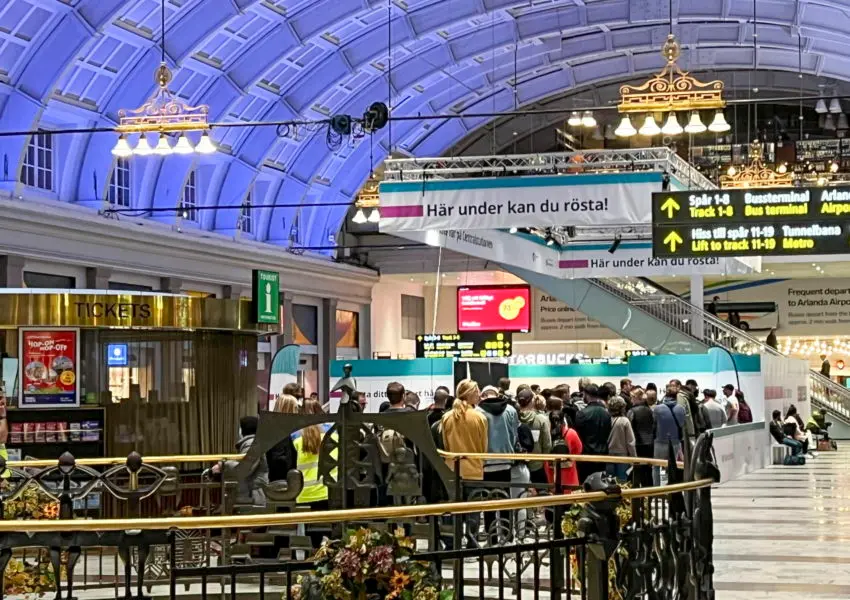
This is mainly because of the long queues at many special polling stations set up for people who want to vote away from polling station where they are registered, with people still waiting in queue to vote at 9pm on Sunday.
The Wednesday votes are split between those ruled invalid in the first count, some of which may be ruled valid when double-checked, votes from people who voted in early voting polling stations, which then arrived too late to be counted on Sunday, and, finally, votes from Swedes living overseas.
Overseas votes and late early votes are counted together, so there is no hard data on how many of each there are. The Election Authority, however, sent out 160,517 voting cards to overseas Swedes this year, and turnout in 2018 was about 40 percent, which would put the number of overseas votes at just under 70,000 if turnout remains roughly the same this year.
Invalid votes: around 27,000 extra votes. (This is an estimate: 93,734 votes were declared invalid this year, and in 2018 about 30 percent of invalid votes were eventually accepted when recounted)
Late arriving early votes (förtidsröster): Around 170,000, but potentially quite a lot more.
Overseas votes: Around 70,000
Why do people think the remaining votes will benefit the right-wing wing parties?
Even before the election, the Moderate Party was saying it was hoping to win additional mandates from overseas Swedes, who in 1979 sensationally swung the election for the right-wing parties, losing Olof Palme his majority in the Wednesday count.
Magnus Ehrenberg, chair of the overseas Moderates, told the Altinget politics site before the election that he believed overseas Swedes could once again make all the difference.
The Moderates sent out 200,000 letters to overseas Swedes and even sent videos of Ulf Kristersson reading out a personal message to many, which he did by recording clips of him saying 100 common Swedish first names, in the hope of making the message as personal as possible.
As soon as the exit polls made it look like the Moderates had lost, the party's activists began to talk up the advantage they hoped to get among overseas Swedes.
The Aftonbladet leader writer Anders Lindberg told AFP in the early hours on Monday that it now looked “impossible for the left to win because the votes from abroad are… usually in favour of the right”.
What's the evidence that votes from overseas Swedes favour the Moderates?
It's been a true-ism in Swedish politics since at least 1979, when many overseas Swedes were wealthy people who had moved abroad to escape the high taxes brought in by the Social Democrats.
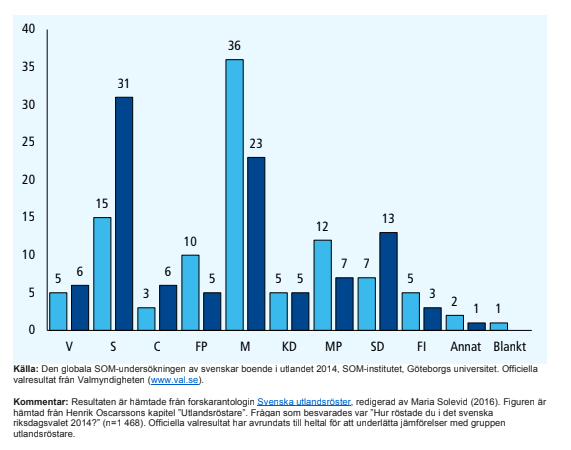
The only recent hard evidence, however, comes from a 2014 survey of overseas Swedes carried out for the Election Authority by Gothenburg University's SOM Institute.
This showed the Moderate party was over-represented among overseas Swedes and the Social Democrats heavily under-represented, when their voting preference was compared to how these parties did in the election as a whole.
But when it comes to the smaller parties the picture was much more complicated.
More popular abroad:
Moderates: 36 percent among overseas Swedes, compared to 23 percent overall
Green Party: 12 percent among overseas Swedes, compared to 7 percent overall
Feminist Initiative: 5 percent among overseas Swedes, compared to 3 percent overall
Liberal Party: 10 percent among overseas Swedes, compared to five percent overall
Less popular abroad:
Social Democrats: 15 percent among overseas Swedes, compared to 31 percent overall
Sweden Democrat: 7 percent among overseas Swedes, compared to 13 percent overall
Centre Party: 3 percent among overseas Swedes, compared to 6 percent overall
Left Party: 5 percent among overseas Swedes, compared to 6 percent overall
The Christian Democrats were unchanged.
As you might expect, the survey showed overseas Swedish voters in general favouring economically liberal parties, but it also seemed to show them favouring socially liberal parties, those open to immigration, and in favour of taking action on climate change, such as the Green Party, Feminist Initiative, and the Liberals.
Since 2014, the Moderate Party has become much more hostile to immigration, as well as teaming up with the Sweden Democrats, who overseas Swedes in 2014 supported to a much lower extent than domestic Swedes.
This makes it far from certain that the parties backing Ulf Kristersson will still have the advantage among overseas voters.
Do late early voters skew right- or left-wing?
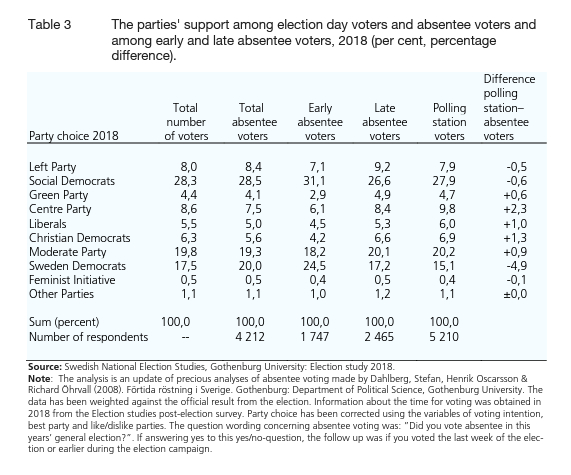
Another study by Gothenburg University into those who cast their votes early, away from the polling station where they are registered, does not suggest a clear advantage for the right-wing parties.
The Sweden Democrats had a clear advantage among so-called absentee voters in that study, with 20 percent of absentee voters voting for the populist party, compared to 17.5 percent of voters as a whole. The Left Party and the Social Democrats also got slightly more votes among absentee voters.
However, Maria Solevid, who was part of the team who carried out the 2014 study, told The Local that for the purposes of this election, it is the "late absentee voters" that count, those who voted at early voting polling stations on election day itself, or perhaps the day before.
These voters are slightly less likely to vote for the Sweden Democrats, Liberal Party, Centre Party, or Social Democrats, but slightly more likely to vote for the Left Party, Green Party, and Christian Democrats, and to a lesser extent for the Moderates.
This means that in total, they probably skew, if anything, slightly to Andersson's advantage.
What's the evidence from the Wednesday count in previous elections?
If you look at how the mandates moved in recent Wednesday counts, there's no clear pattern that would suggest an advantage for team Kristersson.
If anything, once you take into consideration that the Centre Party are now in the left bloc, the parties backing Magdalena Andersson have tended to benefit.
2018: Andersson parties +1, Kristersson parties -1
2014: Andersson parties +1, Kristersson parties -1
2010: no change
2006: no change
2002: no change
1998: no change
1994: Andersson parties -1, Kristersson parties +1
Maria Solevid, from Gothenburg University, said that there was "no systematic pattern" from past elections backing the idea that right-wing parties normally gain mandates in the Wednesday vote count. "We cannot say whether there will be a shift, or say that it will always be to the right."
Does the way Sweden's system of proportional representation mean team Kristersson has an edge?
We are already in the middle of the vote count, which means that the extra votes that come in will not affect all parties equally.
According to KTH mathematics professor Svante Linusson, the right-wing bloc currently has an advantage due to Sweden's system of proportional representation, the so-called modified Sainte-Laguë method (jämkade uddatalsmetoden). See our Ultimate Guide to the 2022 Swedish Election for an explanation into how this system works.
The Left Party, Centre Party, Green Party and Social Democrats have taken the last four mandates, according to Linusson, which will mean that the Left bloc will need to get a very large share of the remaining votes to gain even more mandates.
"The Left Party have been rounded up the most, because they got the very last seat. So sat that they've been routed up from from 23 and a half to 24 seats, for them to be rounded up even further to get to 25 seats, it's a much longer way to go," he explained. "Then for The Moderates, that have been rounded down from 0.4 of a seat, they only need like just to go just a little bit higher to take another seat from some other party."
For the Left bloc to gain another seat, one of the parties in it would have to gain a very large number of extra votes.
"It has to be something that has happened before, like a lot of voters decided at the last minute to vote for the Green Party, or a lot of Swedes living abroad decide to vote for the Centre Party," he told The Local. "This election is a bit different, so the absentee ballots could be different from what they've been before. But it's still not very likely from a mathematical viewpoint."
Comments