
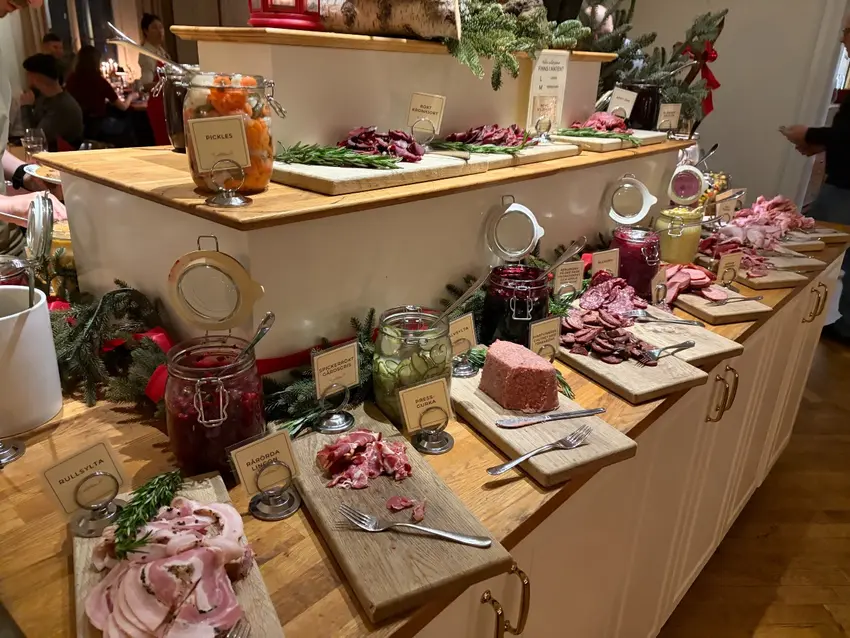
Anyone who thinks that Swedish cuisine has nothing to offer the world has not eaten a Julbord Christmas dinner at Staffanstorps Gästis.
Last night, The Local's team in Southern Sweden and Denmark trekked out to this 150-year-old former coaching inn in Emma's home town to enjoy a variety and quality of locally made dishes that would put any French auberge to shame. (Well, some of them at least).
A highlight for me was the pâté section, which had ten different pâtés and terrines made from the flesh and innards of various wild and farmed animals - all prepared on site and all delicious. There was hare and wild boar air-dried and smoked into a delightful chewy consistency.
There were a dozen varieties of pickled herring, include Prostens purjosill, a recipe involving leeks invented by the town's former priest (who, it turns out, was a friend of Emma's father), one with burnt butter, and one which was chorizo-flavoured. There was also smoked eel, which, as you may or may not know, is a "critically endangered" species.
Alongside the meatballs (which, this being rural Skåne, were in the style of Danish frikadeller) was a wonderfully sticky dish of pork roasted in reduced glögg wine.
As might be apparent, this was not a vegetarian-friendly meal and Staffanstorp, shall we say, has a reputation. This is the town which in 2022 simply refused to pick up the UN quota refugees it had been allotted, leaving them stranded at the airport. The town's controversial mayor has since been charged with "grave misconduct in office" as a result.
The municipality has also, among other immigrant-unfriendly measures, sought to ban both Islamic headscarves and halal meat in schools.
So I was surprised to see how many of the other people indulging in this sumptuous feast in Sweden's arguably most immigrant-unfriendly municipality were in fact immigrants.
At least half of the young men on the long table next to us had foreign backgrounds, and almost every other table appeared to include someone with an immigrant background, someone who looked Asian, someone who looked Middle Eastern, or, on our table, three Brits, a Serbian and a Swede.
My point, I suppose, is that if you open your eyes and look around, you quickly see that Sweden is much better integrated than you might think from listening to politicians or reading the newspapers. Even in this bastion of Scanian food culture and tradition in this famously anti-immigrant municipality, the clientele is mixed.
The reality is more complex than how it is portrayed.
Which brings me to my favourite article on The Local this week, the essay by Faisal Khan on Swedes' tendency to divide immigrants into four simple categories: good, bad, ugly and evil, and his call for Swedes to "come closer" to people of immigrant origin, to get to know and understand them better.
We wouldn't normally run an article this long on the site, but I'm glad we did.
Migration news
There are growing signs that the Swedish media, and as a result the public, are waking up to the consequences of stricter migration laws, with the impending deportation of a Persian family in Norrland, and the deportation of a popular basketball coach to Uganda, and the impending deportation of a nursing assistant in Nyköping all receiving heavy coverage.
This has prompted politicians from the ruling Moderate Party, including the chair of its youth wing, Douglas Thor, to call for an adjustment to the law abolishing the 'track change' or spårbyte option so that migrants who are employed and integrated can stay in Sweden.
We interviewed the coach, Eric Nsubuga, who said he was struggling in Uganda, a country where he has not been since he was 10 years old, where he has no relatives, and where he does not even speak the language.
A report from the Swedish Association of Local Authorities and Regions (SALAR), meanwhile, has highlighted the growing role of immigrant workers in delivering health and other welfare services, finding that more than half of all nursing assistants now have immigrant backgrounds.
The UN's Committee on the Elimination of Racial Discrimination (CERD) has published a scathing report into what it argues was worsening racial discrimination in Sweden, arguing that plans to tighten citizenship requirements were "discriminatory", while stop-and-search zones were "illegal".
European countries, meanwhile agreed to set up 'return hubs' outside the union where foreigners refused asylum will be sent.
What else have we been writing about?
We started to get into the Christmas spirit a bit more this week, bringing you up to date with classic Swedish Christmas songs like "Our Christmas ham has run away", showing a selection of the best gingerbread houses from the annual competition at ArkDes in Stockholm, and giving an immigrant's view of the Lucia celebrations.
We also continued helping you get prepared for the year ahead, with articles on changes which will affect your finances, changes which will affect your family, and advice on which days to take off work in 2026 to make the most of the public holidays.
Thanks to those of you who responded to our survey giving your predictions of what will happen in Sweden in 2026. It was good to see that our readers are slightly more optimistic than they were this time last year when the mood was grim.
The big news in politics was the meeting of the leaders of the four pro-government parties at the home of Prime Minister Ulf Kristersson in Strängnäs, outside Stockholm, although it was essentially little more than a photo shoot.
Our new contributor, Umeå-based Mandy Pipher, wrote us an excellent guide to surviving the long, dark winters of northern Sweden. Membership+ subscribers can hear her discuss life in Northern Sweden in this week's issue of our Sweden in Focus Extra podcast.
I will now spend the afternoon removing leaf mould from the compost heap at our summer house before returning to Malmö for a glögg party.
Have a lovely weekend and see you next week!
Comments